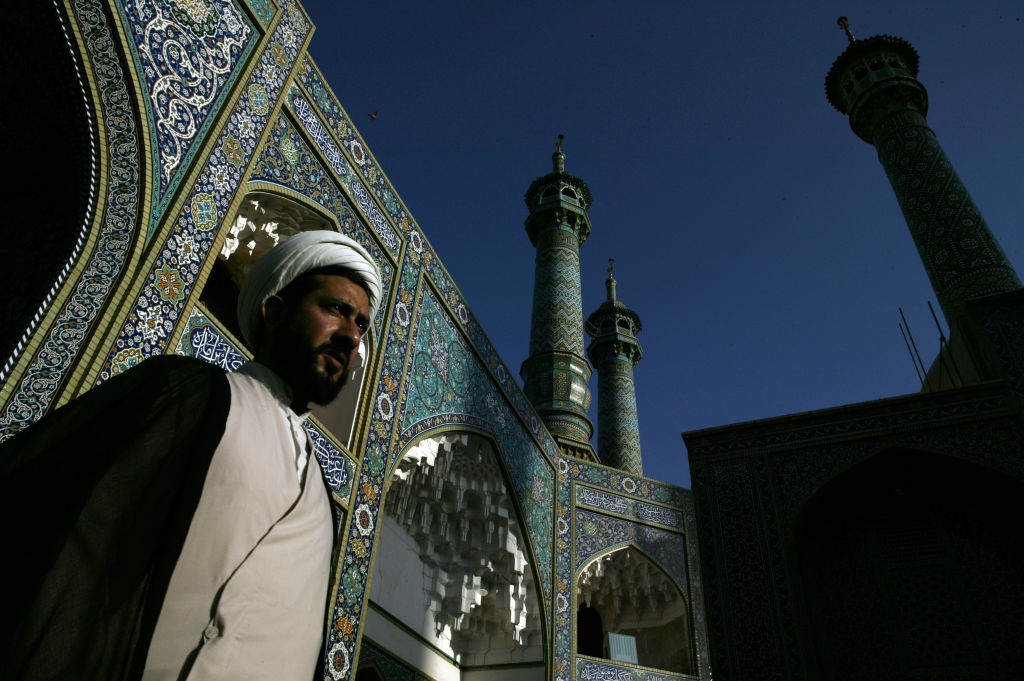
Iranians have adopted a new sport in the past few years: knocking the turban from a passing cleric’s head. There are points for technique and for how high and how far you can get their headgear to go. These are small acts of revenge against a hated religious elite who came to power on a wave of arrests and torture and who, as recently as January, ordered thousands of peaceful protesters to be shot in the streets. It’s also a symptom of something larger. Political Islam is in retreat across the Middle East and the wider Muslim world.
“The strange death of political Islam” is an idea that’s in the air at the moment. Rule by clerics, and by others who claim to speak in the name of God, is going out of fashion in the Islamic world. The New York Times carried an essay on this in June by its expert Middle East correspondent, Ben Hubbard. After the Arab Spring, he writes, there were many attempts to govern strictly according to Islamic principles. They failed. And so “political Islam in the region has withered.”
Every country is different and Iran has special circumstances: the Shia clerics’ grip on power was pried loose in the turmoil caused by US and Israeli bombing. The beneficiaries have not been the democracy protesters, but the ultra-hardliners of the Islamic Revolutionary Guard Corps. So one of the few achievements of Donald Trump’s ill-considered war has been to shift power within the regime to those with even more uncompromising attitudes toward the Great Satan. A huge new mural in Tehran shows Trump (and Benjamin Netanyahu) sinking beneath a roiling tide of blood. “You will drown in the sea of the Iranian nation’s revenge,” the slogan says, in English as well as Persian.
Islamism is over in the same way that communism was over after the end of the Cold War
Still, the end of clerical primacy is having real effects. Iran is, very slightly, less Islamist than before. State television coverage of government rallies shows women without headscarves – and even broadcasts interviews with them. That is astonishing given that the last cycle of anti-government protests began after a woman was beaten to death in a police station, having been arrested for not wearing her hijab in the “proper” manner. On Instagram, the “Rich Kids of Tehran” account posts defiantly hedonistic images designed to enrage religious conservatives: young women in Lycra exercise gear, bikinis or little black dresses and vertiginous heels. Many of these shots do seem to have been taken in Iran.
Professor Faisal Devji of Oxford University has written a book, Waning Crescent: The Rise and Fall of Global Islam, about what he believes is a long-term trend. In Iran, he says: “The clerics are out, and I would be surprised if they ever came back. They’re going to be more symbolic figures.” Islamism is over, he writes, in the same way that communism was over after the end of the Cold War. He ticks off countries: Pakistan, an Islamic republic, but the military are in charge; Turkey and Malaysia, both with rulers who are personally Islamist, but who run countries with secular constitutions; Saudi Arabia, where Crown Prince Mohammed bin Salman has “crushed” the Wahhabi religious establishment; and Syria, where President Ahmed al-Sharaa has “suspended” his previous Islamist beliefs.
There is now a “neoliberal” Islamism, Professor Devji says. This is about adopting a certain lifestyle and buying Islamic products: Islamic consumerism, you might say. It is not about jihad. ISIS and al-Qaeda could emerge only in failed states or amid civil war. In Europe and the United States, it picked up supporters mainly from among drug dealers and other petty criminals. Violence is the only thing that interests these movements, he says: being willing to kill and die to demonstrate their supposed Islamic credentials. “They [ISIS and al-Qaeda] don’t have fully developed ideologies. They’re memes.” Up to a point…
A clerical regime is back in power in Afghanistan after the Taliban chased out the United States and its allies. The Islamic Emirate of Afghanistan is, as its title says, a state run on strictly religious lines. Devji maintains that this time around, the Taliban is more “pragmatic” than before. I’m not so sure. The Taliban published new laws in May to enable child marriage. According to Amnesty International, its Decree No. 18 interprets a girl’s silence after puberty as agreement to marriage.

But Afghanistan may be an outlier. In the Middle East, the advert for a new pragmatism among former Islamists is Mohammed al-Jolani, as he was known when he led al-Qaeda in Syria. As President al-Sharaa, he wears a suit and tie and yuks it up in the Oval Office: last year, President Trump gave him a bottle of cologne from his Victory 47 line. “There’s another bottle for your wife,” Trump said, “How many do you have? With you guys I never know.” Al-Sharaa replied that he has “just one” wife and asked Trump how many he has. (“Right now, one.”)
Al-Sharaa is admired in his own country and in the wider Arab world for a deft political transformation that has seen him become the first-ever Syrian leader to be received at the White House. This transformation is not risk-free. Another viral video from April shows al-Sharaa watching a show at the Al-Fayhaa Sports Hall in Damascus, put on before a basketball match. Male and female dancers grind their hips to “Work It” by Missy Elliott. Al-Sharaa looks distinctly uncomfortable, and his office later said he hadn’t known the performance would be on the program. The show was roundly criticized by imams at Friday prayers. Some of those who put al-Sharaa into office feel betrayed – and many of them have guns. There may be a vicious power struggle to come in Syria. Al-Sharaa will need his base to stay with him if he is to survive. He could not depart too far from Islamic orthodoxy even if he wanted to – and he does not want to. After he assumed office, he made sure the new constitution said Syria’s ruler had to be Muslim, its laws Islamic. A Supreme Fatwa Council of Sunni scholars exercises an effective veto over legislation that does not conform to sharia.
There is a similar balancing act in Saudi Arabia. Mohammed bin Salman has snuffed out all opposition, whether from (the mildest of) pro-democracy activists or from the religious establishment. By the time he grabbed power from his astonished rivals, he found the religious police – the mutawa – had already been defanged. They had been stripped of their powers of arrest and told they could do no more than “advise, kindly and gently.”
Today in Saudi Arabia, women can drive; cinemas are open; there are pop concerts and boxing matches. Wealthy foreigners can even buy booze in Riyadh if they are not Muslim. But the House of Saud remains the “custodian of the two holy mosques” in Mecca and Medina. This is a major source of their legitimacy and bin Salman, presumably, knows there are limits to his reforms.
The Arab world’s most populous nation, Egypt, was led for a time by the Islamists of the Muslim Brotherhood. There followed what the United States and others are still reluctant to call a military coup. In 2013, the generals seized back control and shot dead a thousand of the Brotherhood’s supporters in a single day at the Rabaa al-Adawiya mosque. The Islamist government was, then, never rejected by Egyptians at the ballot box. Perhaps they would have done so once the Brotherhood had made enough of a mess of ruling Egypt. Instead, authoritarian repression has helped keep the flame of an idea alive.
In any conflict, there are always some hardliners who do not wish to give up their guns
The other great failed experiment in Islamist rule was the ISIS caliphate. Of course, nobody elected the self-declared caliph, Abu Bakr al-Baghdadi. He seized power holding a bloody sword and kept it the same way. One traumatized resident of a town in northern Syria told me how severed heads would be left on the main traffic roundabout after the regular Friday beheadings. Everyone was too scared to move them.
Then the caliphate was bombed out of existence by the United States. That meant it was never decisively rejected by the rural Sunnis in Syria and Iraq who had supported ISIS – and who will no doubt support its next incarnation.
George Dangerfield’s The Strange Death of Liberal England, published in 1935, described how Britain’s once-great Liberal movement and party of government had simply collapsed from within. But the two Middle Eastern experiments in Islamist rule of this century – the Muslim Brotherhood government in Egypt and the ISIS caliphate – were destroyed from without.
The idea that animated them both, of re-creating an “authentic” version of Islam as lived by the Prophet Muhammad, remains as seductive as ever for some Muslims. Islamism has been declared dead before – for a time, the democracy protesters of the Arab Spring seemed to make al-Qaeda irrelevant. Then along came the Islamic State, ISIS. It is too early to say we are living in a post-Islamist world. In any conflict, there are always some hardliners who do not wish to give up their guns – or their ideology. As Gerry Adams once said of the provisional IRA: “They haven’t gone away, you know.”






Comments