Al-qaeda

Accelerating the ‘kill chain’ – a terrifying glimpse of future warfare

From our UK edition

America possesses the most powerful military in history, but since 1945 it has not won a war against anyone other than Saddam Hussein. It appears not to understand why. In fact the only thing the US seems worse at than winning wars is learning lessons from its defeats. People such as the secretary of war Pete Hegseth think it’s all about woke. Lily-livered longhairs stateside stabbed the army in the back over Vietnam; then ‘stupid rules of engagement’ tied the military’s hands in Iraq and Afghanistan and caused the disasters there. The solution is to fight harder, if necessary even at the expense of ethics and the law. Another answer might be to get US forces fighting smarter.

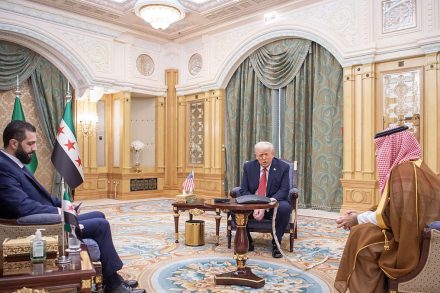
Why Trump met Syria’s interim president

Few career arcs in modern history can be as remarkable as that of Ahmed Hussein al-Sharaa – or Abu Mohammed al-Jolani, to give him the nom de guerre under which he fought American troops in Iraq back when he was a firebrand member of al-Qaeda. Twenty years ago al-Sharaa was languishing in a US military prison in Baghdad, held on suspicion of terrorism. Today, as Syria’s new interim President, he shook hands with Donald Trump posing for photo-calls alongside the de-facto ruler of Saudi Arabia Mohammad bin Salman. Trump was evidently impressed by al-Sharaa, who has swapped the turban and dusty fatigues that he habitually wore before taking Damascus by storm last winter for a plain blue suit and purple tie. “He’s a young attractive guy.

al-sharaa

On the anniversary of the Iraq invasion, spare us the sermons

Twenty-one years ago today, the United States committed its worst foreign-policy mistake in generations: invading Iraq to overthrow Saddam Hussein, the despot who ruled the Arab country with an iron fist for nearly a quarter-century. The entire operation was supposed to be a “cakewalk,” in which the mighty US military, stocked with the best technology and weapons the world had to offer, would pummel a decrepit Iraqi army that was hobbled by international sanctions for the better part of a decade. The mood at the time was serious but stoic. Donald Rumsfeld, the US defense secretary, argued that the entire war wouldn’t last more than five months.

iraq war

The never-ending War on Terror

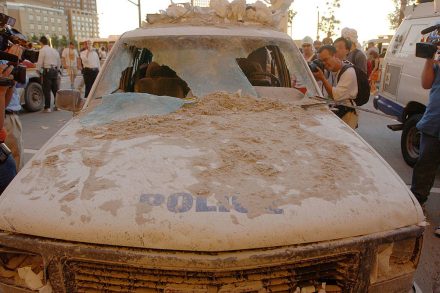
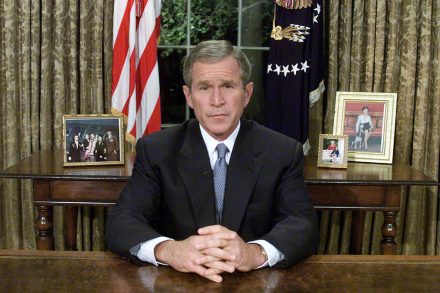
Twenty-two years ago today, the United States experienced its worst terrorist attack in history. It was a life-changing moment for tens of thousands of Americans, particularly those in the New York metropolitan area who saw two of the city’s most iconic buildings reduced to smoldering heaps of rubble and ash. The Pentagon, a stoic building across the Potomac River from our capital, saw one of its sides destroyed. About 166 miles to the northwest, another hijacked plane went down in rural Shanksville, Pennsylvania. By the time that horrible day was over, nearly 3,000 people had lost their lives. The country’s entire being was shaken to the core. Americans, particularly those in New York and Washington, DC, felt more vulnerable than they had in years. For President George W.

terror

Afghan leaders say country is a terror haven

The Biden administration is using every tool at its disposal to paint a rosy picture of Afghanistan as a terrorist-free state as the two-year anniversary of its disastrous withdrawal approaches. But a coalition of Afghan generals, diplomats and civil servants is writing to Congress to explain that in reality, “today’s Afghanistan under the Taliban and their al-Qaeda allies, is again the greatest terrorist safe haven in the world.

afghan taliban

One year later, Biden is right to have left Afghanistan

A year ago today, the Taliban captured the northern Afghan city of Kunduz, dealing the US-supported Afghan government an embarrassing blow and setting in motion a blitz across the country that would eventually send Afghan President Ashraf Ghani and his closest aides into exile. A week later, Taliban fighters entered Kabul virtually unopposed. American forces would leave the country two weeks later, cutting the cord on a two-decade war that cost the US over $2 trillion and tens of thousands of casualties. "We succeeded in what we set out to do in Afghanistan over a decade ago,” President Biden said from the White House last August 31. "Then we stayed for another decade. It was time to end this war.” Much has changed since the troops left.

What happens to US fighters captured in Ukraine?

Alex Drueke and Andy Huynh are two former American military members now in Russian custody, captured by the Russians in Ukraine, where they were fighting for the Ukrainian government. What is going to happen to them? The most likely thing is that both men will eventually be traded to the US in return for captured Russians. Prisoners are very valuable and rarely wasted in executions unless those carry much more value than the prisoners held by the other side. The deal may be public or secret, and the US can expect to pay a premium. Israel usually releases ten or more Palestinian prisoners in exchange for one of its captured troops.

Noninterventionists never win arguments

I’ve been thinking about where I was on the eve of the US invasion of Iraq in 2003, and my memories of the event are quite depressing. What have we learned? As a research fellow at the Cato Institute at that time, I was working with other analysts preparing research, authoring commentaries, publishing op-ed articles and giving interviews to the broadcast media, warning about the consequences of the coming American military conquest in the Middle East. It's not polite to toot one’s own horn, but we were right.

terror

Will Biden deal with the Taliban?

When President Joe Biden tapped longtime aide Antony Blinken to be his secretary of state last November, Blinken landed his dream job. Here he was, a man widely respected in foreign policy circles, continuing the family business (his father and uncle were both ambassadors and his stepfather was an adviser to John F. Kennedy). What Blinken could have lived without, however, was the grandstanding, bravado and livid speeches from lawmakers responsible for overseeing his work. Unfortunately, fielding self-righteous questions is a part of the job description.

taliban

The wars go on

America’s longest war has just entered its 20th year. The US invaded Afghanistan in October 2001 to overthrow the Taliban and destroy al-Qaeda. Now, nearly a decade after the death of Osama bin Laden, the Afghan war continues. And everyone expects that if the Americans ever leave, the Taliban will return to power. Yet the Taliban who take charge will not be the same as those who harbored bin Laden. The median age in Afghanistan is around 19 years old: half the country’s population was born after the war began. The US is not fighting a limited reservoir of Taliban militants; it is fighting a cultural force that has renewed itself over a generation.

wars

Is The Undoing properly great or just a run-of-mill thriller with a brilliant casting director?

From our UK edition

There must be some people somewhere who vaguely know their own spouses — but if so, they don’t tend to appear in domestic-based thrillers. Last week when Sky Atlantic’s The Undoing began, Jonathan and Grace Fraser (Hugh Grant and Nicole Kidman) seemed to have the happiest of middle-aged marriages. They still laughed at each other’s jokes. They still kept each other fully informed about the kind of day they’d had at work: he as a kindly child oncologist, she as an unfailingly wise therapist. Not only did they still have sex, but when they did, it wasn’t always in bed. True, they weren’t wholly without their problems. Their loving son Henry, for example, sometimes didn’t clean up after making smoothies.

A new ‘War on Terror’ is a terrible idea

Does anyone in their right mind really think the ‘War on Terror’ waged by the United States since 9/11 has been a successful policy? , The terrorist group the US claimed it was most determined to destroy, al-Qaeda, has surged in strength over the last few years. ISIS sprouted in Iraq and Syria as a direct consequence of the general ‘War on Terror’ posture, which had its most egregious manifestation in the 2003 invasion. Today, the US bombs countries and stations troops all over the world with the nebulous goal of ‘defeating terrorism,’ which of course is just a tactic and can never be truly ‘defeated’ – or so we once thought.Back in the George W.

war on terror

Tulsi Gabbard is right. Trump supports al-Qaeda…just like Obama did

Rep. Tulsi Gabbard made a comment during Wednesday’s Democratic presidential debate that left many scratching their heads 'We were supposed to be going after al-Qaeda, but over years now, not only have we not gone after al-Qaeda,' she said, adding, 'our president is supporting al-Qaeda.' https://twitter.com/CNNPolitics/status/1156755828625555457 Donald Trump is supporting al-Qaeda? Gabbard doubled down on her statement during a post-debate appearance on Fox News, saying that the Trump administration’s ‘support and alliance with Saudi Arabia that is both providing direct and indirect support directly to al-Qaeda.’ ‘How can you say Saudi Arabia is a great partner in fighting terrorism when they are fueling and funding terrorist groups in Yemen?’ Gabbard added.

tulsi gabbard al-qaeda

A losing battle

From our UK edition

Foreign fighters are returning from the battlefield — not Islamists but the Americans, Europeans and South Americans who fought to rid the world of Isis. But for all their bravery, their homecoming is a tricky one because their home countries do not want them back. I have now interviewed more than a dozen volunteers. Many of them share similar stories of arrests and detentions. They have been stripped of their ability to travel, have their movements monitored, their bank accounts closed. One of them, an American, has since committed suicide. One fighter, who wishes to be known as Max, tells me in an email that he has left his home country of Denmark.

Syria Notebook

From our UK edition

In order to avoid the Labour conference and yet more predictable media attacks on Jeremy Corbyn, I escaped late last month to Syria, where children were returning to school after the summer holidays. Large tracts of the country have recently been liberated from the control of jihadi groups, meaning that in some places children are going back to school for the first time in five years. At Sinjar elementary school in Idlib province, I found the local headmaster painting the school sign. Five years ago rebels gave him the choice of closing down or being killed. He was confined to his house while the school buildings were converted into an arsenal.

The terrible truth

From our UK edition

Here’s the bad news. One day you or someone like you will be shopping in a mall or enjoying a concert or about to catch a train when the first sudden, sharp crack will rend the air and your world will change forever. Around you, people will start to crumple and as the panic and horror finally dawn the screams will begin while the automatic rifle fire escalates and those still standing will begin to flee — but where to? If you run away from the gunfire you’re being herded into a trap. If you run towards it you’ll be shot, either killed immediately, or casually, later, as you lie wounded, probably by knife to save ammo.

How to beat terrorism

From our UK edition

Until a few years ago, Pakistan was one of the most dangerous countries on earth. The tribal areas in the north were infested by the Taleban, whose bases stretched to within 100 miles of the capital, Islamabad. Western intelligence agencies feared that the Taleban could seize one of the country’s nuclear installations, then hold the world to ransom. Large parts of the country elsewhere were lawless or terrorised by armed groups. It would be foolish to claim that Pakistan’s security problems are over. But something extraordinary and unexpected has certainly happened. Since it fails to fit the established narrative of Pakistan as a dangerous nation, it’s gone unacknowledged in the West. Violence has not just dropped a bit.

A tale of two battles

From our UK edition

For the past few weeks, British news-papers have been informing their readers about two contrasting battles in the killing grounds of the Middle East. One is Mosul, in northern Iraq, where western reporters are accompanying an army of liberation as it frees a joyful population from terrorist control. The other concerns Aleppo, just a few hundred miles to the west. This, apparently, is the exact opposite. Here, a murderous dictator, hellbent on destruction, is waging war on his own people. Both these narratives contain strong elements of truth. There is no question that President Assad and his Russian allies have committed war crimes, and we can all agree that Mosul will be far better off without Isis. Nevertheless, the situations in Mosul and Aleppo are fundamentally identical.

Clueless in Syria

From our UK edition

The other day I was speaking to a Kurdish journalist who was held in Isis captivity for ten months. He and a colleague had had the bad luck to run into an Isis checkpoint in Syria. ‘How do you perform the midday prayer?’ they were asked after their car was waved to a halt. Unable to answer — they were not believers — they were immediately beaten around the head. Then one of the jihadis from the checkpoint was put into the back of their car and they were told to drive to the Isis base. The fighter had a pistol pointed at them the whole time, which was superfluous because he was also wearing a suicide belt. ‘Make a move and I’ll detonate myself,’ he said. ‘We’ll all die together.