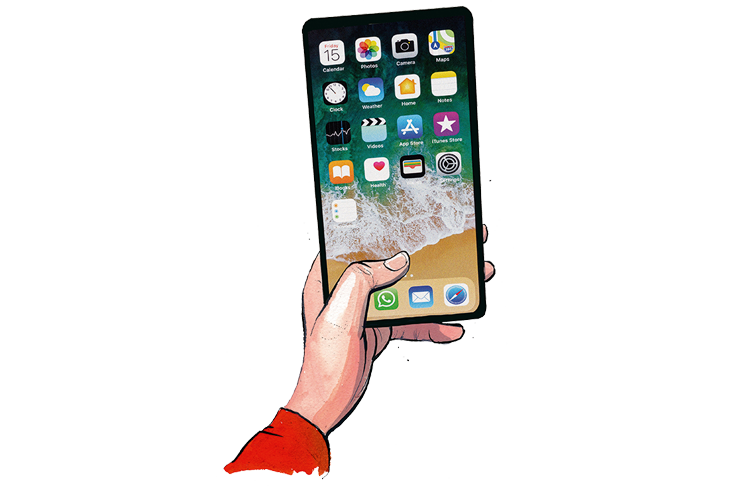
A new study has found that smartphones are a likely cause of falling American birth rates. Economists Caitlin K. Myers and Ezekiel Hooper tracked the rollout of the iPhone across the country and found that the more people used smartphones, the further birth rates fell.
This was especially true for the youngest cohort of women. Between 2007 and 2011, use of the iPhone was correlated with between 33 to 52 percent of America’s fertility decline.
There’s been a lot of discussion about smartphones and falling fertility rates lately. Most arguments go something like this: smartphones and social media are linked to rising rates of anxiety and depression, less sex and less in-person socializing. My generation is distracted from what really matters and is hooked on simulations of human connection. These are decent explanations. But they are not the full story.
Social media doesn’t just distract us from having children, but completely alters how young women think about themselves. Since the rise of platforms such as Facebook, Instagram and Snapchat, young women have grown up seeing themselves as nothing but objects in a marketplace. For young women today, life is not about living a fulfilling human existence but about optimizing ourselves for the market. We are very different from previous generations of women. We are more like products than people.
Young women have grown up seeing themselves as objects in a marketplace
When you begin to understand this, our hesitancy about having children makes sense. And that hesitancy is real. According to a 2024 Pew survey, only 20 percent of young American adults say being married is “extremely or very important” for fulfillment – and just 22 percent say the same about having children.
Older generations wonder why we wouldn’t want to do something so human, forgetting that we aren’t anymore. Instead, we are ornaments for Instagram, filtered and Facetuned. We are objects, shopped for on dating apps. We are brands, managed and monetized. The market determines the worth of our faces, our bodies, our relationships, our memories – and we spend our time tweaking ourselves to become what sells.
More than anything, young women want to look like perfect products. Not even necessarily for male attention but for popularity on Instagram and for the other women scrolling through our profiles. And products must be pristine, without defects. Pregnancy might damage our packaging. This helps to explain trends like the “Girl with the List,” a young woman who went viral after sharing a crowdsourced list of reasons not to have children, which included everything from “acne breakouts” and “stretch marks everywhere” to “your face swells up” and “your booty may go flat.”
Another popular TikToker hosts a “Free Birth Control” series for her 1.6 million followers, posting hundreds of reasons not to have kids. “Pregnancy nose is no joke,” she warns in one video, explaining how your nose, face and feet can all widen while pregnant. “Take your birth control. Take it right now.” Women in the comments reacted with horror, swearing off children entirely and declaring this “the strongest birth control ever.” So many of my generation’s decisions make sense when thought of in these terms: we want to be the best product on the market.
We also experience the world very differently from previous generations. Life is now, first and foremost, content. We put on make-up to look good for Instagram. We travel to get good TikToks. We make memories to market them online. Other people have become props for our posts; boyfriends have turned into tripods who take endless pictures of us. Beautiful scenery is nothing but a backdrop for selfies, friends are accessories to pose with. We have become so consumed by our online lives that very little exists outside them.

If you think our addiction to social media couldn’t possibly override the most natural of human instincts, think again. People risk their lives for selfies, hurt themselves with stupid “challenges” for more followers, let strangers watch the most vulnerable moments in their lives for views. Our basic biological drives can be overrun for online attention – and this is what’s happening with fertility. The pull of social media is so powerful it feels more important than the primal instinct to have children.
I don’t say this to blame young women. This is the only world we have ever known. We spent our formative and most vulnerable years on social media. We went through puberty marketing our developing bodies online, flirted for the first time through these platforms and spent our teenage years advertising ourselves on dating apps. We have been ranked and reviewed like products since we were preteens. Now our self-worth is inextricably tied to likes and followers. Our value is determined by how well we are selling. We can’t imagine our lives without an audience consuming them.
Deep down, I think we are also afraid. We are scared of being betrayed in relationships, terrified of hurt and heartbreak. It almost feels safer to become a product, to be inanimate. Better to invest more into our online profiles, something we can control and perfect, than a partner who could leave us, or a family that could fall apart.
Many of us lack the kinds of support that previous generations had. As many as half of American marriages end in divorce, meaning that many young people have no stable family to fall back on if things go wrong. Meanwhile, communal spaces have collapsed, neighbors no longer talk to each other, and religious faith has declined. We distrust other people, and the possibility that anything meaningful could last. But online, we are instantly rewarded with likes and views and followers and an immediate sense of belonging. So we follow the incentives and we focus on ourselves.
The results are clear. One in four millennials and Gen Zers has reportedly ruled out children entirely, the most common reason being “wanting time to themselves.” As if we don’t already have plenty of time to ourselves. Statistics from the United Kingdom show that the amount of time people spend socializing has fallen by two-thirds in a single generation. In the US, a 2021 Pew survey of adults found the top reason for deciding not to have children was even simpler: “I just don’t want to.”
Young women aren’t the only ones turning inward. Increasingly, young men are striving to become perfect products too. There’s the rise of “looksmaxxing,” in which men compete to give themselves the smoothest skin, sharpest jawline and most sculpted physique; some resort to steroids, cosmetic surgery and even hit their faces with hammers in the hope of improving and honing their bone structure.
Men also obsess over self-optimization by tracking sleep scores, calories and hormones, and by following perfect productivity routines – but not to become fathers. As with young women, this isn’t about becoming beautiful to attract a partner and start a family. Instead, their aim is to build a bigger online profile, for better metrics, more engagement and a higher market value.
Our self-worth is inextricably tied to likes and followers
It’s young women, however, who feel the most anxious and hopeless about the future, who are the least interested in getting married and having children.
In the US, a quarter of eighth-grade girls spend seven or more hours a day on social media. Instagram and TikTok are precision-designed to snare teenage girls, tapping into their vulnerabilities and vices during their most impressionable years. This has huge consequences not only for their happiness, but for their future relationships – and for the fate of society as a whole.
Human beings were never meant to be products. This isn’t making any of us happy. Since I published my book, I keep getting asked about the way out, about how we can go back to being people again. The most countercultural thing you can do now is be a person. Notice when you are treating yourself like an object, and decide to stop.
If we choose, again and again, to be people over products, maybe our most human instincts will come back. And maybe we will finally remember what life is really for.





Comments