
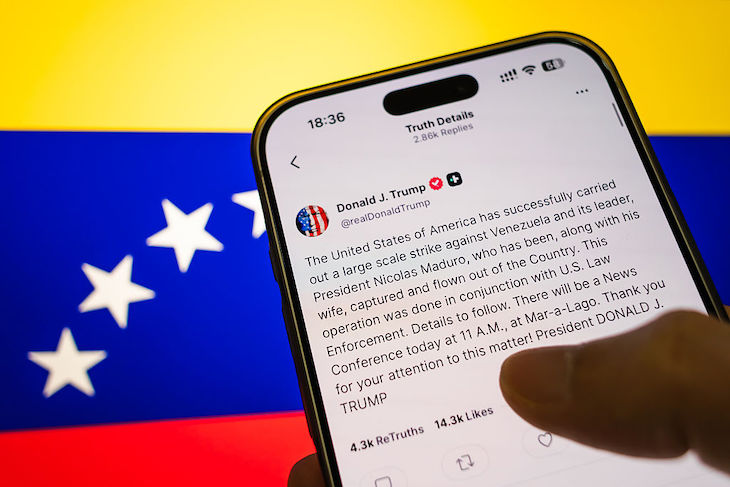
The Vietnam war was the first Americans watched on their nightly TV news, the Gulf War the first that could be followed live on CNN, and the Global War on Terror the first documented online through the work of bloggers, citizen journalists and video-sharing sites like LiveLeak.
Meme warfare is being used not only to humiliate the Venezuela regime but also domestic critics of the President’s actions
The US invasion of Venezuela, Operation Absolute Resolve, marks another innovation: it is the first armed conflict in which the victor has simultaneously won a conventional military victory and a meme war.
Seeing as US forces managed to violate Venezuelan sovereignty, seize and extract its president Nicolás Maduro, and transport him to stand trial for alleged narcoterrorism offenses in New York City, it’s safe to say Uncle Sam achieved its operational aims. (At least its immediate aims. Washington’s track record on ousting communist strongmen in Latin America is not without blemish, plus there is no guarantee that Maduro, if tried, will be convicted.)
If the execution of Absolute Resolve was breathtaking in its secrecy, speed and efficacy, no less extraordinary has been Washington’s parallel meme war against the Venezuelan regime, in which US diplomatic and military leadership, not least commander-in-chief Donald Trump, has recorded absolute victory.
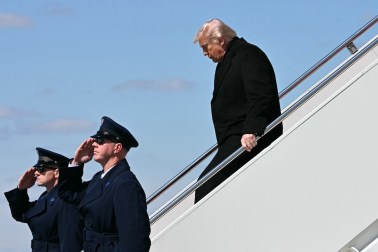
The White House shared a video on social media comprising Maduro’s now-infamous “Come get me” taunt; a clip of Marco Rubio remarking “If you don’t know, now you know”; and a still photograph of Maduro in US custody, a shot of Trump striding confidently, and a sample of the Notorious B.I.G. song “Hypnotize.”
It’s a format used to ridicule those who FAFO (fuck around and find out) and accord “gangsta” status to whoever helped them “find out.” It’s an indication of just how comprehensively Trump won his meme war that the White House has appeared to get away with the ultimate faux pas: the sampled track contains an uncensored use of the N-word.
It would be a mistake to dismiss this communications strategy as insubstantial fluff or edgelord poasting by terminally online interns in the White House press office. It is not merely political messaging but the digital extension of conventional force, a psychological double-tap to make total and beyond doubt the enemy’s defeat. With apologies to Clausewitz, social media bombardments are the continuation of war by other memes.
Meme warfare is being used not only to humiliate the Venezuela regime but also domestic critics of the president’s actions. When leftist senator Bernie Sanders tweeted a lengthy statement condemning the capture of Maduro, the Republican Party’s X account responded with the “i ain’t reading all that, i’m happy for u tho, or sorry that happened” meme. Where the military operation was carefully targeted, the meme assault has been a less focused blitz in all directions.
But the enduring meme of the Venezuela incursion is a short video Trump posted on Truth Social showing American war planes stalking the dusky skies over Caracas as explosions plume up from the ground below.
This is followed by clips of incendiary devices making contact with the ground with searing flashes and a shot, which appears to have been filmed by a Venezuelan motorist through his car windshield, depicting mammoth charcoal columns towering into the night sky. Someone – whether inside or outside the Trump administration, it is not clear – has laid over the audio track the first two verses and chorus of Creedence Clearwater Revival’s 1969 record “Fortunate Son.”
Whatever one’s opinion of the military action, this video is undeniably cinematic – a spectacle of image and sound arranged to convey a sensation or a meaning. In this case the sensation is awe and the meaning one which, until this video, had been best expressed in Team America: World Police (Trey Parker, 2004): “America, fuck yeah!”
“Fortunate Son” is a perfect choice to score the scenes of the US military dominating the airspace over a communist nation. The track was written in response to the Vietnam war and for at least one generation of Americans it is one of the pieces of music that define that conflict and its era, thanks in no small part to its subsequent use in media depicting the Second Indochina War. Most famously, it is the song that accompanies Tom Hanks’s arrival in Vietnam in Forrest Gump (Robert Zemeckis, 1994).
That it is a protest song about the ability of scions of the wealthy and powerful to avoid the draft – scions, ahem, like Donald J. Trump – makes it almost certain that whoever produced the video did so to bait educated progressives into a smug, frothing rage about MAGA dummies missing the irony of lyrics like: “Some folks are born made to wave the flag/ Hoo, they’re red, white, and blue/ And when the band plays ‘Hail to the Chief’/ Ooh, they point the cannon at you, Lord.” The Trump administration even does trolling as a preemptive strike.
The Creedence video is a reminder that Donald Trump is a baby boomer, a generation whose lives have been saturated in media and its evolving technologies, from an infancy bathed in the authoritative glow of television to a dotage spent scrolling and sharing every kind of content that can be created and consumed on a smartphone. It is somehow fitting that under Trump, probably the final boomer president, the revolution was not only televised but Snapped and WhatsApped, streamed and memed.
The target of the administration’s meme warfare was Venezuela but the audience is the rest of the world. Hostile states have been notified in the most spectacular fashion that crossing the United States carries a heavy price. The message might be obnoxious, it might be at odds with global norms and international law, but the Trump administration is not concerned with such things. It believes that might is right, that US interests override foreign sovereignty, and anyone who gets in the way can expect both their airspace and their timelines to blow up.

Comments