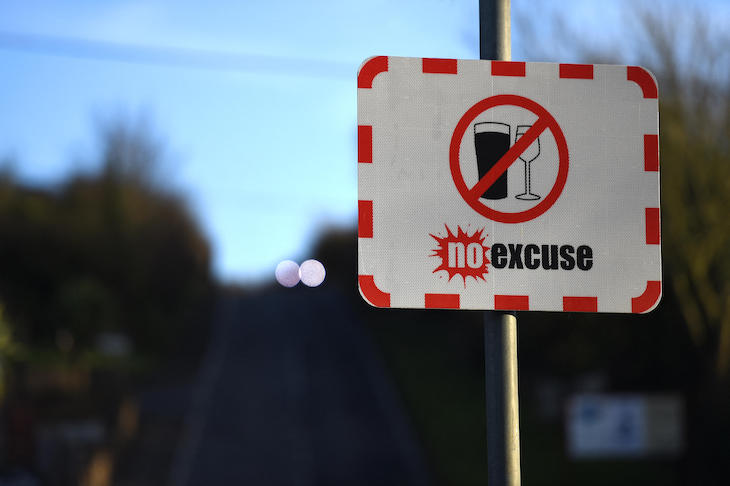
‘We will tread more lightly on your lives,’ promised Keir Starmer in his first speech as Prime Minister. Yet his government has not lifted the weight of the state in their 18 months of power but made it more intrusive. Today, as part of a new road safety strategy, Labour is proposing cutting the drink-drive limit from 80 to 50 milligrams per hundred millilitres of blood, matching the stricter Scottish limits. I’m not convinced this crackdown will save lives.
I have not had to peel the remains of mangled children and adults from cars and pavements, as many police officers and paramedics have. But as an A&E doctor I have heard their stories and looked after those they brought in who survived, sometimes only long enough to die as I tried to keep them alive. Questioning the government’s plans isn’t dismissing these horrors but taking them seriously. Our responses need to be effective, not performative.
This is a government run by announcement culture
There have been multiple recommendations, nationally and internationally, to cut the drink-drive limit to Scottish levels. The European Commission told member states to do so from 2001. In 2021, two authors from the Institute of Alcohol Studies – dedicated to reducing alcohol-related harms and no friend to the industry – looked at the impact of the 2014 reduction in the Scottish drink-drive limits. Because the reduction took place nowhere else in the United Kingdom, it provided a unique opportunity to measure its impact separately from other potentially confounding influences – changes in technology, culture and other road safety regulations.
‘Assembling several new data sources and using careful research designs,’ said the resulting research paper, ‘we conclude that the reform had no effect on accident rates.’ There was no effect on major crashes or minor collisions. Across all subgroups, the young and the old, men and women, day or night, weekend or in the working week, there were no benefits. ‘Taken together, our no-effect results defy pre-reform expectations as well as most of the existing medical evidence, which is predominantly correlational.’
The reduction in Scotland made no difference. Data predicted it would, but that data was poor quality, observational, vulnerable to confounding. The Scottish experience provided a rare natural experiment, a high-quality test of whether stricter drink-drive limits reduce crashes. They don’t – yet our government now wants to roll out the policy nationwide. This is a government run by announcement culture, with thoughtless policies churned out to sound virtuous in a press release.
I live in a village, two doors down from the only pub. I want the pub to keep going, and I am infuriated by the men who drive in, drink, and hours later drive home. The reckless will ignore the new limits as they already ignore the current ones. Meanwhile the careful, including those driving only the morning after having a drink, stand to get criminalised, all without any public health benefits. Even small improvements in road safety are valuable, but those wanting to expand state control have a poor argument for their intrusion when the best evidence shows no improvement in safety at all.
There is huge scope to reduce avoidable premature deaths in Britain. Our dysfunctional NHS kills people daily with its trolley waits in A&E, its appalling cancer outcomes, and its ambulance delays for emergencies like heart attacks and strokes. A government wanting to be useful could focus its energies here.
On the roads, it could avoid introducing new restrictions shown to confer no benefit, and look for achievable ways of making a permanent difference. Self-driving cars and taxis could do that to a massive extent, and in a way which not only reduced congestion but also hugely increased our freedom – and made driving to the pub safe.
Vince Cable, during his time as business secretary, announced measures in 2014 to introduce driverless cars to UK roads from 2015. Chris Grayling, as transport secretary in 2017, said driverless cars would be on British roads by 2021. ‘We’re planning for self-driving cars to carry passengers for the first time from Spring,’ said Heidi Alexander last month, in a delusionally parochial announcement. Waymo has been offering a commercial service since 2018. Publicly released safety data shows the company has covered 127 million driverless miles, with 90 per cent reductions in serious crashes. British politicians make it sound like we’re boldly innovating, and worryingly, they may even believe that. The reality is that their own regulations prevent us from embracing real benefits already present elsewhere.
A government wishing to tread lightly could stop policing the marginal habits of responsible adults and start fixing the systems failing them so badly. There are many ways in which our government could help improve our lives. Instead, they keep finding ways of making it worse.





Comments