Peter Hoskin

Just whom will the Lib Dems work with, then?

Two noteworthy entries, today, in the will-they-won't-they game of coalition government.  The first from Nick Clegg in the Sunday Times: "You can’t have Gordon Brown squatting in No 10 just because of the irrational idiosyncrasies of our electoral system." And the second from Paddy Ashdown speaking to the People: "Nick Clegg cannot work with David Cameron ... We could not go into a coalition with the Tories, it wouldn't work." So, assuming both are true, it sounds as though Clegg would only work with a Labour party headed by someone other than Brown.  But don't count on it.

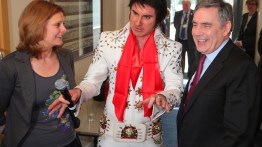
When the going gets weird, the weird hire an Elvis impersonator

Really, what's happened to the Labour campaign?  You know things are taking a turn for the worse when you read that Gordon Brown is taking a more high profile role to save his party from a third-place finish.  But then you see that high profile role in action, and, well ... First there was an event which incorporated some deliciously ironic innuendo about the Tories' spending cuts.  The PM lamented the fact that Jeremy Paxman didn't press the Tory leader on claims that there is "too much" public spending in Northern Ireland and the North East, concluding that "there is no part of the United Kingdom that is safe from what the Conservative party would do.

Tories growing used to a hung parliament in public and in private

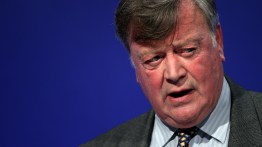
Planting seeds, that's what the Tories are doing – they're planting the seeds of a Lib-Con alliance.  Yes, it's a subtle process, and is couched in terms of denial and defiance.  But it's still going on.  I mean, look at Cameron's interview with Jeremy Paxman past night (video on Spectator Live), where he declined to rule out having Nick Clegg in his Cabinet – although, happily, he was more unequivocal on the subject of Vince Cable.  And then there's Ken Clarke's interview with the Daily Telegraph this morning, in which he says that the Conservative "starting point" for any coalition would be a refusal to compromise on their economic plans.

Blood and guts

Centurion 15, Nationwide You know how it is. There are two sword-and-sandal films opening in cinemas, and you just can’t decide which one to see. Will it be Alejandro Amenábar’s Agora, which looks poised, if a little sterile? Or will it be Neil Marshall’s Centurion, which is all about the action, action, action? So you do as I did, and reach for a coin in your pocket. Heads, it’s Agora; tails, Centurion. You throw. The coin somersaults in the air, plunges back towards your hand, and... Centurion is Marshall’s fourth feature, and it remains faithful to the horror-cum-comic-book stylings of his previous three. In Dog Soldiers (2002), it was soldiers versus werewolves. In The Descent (2005), it was potholers versus subterranean monsters.

The nation’s Cabinet

Just to flag up an eyecatching poll from PoliticsHome, asking the public to pick the members of their ideal coalition government. Methodology and details here, and the results pasted below.  Two things strike me: i) Alistair Darling once again proves he's popular, which you wouldn't necessarily expect of a Chancellor who has presided over a recession, and ii) Hilary Benn's presence may well show that, so far as Brown's government is concerned, keeping a low profile is a good way to get noticed.

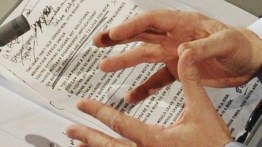
Brown, behind the scenes

A neat election-time spot from the Guardian's Haroon Siddique, who brings us the above photo of Brown's speaking notes from the TV debate last night.  Turns out - surprise, surprise - that the "two boys squabbling" line was prepared in advance.  As were a few other clunkers that we thankfully didn't hear.  I mean: "You can phone a friend, you can ask the audience, you can go 50-50 with Nick." Really?

GDP grows by 0.2 percent in first quarter of 2010

Now we know: the official preliminary estimate says that GDP grew by 0.2 percent in the first quarter of the year. So the double dip looks to have been averted (for now) – but not by much. The figure is at the low end of economists' estimates and lower than the growth experienced in the final quarter of 2009. Labour, of course, will spin this as further proof that we can't risk the recovery by voting for those dastardly Tories.  And the Tories will say that it shows just how damaging Gordon Brown has been for our economy.  But I wonder whether voters will choose between the two messages, or come to see a hung parliament as a decent compromise between them.  If it's the latter, then fasten your seatbelts, etc.

The morning after the debate before

So, like last week: what's changed?  And, like last week, it's probably too early to judge.  The insta-polls may have Cameron and Clegg on level footing, but, really, we need to wait for voting intention polls before coming to any firm conclusions.  As we saw the day after the first debate, they can work in quite surprising ways. My instinct, though, is that things will remain relatively steady.  The Clegg surge of last week was, at root, a cry for change from the electorate – any change.  So it will probably take more than a solid Cameron victory in one TV debate to have voters flooding back to the Tories.  And it will probably take worse than a decent enough performance from Nick Clegg to shoot down the yellow bird of liberty.

Has Brown blown it?

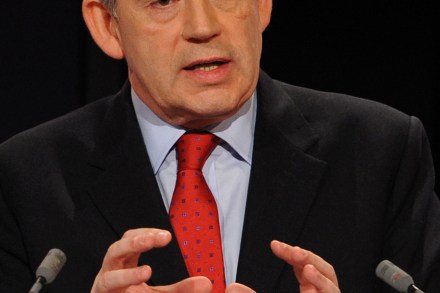
Gordon just can't help himself, can he?  There can't be a simple dividing line – oh no.  It has to be one built on exaggerations, half-truths and plain lies.  So it has always been with his brand of government, and for much of the time – think cuts vs investment – it has worked in his favour.  But tonight, despite a surprisingly punchy performance from the PM, it seems to have backfired dreadfully. The Tories are going big on those misleading Labour leaflets – and rightly so.  Brown denied that he authorised them.  But the fact that a Labour party political broadcast made similar claims about the Tories and old-age benefits makes it impossible for the PM to distance himself from this.

TV debate – live blog

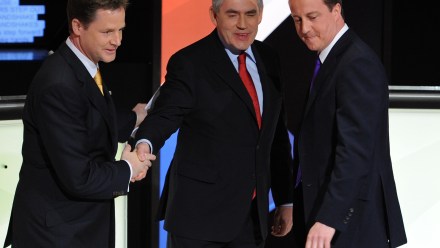
2130, PH: And that's it.  I'll be posting a verdict shortly. 2129, PH: Clegg tries to repeat his Amazing Memory Feat from last week - but this time it's the issues discussed, and not questioners' names.  Not as impressive.  After that, he talks "change" and delivers a few jibes about the "opponents of change". 2128, PH: Cameron, to camera: "That sounded desperate ... we need a clean break."  Cameron says "clean break" again, and mentioned the "Big Society". 2127, PH: Closing pitches now. Brown doesn't look at the camera for his - it starts slowly, but he looks more enthusiastic when he gets to the bit about the Tories being a "risk to the economy".  He adds that the Lib Dems are a risk because of their policies on Iran and Trident.

Team Brown playing the same old tunes

The strange thing about last week's TV debate is that, for all its transformative power, it doesn't seem to have changed Labour's campaign strategy in any fundamental way.  Team Brown were hoping for a hung Parliament, and courting the Lib Dems, before last week.  And, as Peter Mandelson demonstrated earlier, they're still doing the same now.  The only difference is that it's more likely their wishes will come true. But this creates problems for Brown so far as tonight's TV debate and the rest of the election are concerned.  His instinct may well be to repeat the "I agree with Nick" positioning of last week.  But this has already been heavily lampooned - and was batted away quite comprehensively by Clegg the last time he tried it.

People loathe politicians – but do they loathe the political media too?

One thing's for certain: the Lib Dems are coming in for greater scrutiny and attention from the media.  The covers of the Telegraph, Sun, Mail, Express and, yes, The Spectator are testament to that - even if some are less substantial than others.  But the question is: will this derail the Clegg bandwagon?  And, like Iain Dale, I'm not so sure. Iain's point is that some of the coverage is so spiteful that it will "serve to increase his popularity and position in the polls".  He adds that this would be a "sure sign that the power of the press to influence an election is on the wane".  He's right, and the theme he identifies is one of the major currents that's swirling about underneath the surface of this election campaign.

Numbers which show why the TV debates are priceless for Nick Clegg

How valuable was the TV debate to the Lib Dems?  Well, we've seen the poll numbers, of course.  But the Electoral Commission has just released some figures which shine a different light on proceedings.  They show that the Tories received party donations totalling £1.46m in the first week of the campaign.  Labour, nearly £800k.  And the Lib Dems were way, way behind on £20,000.  So, Clegg & Co. are heavily outgunned financially - but they've still had the biggest upsurge in publicity and popularity. True, donations to the Lib Dems have risen dramatically since the TV debate - but it's still unlikely that they'll reach Tory, or even Labour, levels of income.

Grayling wins the perceptions battle

Another day, another TV debate – only this time it was Alan Johnson, Chris Grayling and Chris Huhne behind the lecterns, talking crime on the Daily Politics.  Just like yesterday's debate, the questions were incisive and insistent.  But the politicians conspired to turn proceedings into a mush.  There was very little clarity, a sizeable dollop of bickering, and proof, were it needed, that Huhne really can go on a bit. To my mind, it all boiled down to likely audience perceptions.

A bumpy ride for Brown on Radio One

Gordon, meet disillusionment.  Disillusionment, the Prime Minister.  Ask him questions on whatever you want: the economy, jobs, immigration, expenses - the ball is in your court.  Make him squirm, if you like.  Confront him.  He is, after all, here at your pleasure. For that was the set-up of Radio One Newsbeat's interview with Gordon Brown earlier this afternoon.  It was one of those impossible situations for the PM.  He could hardly decline to be quizzed by a group of first time voters, aged between 18 and 28.  But it put him at the mercy of some pretty disgruntled members of the public.  And they took full advantage. The questions were direct and drew blood.  On the economy: "Where are the cuts going to come from?

Brown’s leadership back under the spotlight

Things have clearly moved on since I wrote this back in March.  From Rachel Sylvester's column today: "...those close to Mr Clegg have made it clear to senior Labour figures that it would be difficult for the Liberal Democrats to do a deal with a Labour Party led by Mr Brown. 'The whole notion of change is so important to Clegg and Gordon doesn’t represent change,' says one Labour strategist. 'It’s hard to see how they could prop up Brown in a hung Parliament.' With Cabinet ministers openly discussing the prospect of coalition, the question of the Labour leadership is back on the agenda.

No clear winner in the foreign affairs debate

Only defuse.  That seemed to be the approach of all three participants in the Daily Politics' foreign affairs debate this afternoon.  The frequent questions from Andrew Neil and Mark Urban put David Miliband, William Hague and the Lib Dems' Ed Davey on the collective back foot.  It was all they could do to take some of the sting out of proceedings. In Miliband's case, that meant Iraq and defence spending.  On the former, he started with one of the bluntest statements we've heard from any government minister on the issue: "If we knew then what we know now," he said, "we wouldn't have gone into Iraq."  You can see the thinking: distance the Brown Government from Blair's War.