Peter Hoskin

Will the tactical voting plea work?

There's only one question which matters when it comes to Labour's tactical voting plea: will it work?  You can certainly see Brown & Co's thinking on this.  This is the election, after all, where the Lib Dems have become a viable option for a lot more people - so they might act as a speed bump for people rushing away from Labour and towards the Tories.  And anything which depresses the Tory vote gives Labour a greater chance of holding the most seats in the House, and of making some kind of post-election pact with Nick Clegg. But as David said earlier, Labour's osciallating stance towards the Lib Dems - lofty sneers one minute, sickly grins the next - is hardly convincing.  And neither is the timing.

The Tories plan to cut early – but how would their opponents respond?

Oh yes, the Tories are broadcasting more Ready For Government noises this morning.  There's an article in the Telegraph suggesting that David Cameron would choose a minority government ahead of coalition with the Lib Dems.  And the Guardian reports that a Tory government would set out a bulkload of spendings cuts in the first six months of office, when, as a senior Tory puts it, the "excitement of the general election aftermath" will still be hanging in the air. You can understand the Tory thinking here.  Not only will they find it easier to achieve things during the heat and righteous fury of early government, but they will also need to seize something like a mandate for the cuts which have remained off-stage during the election campaign.

Nothing but negativity

A telling passage from Nicholas Watt and Patrick Wintour's campaign report this morning: "Gordon Brown visited 10 London constituencies [yesterday] eventually leaving a pub in Kilburn by a side door after it was besieged by Tory and Lib Dem activists. He is now running a campaign almost exclusively warning of Tory cuts, and claiming that the party's first tax cut would be for Britain's richest millionaires. Brown also described the Tory manifesto as a 'horror show', flagging up their plans on inheritance tax, public services and the deficit, adding: 'I say the Conservative party is not fit for government if it has policies like that.

A grim reminder of the Islamist threat?

Yesterday's attempted car-bombing in Times Square doesn't really tell us anything beyond that there are sociapaths willing to blow people up, and that sometimes luck – rather than judgement – foils their bloody plans.  But, given the Pakistani Taliban's claim that they were responsible for the attempt, it does serve as a grim reminder of the poison seeping out of that region.   The question now, and for the next few months, is whether the West will somehow become more engaged inside Pakistan.  It's notable how British ministers have increasingly namechecked the country when justifying our presence in Afghanistan – but, still, it seems that the Taliban and other Islamist groups have strengthened their foothold there.

Cameron gets ready for government – but will he manage to avoid “frontline” cuts?

For the past few years, the Tory task has been to look like a government-in-waiting. Now, with the election only a matter of days away, David Cameron has dialled that process up to eleven. In interviews with the Sunday Times and Andrew Marr today, the Tory leader concentrates firmly on the nuts and bolts of government. The content of the Queen's speech, the depth of Tory cuts, the possibility of coalition – all get name-checked and cross-referenced. There's much in there to encourage Tory supporters. Indeed, CoffeeHousers have been clamouring for one of Cameron's proposals: a "Great Repeal Act," which would "scrap ID cards, home information packs and dozens of rarely enforced criminal offences introduced by Labour over 13 years.

The Brownites still think they can win the election

So, back to the Labour leadership with Patrick Hennessy's snappy article on the subject for the Sunday Telegraph.  The main sweep of Hennessy's piece is that Brown is likely to step down quickly in the event of defeat; that Harriet Harman could well fill the caretaker leader role; and that certain Dark Forces are moving to install David Miliband as party leader proper.  The colour, though, lies in a couple of juicy snippets which are worth repeating here: "Last week, this newspaper has learnt, Lord Mandelson was overheard telling colleagues of his difficulties running the campaign when other figures – who could only be Miss Harman and her followers – kept insisting that every event must have a proper 'gender balance.

The curtain starts to fall on Gordon Brown

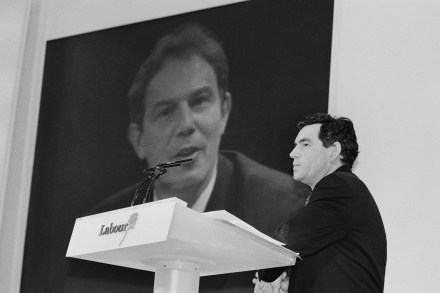
There's a strange fin de siècle air about Labour this weekend: a new appreciation that the forthcoming election marks either the end of their reign, or – at best – is the start of a different, diluted kind of power.  There are still a few signs of life and struggle, sure.  I mean, Gordon Brown's interview with Jeremy Paxman last night was fairly proficient by his standards, if typically disingenuous.  But, even then, the PM is struggling to move the conversation on from Gillian Duffy.  In interview with the Telegraph today, he admits that he has "paid [a] heavy price" for his gaffe. That line forms the headline of the article. Even Tony Blair can't inject much joy into Labour's campaign.

The quiet rise of Alistair Darling

A noteworthy set of observations from Iain Martin over at the Wall Street Journal: "The Labour family is starting to realise that if it is out of power it would need a caretaker leader in place quickly so that it can regroup, rethink and then work out which of the competing contenders has the best chance of beginning the work of reconstruction. In this context, I hear the name of Alistair Darling being mentioned increasingly as the interim option. It makes a lot of sense. The Chancellor has had a good crisis and he could steady the ship. He also has a great sense of humour - which will be crucial in the circumstances. Johnson is said not to really want it and Jack Straw is done for. Harriet Harman?

Too little, too late | 30 April 2010

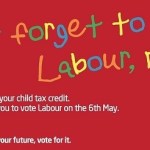
My gosh, these latest Labour posters are open for all kinds of spoofery. But at least they're positive and colouful - unlike Gordon Brown's performance in the TV debate last night.  Which, really, highlights Labour's fundamental problem during this campaign.  The big set-piece events have been almost relentlessly negative, whilst they've left what passes for a positive prospectus to posters which will barely make it past the confines of the political blogosphere.  But, never mind - Tony Blair thinks that "Labour's got every chance of succeeding."  So all's well then.

The Tories’ final push

Fresh from David Cameron's victory in the final TV debate, the Tory campaign has taken another assured step this morning.  As Tim Montgomerie reports over at ConservativeHome, they're going to flood the doorsteps with the leaflet, 'A contract between the Conservative Party and you' (pdf here).  Inside, a list of clear policy commitments from "publishing every item of government spending over £25,000," to "reducing immigration" to the levels of the 1990s – meaning tens of thousands a year, instead of the hundreds of thousands a year under Labour."  And, on the back page, a refutation of some of Labour's most misleading claims about the Tories.  Clear, simple and direct.

Sunshine wins the day for Cameron

So that's the second time that immigration has had a major impact upon proceedings this week.  Until we came to the question on that topic, I thought Clegg was bossing the TV debate.  He was clear, personable and managed to hover elegantly above Brown and Cameron's dusty brawl over spending cuts.  But as soon as it came to clarifying Lib Dem policy on an amnesty for illegal immigrants, the wings rapidly fell off the yellow bird of liberty.  All of a sudden, Clegg sounded rattled and unpersuasive.  From then on in, it was Cameron's game. It helped that Cameron had the clearest – and, I suspect, the most popular – line on immigration: "We would cut immigration from the hundreds of thousands to the tens of thousands.

The final TV debate – live blog

2227, JGF: Rumour going around the press room that a certain A Campbell has been overheard saying 'I think we've had it' 2201, PH: And that's it. I'll be putting up my verdict in a separate post shortly. Thanks for tuning in. 2200, PH: Woah. Brown starts positive - thanking everyone involved in the debates.  But he's soon into hardcore negativity: attaking the Tories for their inheritance tax plans and pointing out what areas of spending they will cut.  It's all scaremongering about child tax credits, cancer guarantees and the like.  This, lest you need reminding, is his pitch for the country. 2128, PH: Clegg hones in on the "old parties," claiming that they will stand in the way of "real change".  He says that he will "fight for fairness".

A tale of two images

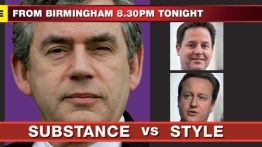
Labour's, erm, "poster" ahead of the TV debate tonight: And Coffee House's take on what Number 10 might look like on May 7th (with thanks to the great Carla Millar for putting the photo-montage together):.

To what extent should Cameron and Clegg use Brown’s gaffe against him?

Given the timing of Brown's Mega Gaffe, you've got to wonder how it will play out in the TV debate tonight.  Will it, for instance, mean that he gets a hostile reception?  Will he try to defuse the situation by repeating his apologies, or perhaps by making some sort of light out of it ("Yesterday, I met a woman in Rochdale...")?  Will it overwhelm the deeply serious economic questions which need asking and answering?  And so on. There's one question, in particular, though, that I'd be keen to hear CoffeeHousers' views on: how much should Cameron and Clegg use Brown's gaffe against him?

The timing could not be worse

So Brown has now visited Gillian Duffy's home to apologise to her in person.  Somehow, I think that's not going to defuse this row.  Labour have, in the lingo of the The Thick of It, a major omnishambles on their hands.  And he's called Gordon. The worst aspect of this for Labour, though, is the timing.  Sure, they wouldn't have chosen this at any point the campaign.  But, with only a week left, it threatens to both obliterate eveything that's gone before and overshadow whatever Brown does from now until polling day.   And then there's the final TV debate.

Brown calls woman a ‘bigot’

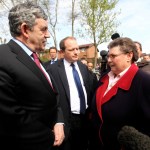
Wow. Just when you thought Labour's campaign couldn't get any worse, they go and wheel out Brown in front of ordinary voters.  And this is the result: he has been caught on mic describing a member of the public as a "bigoted woman".  Speaking to one of his advisers, he added "you shouldn't have put me with that woman. Whose idea was that?"  Classic. This may be trivial beside the big questions about the economy, etc. - but you can expect is to become one of the defining TV moments of the campaign.  It's one thing to insult and attack the politicians who serve alongside you, but quite another to do similar to someone whose vote you're courting.  Toxic, toxic stuff.

Where is the axe going to fall?

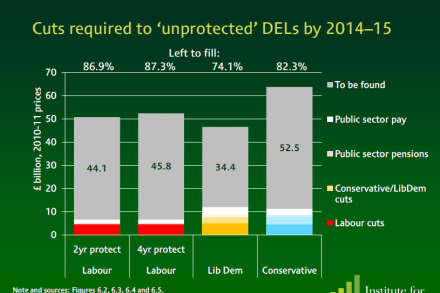
If you want a sense of where our politicians are when it comes to sorting out the nation's finances then I'd recommend you read this briefing paper which the IFS released earlier today.  What it shows, in stark graphs and charts, is what Adam Boulton, Andrew Neil et al were getting at in Labour's press conference earlier: yes, we know that there are significant cuts to come, but none of the parties are really letting on just where they will come from.   To my eyes, this chart tells the story particularly well.  It depicts how much each party will cut "unprotected" departmental spending by - and how much of those cuts has still got to be identified.

The spotlight turns on Labour

It's the story which has been simmering throughout the election campaign, and now it has has boiled over onto the front pages: fear and loathing in the Labour ranks.  After rumblings in the Sunday Times yesterday, its sister paper splashes with the headline "Labour in turmoil as pressure on Brown grows".  And, inside, Francis Elliot and Suzy Jagger report on the "jockeying to replace Gordon Brown".  Meanwhile, the front of the Independent speaks of "growing recriminations in senior Labour ranks over a lacklustre campaign that has seen the party relegated to third place in opinion polls."  The spotlight is finally turning, white-hot, on to Labour - after ten days of near exclusive illumination on the Lib Dems.