Peter Hoskin

Andy Burnham, football mad

Humble hat-tips to Iain Dale and Jim Pickard for spotting this fun exchange in Labour Uncut's interview with Andy Burnham: Q. (from Jackie): If you had the choice between playing for Everton in an FA cup final, or become the next Labour Prime Minister which would you chose? A. (after exactly two seconds) Everton, FA Cup final. press secretary: (howls) No! Q. That is a bold statement! press secretary: I’m going to kill him. Q. She is going to strangle you when I leave. press secretary: I am. Campaign manager Kevin: Can you re-answer that one please Andy. A. Well it’s a different choice isn’t it!

The equality landmines that Labour have left the coalition

Oh dear, the Treasury is mired in another controversy about equality after the Guardian published a letter which Theresa May sent to George Osborne before the Budget. In it, she warned that the government could face legal action if it is unable to show that its decisions were made with a consideration to "existing race, disability and gender equality duties." As she puts it: "If there are no processes in place to show that equality issues have been taken into account in relate to particular decisions, there is a real risk of successful legal challenge by, for instance, recipients of public services, Trade Unions or other groups affected by these decisions.

How tightly are the Lib Dems bound to the Tories?

A thoughtful and thought-provoking column from Danny Finkelstein (£) in the Times this morning, which is well worth a trip beyond the paywall to read. In it, he makes a persuasive point: that, despite their plunging poll ratings, the Lib Dems aren't doing too shabbily at all. After all, who, looking back at the party's recent history, would have thought they would be in power in 2010? That they are suggests, in Danny's words, that "this is not not the bottom for the Lib Dems, it is the top." From there, an important point is made against those who still contend that the Lib Dems would have been better off shacking up up with Labour in May, that it would have been a more natural fit. Here it is: "…the price of joining Labour might well have been greater.

The government could make political and fiscal gains if it reviews the Trident upgrade

On one level, there is something admirable about the government's uncompromising support for a Trident upgrade: senior Tories really do believe in the deterrent's strategic importance, and are not willing to sacrifice that. But, on many other levels, that same inflexibility is looking more and more unwise. Three former senior military figures write to the Times today with a new riff on a point that they have frequently made before. Why not squeeze another 15 years out of the current system, they say – by which time, "the anachronistic and counterproductive aspect of our holding on to a nuclear deterrent would be even more obvious." This is an argument with which a whole host of military figures and Lib Dems will sympathise.

Why the government needn’t fear the strikes

With the threat of major strikes timed to coincide with Osborne's spending review in October, I think it's worth exhuming an important point that Julian Glover made in his Guardian column last month: "UK politics is often characterised as a contest for the centre ground, but that misdescribes the nature of the quest. Centrism implies banality, but I don't think voters want their governments to be mundane. There is a willingness to endorse radical action if it is explained and if it looks practicable. It worked for the left under Attlee and Blair; it worked for the right under Thatcher; and it is working – so far – for this government.

Balls: let’s remain on the centre ground and oppose cuts

As the New Statesman's George Eaton suggests, there's quite a lot packed into Ed Balls's piece in the Times today (also on his website for those who can't venture beyond the paywall). And, what's more, some of it makes sense. Take his argument that Labour shouldn't cede the "radical centre ground" of British politics to the coalition. That's the right argument to make, even it if is rather undermined by Balls's own efforts to drag the party leftwards. As usual, it all starts to unravel as soon as Balls gets to the public finances. His position is blunt and straightforward: that "Labour needs strong leadership to make a credible argument against slashing public spending and raising VAT, which will increase unemployment and risk a double-dip recession.

A postcard from Dave and Nick

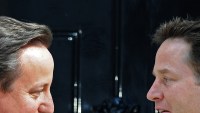
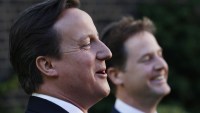
Here's a slightly curious one: David Cameron and Nick Clegg have written a public letter to their ministers, reminding them that, "deficit reduction and continuing to ensure economic recovery is the most urgent issue facing Britain," and that, "the purpose of our government … [is] … putting power in the hands of communities and individuals and equipping Britain for long-term success." If you wanted to read into it, then you could say that the emphasis on the "long-term" throughout the letter is a warning to any disgruntled sorts: policies for the long-term require time to implement, so the coalition has to be built to last, etc. etc. But, of course, this missive is directed at voters as much as anyone else.

Tyrie asserts himself once again

Few MPs have made quite so many waves recenty as last year's Spectator backbencher of the year, Andrew Tyrie. Under his chairmanship, the Treasury Select Committee seems to have gained a new vitality and edge. And it has certainly accumulated more powers, with the ability to veto the government's appointments to, and dismissals from, the Office for Budget Responsibility. As he put it himself in an interview with the Independent last week, "The fight back by Parliament is beginning now." Just how aggressively he intends to prosecute that fight back is suggested by his comments in the Times (£) today.

Dannatt’s departure means one less cook stirring the defence broth

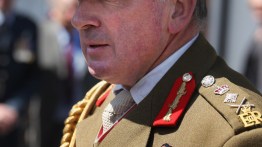
So Sir Richard Dannatt has departed the Tory fold almost as curiously as he entered it. Sure, have been no gaffes from Chris Grayling this time around – but when it was announced last October that the former head of the Army was advising David Cameron, it was widely expected that he'd graduate to become a peer and a minister in any Tory government. But today he announces his "retirement" as neither. The Tories are downplaying all this, eager to avoid a repeat of the speculation that surrounded Sir Alan Budd's departure. And, to be fair, there are few signs, as yet, that this is a viciously unamicable split.

Who is Labour’s Mr Sun?

Writing for the Times, Tim Montgomerie neatly overlays Aesop onto the Labour leadership contest: "The next Labour leader is unlikely to be an Abbott, Balls or Burnham. Gordon Brown’s successor will be a Miliband. But I’m more interested in whether he will be Mr Sun or Mr Wind. Aesop captured the dilemma in a fable. If you want a man to take off his cloak, do you huff and puff and force him to give it up or do you cover him with warmth until he discards it freely? In Aesop, the sun scores a predictable victory. Politics isn’t so easy. Harriet Harman’s blasts at Nick Clegg’s alleged betrayal of left-wing voters has undoubtedly blown many Liberal Democrat voters towards Labour.

Brown, the third worst Prime Minister since WW2?

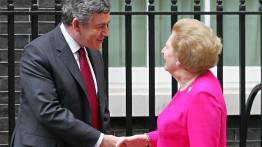
Now here's a poll that you can really get your teeth into. Reported in today's FT, a survey of 100 or so academics has rated Gordon Brown as the third worst Prime Minister since the second world war. It marks him with 3.9 out of 10, ahead of only Sir Anthony Eden and Sir Alec Douglas-Home. At the other end of the scale, Clement Attlee comes out on top with 8.1 our of 10, ahead of second-placed Margaret Thatcher on 6.9. Which, as Tim Montgomerie says at ConservativeHome, is understandable enough – Attlee probably made a more indelible contribution to British life than anyone else on the list. I was struck by the context in which one of the survey's compilers placed Tony Blair's third-placed finish.

Cameron’s circles of influence

Andrew Rawnsley's potted hierarchy of the coalition government – and especially its final sentence – is worth pulling out for the scrapbook: "There is still, of course, an inner circle. When not abroad, the first key fixture of the day at Number 10 is the strategy meeting. Its usual attendees include George Osborne, the chancellor; Andy Coulson and Steve Hilton, his director of communications and his senior strategist; Jeremy Heywood, the permanent secretary at Number 10; the prime minister's chief and deputy chief of staff, Ed Llewellyn and Kate Fall. Note that Nick Clegg is not on that list. He belongs to the next circle of influence around David Cameron.

Getting credit flowing will be one of the coalition’s toughest challenges

In interview with the Sunday Telegraph today, George Osborne stresses that the banks have got to start lending again – and he's right to do so. The easy availability of cheap credit may have done much to get us into this mess, but now we face a converse problem. As a recent Bank of England report shows, net lending from the banks to businesses remains negative – or, in other words, more is being paid back than given out – and the situation is getting worse. With small and medium businesses so reliant on credit to get themselves off the ground, this doesn't augur well for a powerful recovery. But what can the government do to rectify the situation?

The coalition’s Lib Dem conundrum

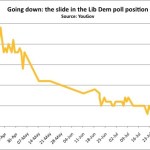
Yesterday, a "source close to the Prime Minister" told the Telegraph that we shouldn't bother much with the opinion polls as at the moment. As they put it, "we're only a few weeks into a new Parliament and we've got nearly five years to go before everyone really has to worry about the polls again." But, make no mistake, there will be Lib Dems who are deeply concerned by how their party is polling at the moment. The YouGov poll in today's Sunday Times, which has the yellow bird of liberty stuttering along at 12 percent, only underlines a remarkable decline since the election campaign (see chart above).

Will Cable be selling the coalition’s cuts?

Compared to the major affairs of state, David Cameron's decision to spend part of this summer touring the nation to sell the coalition and its spending cuts may seem but a trifle. Yet it's a good move nonetheless. After the obfuscations from all sides before the election, Osborne's Budget swept in a more upfront approach to cuts. Cameron's roadshow, you hope, will keep that going. One thing to look out for is how Vince Cable gets on this summer. The Telegraph reports that he will also be involved in the coalition's big promotional drive, and will be holding his own public meetings during August. A recipe for trouble given Cable's singular approach to united government? Perhaps.

Francis Maude is right, but he must remain wary

Big words from Francis Maude, as he tells today's Guardian that the current government is more radical than either Thatcher or Blair were in their first terms. But, to my mind, he's right. Even looking back on the past week – with the proposals to reform policing and benefits – there's a good deal of radical policy. And that's before we get onto the free schools revolution or GP commissioning – or, of course, to a Budget which took shears to the size of the state as few have done so before. But Maude shouldn't get too excited quite yet. It is all very well talking about good intentions and plans, but – as any fule kno – the real challenge will be in the implementation. The case of Michael Gove is instructive in this regard.

The past few weeks have made the struggle in Afghanistan even more difficult

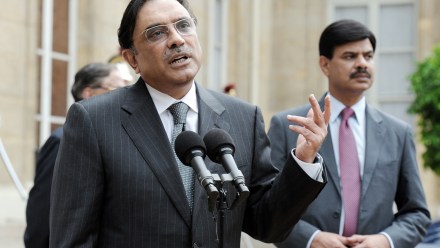
Domestically speaking, it has been an encouraging week from the coalition. Internationally speaking, less so. And today we see the first real rush of fallout from David Cameron’s appearance on the world stage, as the Pakistani intelligence agency cancels a visit to London, “in reaction to the comments made by the British Prime Minister against Pakistan.” It’s not the kind of development that we should exaggerate –after all, it still looks likely that President Zardari will visit Cameron next week, even if officials in Pakistan have been wavering on that front. But we shouldn’t underestimate it either. The main reason to worry is, largely, one of personality.