Peter Hoskin

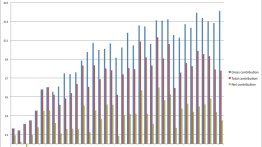
Question: how much do we contribute towards the EU budget?

Answer: it depends on how you look at it. I've put together the chart below (click for a larger version), which sets how much money we've given the the EU since 1973. There are three lines for each year: i) our gross contribution, ii) our total contribution (which is the gross contribution minus the money we get back from the rebate), and iii) the net contribution (gross contribution minus both the rebate and the money that the Treasury gets to pay for various EU projects across the UK). In terms of how much the EU costs the taxpayer, then, I'd say the second line is the best one to follow:   As for the future, there are no comparable figures yet (as the Treasury works in financial years, whereas the EU works in calendar years).

Another fine mess | 28 October 2010

You know that child benefit cut for higher-rate taxpayers? Yeah, well, it may not be quite as straightforward as the government have hitherto indicated. In an important post on his Wall Street Journal blog, Iain Martin sets out a problem that is exercising nerves and minds in the Treasury: simply put, there's no existing method for establishing whether mothers (who receive child benefit) are living in a household which pays tax at the higher rate.

Cameron takes on Europe

European leaders, we are told, have been charmed by David Cameron since he formed the coalition government – today, we must hope that he can use that charm to good effect. The Prime Minister heads to the EU Summit in Brussels later, following an evening of earnest phone conversations with his French and German counterparts. His plea was simple: reject a planned 6 percent rise in the EU budget  for next year. But the outcome is hazy. While our government wants the budget to be frozen in 2011, the likelihood is that it will alight somewhere between the 2.9 percent sought by the European Council and the 6 percent agreed by the European Parliament.

The pros and cons of tweaking the housing benefit cuts

It says a lot about the Lib Dems that a meeting between their party leader and deputy leader can throw up so many policy differences. When Nick Clegg and Simon Hughes chatted behind closed doors yesterday, the latter sought concessions over the coalition's housing benefit cuts – the cuts that Clegg then had to defend in the House. This morning, it was reported that he might just get some of them, even though Downing St are denying the story. Regardless of the outcome, the situation is reminiscent of the child benefit cut for higher-rate taxpayers. A policy was announced, only for the coalition to start pulling back from it in the face of both internal and external opposition.

PMQs live blog | 27 October 2010

VERDICT: The housing benefit cuts inspired Ed Miliband's chosen attack – and he deployed it quite effectively, with none of the unclarity that we saw last week. For the most part, though, Cameron stood firm – leaning on his favourite rhetorical stick, What Would Labour Do? – and his final flurry against Ed Miliband was enough, I think, to win him this encounter on points. But don't expect this housing benefit issue to dissipate quickly. Bob Russell's question was evidence enough of how tricky this could be for the coalition. 1232: And that's it. My quick verdict shortly. 1231: Bob Russell, a Lib Dem, says that housing benefit cuts are "not a laughing matter," and urges the PM to reconsider the coalition's position.

Miliband’s stage directions

Labour have sprung a leak, and it's furnishing the Times with some high-grade copy. Yesterday, the paper got their hands on an internal party memo about economic policy. Today, it's one on how Ed Miliband should deal with PMQs (£). With this week's bout only an hour-and-a-half away, here are some of the key snippets: 1. The Big Prize. "The big prize is usually to provoke the PM into appearing evasive by repeatedly failing to answer a simple question, often one that requires a simple Yes or No." 2. Cheer lines. "It's important to have a cheer line that goes down well in the chamber and can be clipped easily by the broadcasters. Mocking humour us especially useful here, especially if it strikes a chord with Tory backbenchers to silence them." 3.

Clegg holds no punches

Third time's the charm? Not when it comes it Deputy Prime Minister's Questions it’s not. Nick Clegg put in an effective performance this afternoon, but – just like the previous two sessions – there was rather more heat generated than light. So far as Labour are concerned, this monthly Q&A is little more than an opportunity to barrack the Lib Dem leader – and they set about the task with undisguised relish. Unfortunately for them, though, Nick Clegg bites back. Hard.

Stronger than expected growth

The growth figures for the third quarter of the year have just been released, and it's better than we thought: 0.8 percent, twice the 0.4 percent figure that was expected, but down on the 1.2 percent achieved in the spring. In any case, it should play well for Osborne & Co. We've just witnessed the fastest third-quarter expansion of the economy for a decade. Double speed, rather than double dip. Really, though, these figures throw up more questions than conclusions. By far the most important is: where next? The coalition would have been untroubled by an even larger reduction in growth now (caused by weak consumer spending, among other variables), so long as we get stronger growth in future.

Cable takes his wind-up act to the stage

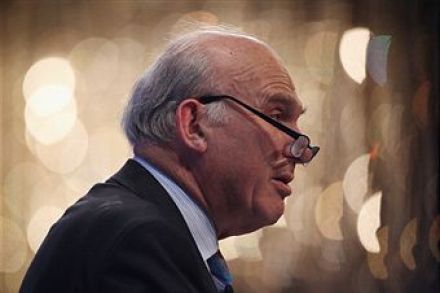
A luminous streak of self-aggrandisement in Vince Cable's speech to the CBI this afternoon, which began thus: "I should acknowledge that that the CBI has been remarkably far sighted; Digby Jones first invited me to speak to you eight years ago, the first Lib Dem asked to do so. I recall some members wondering 'Vince Who?'" And continued, as Paul Waugh notes in a typically insightful post, with a passage that will wind up the Business Secretary's detractors in the Tory party: "Just a few years ago, most people in politics, not only Gordon Brown, thought the growth problem had been solved.

Cameron’s certainty contrasts with Miliband’s equivocation

An opportunity to compare-and-contrast David Cameron and Ed Miliband outside the sweaty heat of PMQs, with both party leaders delivering speeches to the CBI this morning. Given the audience, both majored on business, enterprise, and all that – and it meant there was plenty of overlap on areas such as green technology and broadband. There were some differences, though, that are worth noting down. Cameron was first up, setting out a three-step plan for boosting British business. Broadly speaking, it revolved around what the government is trying to achieve in the Spending Review – and so the PM boasted that, "last week, we took Britain out of the danger zone.

The coalition’s feel-good factor

Since last week's Spending Review – and even before – the government has been operating in a toxic news environment. I mean, just consider the three main news stories that have surrounded the cuts. First, the 500,000 public sector job losses. Then, the IFS report and that single, persistent word: "regressive". And today – on the covers of the Independent and the Times – warnings that we could be dipping back into recession. Set alongside that tidal swell, the outpourings of Simon Hughes and the polling companies register as little more than sour footnotes. Even if the coalition plans to hide some of its better news, there's a clear need for it to push back against the gloom – lest it erode both public and Lib Dem support for they are doing.

The IDS plan approaches consensus status

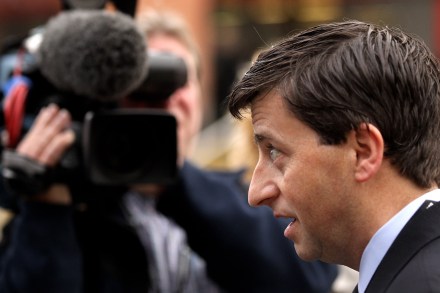
Plenty of attention for Nick Clegg's listening, reading and smoking habits this morning, as well as his appearance on the Andrew Marr show. But it is another of Marr's guests who has made perhaps the most important intervention of the day: the shadow work and pensions secretary, Douglas Alexander. Here's how the Beeb website reports it: "Mr Alexander also said he backed 'in principle' the coalition's plan to replace all out-of-work benefits with a single 'universal credit' payment. He said such a move was 'sensible' but he would be 'scrutinising' the government 'very carefully' over its £2bn start-up costs." If true, then it leaves the the parties in a surprisingly similar position on welfare.

The government goes for growth, as Cable tackles takeovers

As Benedict Brogan observes, the government's renewed emphasis upon growth is hardly deafening – but it is certainly echoing through this morning's newspaper coverage. Exhibit A is the Sunday Telegraph, which carries an article by David Cameron and an interview with Vince Cable – both of which sound all the same notes about enterprise, infrastructure, deregulation, tax and trade. There's a letter by George Osborne in the Sunday Express, which contains the word "growth" a half-dozen times. And then there's Cameron's claim that the next decade will be "the most entrepreneurial in Britain's history," in a podcast on the Downing St website. Welcome to two weeks devoted, apparently, to growth and reform.   This shift in emphasis is welcome, wise and well-timed.

Interview – Tomas Alfredson: outside the frame

Without warning, Tomas Alfredson jumps up and starts wading about the room like a water bird treading over lily pads. ‘There’s a famous sketch by a Swedish comedian,’ he explains by way of a voiceover, ‘in which he’s walking through a meadow of tall grass. He’s walking, struggling through this grass that reaches up above his waist.’ Alfredson pushes out at imaginary foliage around his midriff. ‘Then he steps out into a road and you realise that — all that time — he wasn’t wearing any trousers. Completely naked from the waist down.’ The mime stops as suddenly as it started. ‘That is the cinema of paranoia!

Labour’s Kill Clegg strategy

One question swirling through the sea of British politics is this: how will Ed Miliband act towards the Lib Dems? The Labour leader certainly didn't flinch from attacking the yellow brigade during the leadership contest, at one point calling them a "disgrace to the traditions of liberalism." But surely he'll have to soften that rhetoric in case the next election delivers another bout of frenzied coalition negotiations. Which is why Andy Burnham's article in the Guardian today is worth noting down. In making his point – that the Lib Dems haven't won the pupil premium they sought – he does all he can to force a wedge between Nick Clegg and his party. It's "Clegg's failure". It's "Clegg's ideological journey". It's a "problem for Clegg," and so on.

From the archives: The birth of the NHS

File this double shot from the Spectator archives in the folder marked 'For historical interest'. Our leading article on the creation of the National Health Service in 1948, and an essay by Lord Moran from one week after: Health and security, The Spectator, 2 July, 1948 July 5th, 1948, will be a notable date in British social history, marking as it does the entry into operation of the National Health Service and the National Insurance Acts.

Clegg hits back at the IFS

It's fast becoming a tradition: when the IFS calls the government's work "regressive," send for Nick Clegg to take the think tank on. He wrote an article for the FT debunking their analysis back in August. And, today, he does the same via an interview in the Guardian. It's pretty forceful stuff from the Deputy PM, as this quote testifies: "I think you have to call a spade a spade. We just fundamentally disagree with the IFS. It goes back to a culture of how you measure fairness that took root under Gordon Brown's time, where fairness was seen through one prism and one prism only which was the tax and benefits system. It is a complete nonsense to apply that measure, which is a slightly desiccated Treasury measure.

IFS: The Spending Review was regressive – sorta

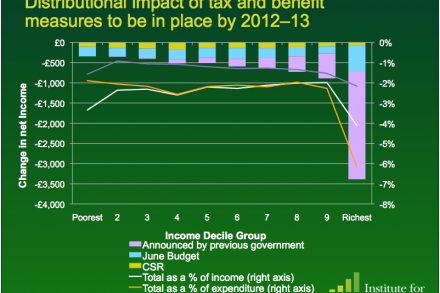
The second half of the IFS briefing was all about the distributional effect of the Spending Review. And you know what that means: decile charts – and lots and lots of them. As it happens, there were some areas of agreement between the IFS and the Treasury figures. Both, for instance, say that the welfare measures set out in yesterday's Spending Review will affect the least well-off the most. But there was one main area of disagreement. The Treasury says that its combined tax and welfare measures up to 2012-13 will be broadly progressive. The IFS says that they will be regressive. This is exactly the same issue that cropped up in August, when the IFS was commissioned to write a report by the End Child Poverty Campaign.

The ‘progressive’ debate re-opens

Busy times indeed for the numbercrunchers and policy wonks. I'm at what is, in effect, the Institute for Fiscal Studies' third post-Budget briefing of the year: one for Darling's final Budget, one for the Emergency Budget and one, now, for the Spending Review. We're half-way through, but we've already been served a hefty chunk of meat: the IFS's analysis of what yesterday's Spending Review meant for public spending and for welfare. So far, there are mixed tidings for the coalition. The IFS's acting director Carl Emmerson - who is filling in now that Robert Chote has departed for the OBR - set the tone with his opening remarks. "By 2015," he pointed out, "departmental spending will be lower under this government than it would have been under Labour".

The chart that could cause trouble for the coalition

Just as they did in the Budget, the coalition have produced a chart showing the impact of the Spending Review's tax, spend and benefit measures on different income groups (see above). In many respects, this is a noble effort: it's a good deal more transparency than Gordon Brown could ever manage in his Budgets. But it also sets a trap for the coalition. As we've pointed out before, these kinds of analyses don't account for measures that can't be quantified in terms of the money handed out to, or taken away from, the public. So policies that might improve the life chances of the least well-off, such as better schools or benefit reform, don't get a look in.