Peter Hoskin

Labour’s striking attack

Quite some claim from Ed Balls, writing in the Sunday Mirror today. "Let's be clear what George Osborne's game is," he blusters, "he's trying to pick a fight about pensions, provoke strikes and persuade the public to blame the stalling economy on the unions." And it is a charge that Andy Burnham repeated on Dermot Murnaghan's Sky show earlier. I was on live-tweeting duty, and lost count of how many times the shadow education secretary used phrases such as "provocation," "confrontation," "playing politics," and "back to the 1980s." This, clearly, is an attack that Labour are determined to push as relentlessly as possible. George Osborne is politicking, they are saying, at the nation's expense. It is, at the very least, an intriguing gambit on Labour's part.

Gove keeps on going

My gosh, Michael Gove is hyperactive at the moment. From his interview with James in the latest issue of the Spectator, to his recent announcements about failing primary schools and secondary school standards, this is a man who just cannot stop. So stop he doesn't. The Secretary of State for education is delivering yet another speech on Monday. And he has another interview (£), with Rachel Sylvester and Alice Thomson, in today's Times. The Times interview, if you can vault across the paywall, is a worthwhile read.

From the archives: Ed Miliband, before the leadership

It has been a turbulent, ol' week for Ed Miliband — all the way from those Ed Balls files, through his most substantial speech so far, to that bruising Twitter appearance. By way of putting a full-stop to it all, here's an interview that our deputy editor, Mary Wakefield, conducted with him in 2007. This is MiliMinor, aged 37, and relatively carefree:  The charm of Ed Miliband, Mary Wakefield, The Spectator, 2 June 2007 Sitting opposite Ed Miliband MP in a large and airy office, the sort of office that befits the Minister for the Third Sector, I suddenly have the surreal impression that I’m at the doctor’s. It’s the medicinal green of the carpet but, more than that, it’s Ed’s demeanour.

Don’t dismiss Davies out of hand

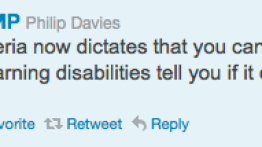
Touchpaper, meet match. That's the explosive situation engendered by Tory MP Philip Davies and his comments about disabled people this afternoon. His suggestion, made in the Commons, was that disabled people could work for less than the national minimum wage. And his justification? That the minimum wage "prevents those people from being given the opportunity to get to the first rung on the employment ladder." Charities such as Mind have since lambasted Davies for even broaching such a thing. The phrase "nasty party" is gushing around Twitter with tidal abandon. But before we pile on, it's worth noting that Davies has identified an issue that is more shades of grey than black-and-white.

Greece on the precipice

Europe is a doom-monger's paradise at the moment. Riots in Greece; summary Cabinet reshuffles; meetings between Merkel and Sarkozy to save the single currency — and there's still the potential for things to get worse, much worse. If the Greek government defaults on its debts, then there's no knowing where the contagion will spread, only that it it will spread wide: from Spain and Portugal to markets across the world. Share indices have already been trembling at the prospect, although many of them rallied slightly today. One consolation, however scant, is that all this crystallises just what can happen to governments who operate beyond their means.

Alexander’s not for turning

After the vacillations of recent days, the government could do with a show of hardheadedness — and Danny Alexander is delivering just that today. He is announcing the government's plans for public sector pension reform later, and they're exactly the sort of plans that will set the union bosses frothing: an increase in the public sector retirement age to 66, an increase in contributions, that sort of thing. But the Chief Secretary to the Treasury is unapolgetic. In an article for the Telegraph, he effectively says that this is a take-it-or-leave-it offer for the public sector. "It may be that those who oppose change think they can force the Government to change its mind," he writes, with his pen pointed accusingly at the unions planning strikes for next month.

Will Pakistan’s politics help al-Qaeda’s new leader?

Just as any major employer would, al-Qaeda released a statement earlier to confirm the identity of its new boss. "Sheikh Dr Ayman al-Zawahiri, may God guide him," it read, "assumed responsibility as the group's amir." And just in case you were wondering whether the organisation's attitude would change with its leadership, it added: "We ask God for this to be a new era for al-Qaeda under the leadership of Ayman Al-Zawahiri, an era that will purify Muslim land of every tyrant and infidel." Which is to say: new leader, same danger. The appointment of Zawahiri comes as little surprise, even if there has been talk of divide and dissent within al-Qaeda over the succession.

Milburn withdraws the Blairite seal of approval

Alan Milburn's article for the Telegraph this morning is a rhetorical blitzkreig against the coalition and their NHS reforms. From its opening shot that "The Government health reforms are the biggest car crash in NHS history," to its closing call for Labour to "restake its claim to be the party of progressive, radical reform," it is searing stuff. And no-one is spared, least of all Andrew Lansley and his "foolish bout of policy-wonking". Such fierce language is unusual, even by the standards of cross-party rough 'n' tumble. What makes it extraordinary is that Milburn is employed by the government to work on their social mobility agenda. The coalition's last report on the matter even expanded and prolonged his role.

Ed Miliband volunteers for a kicking, gets kicked

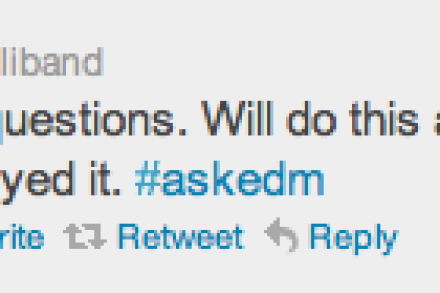
"First he denies his own policy, then he tries insults." So said Ed Miliband of David Cameron's performance in PMQs today. But I wonder what he'd say of the hundreds of Twitter users who went straight for the insults in a special Q&A with the Labour leader earlier. Urged on by Guido, plenty deployed the #AskEdM hash-tag to be rather unkind to MiliMinor. Here's a selection of some of the crueller, funnier and less comradely tweets: @MTPT: If a train leaves Paddington at 1136, carrying 200 commuters, what time will the RMT bring it to a standstill? @FelicityParkes: Where did Ed Balls touch you? Show us on the doll. @MShapland: hows your brother @Charlesm186: how many knives did you put in Tony Blair's back? @alexmassie: Was Brutus an honourable man? Discuss.

Miliband and the past

Labour's simmering resentments and self-doubts have been boiling over recently — and today is no different. Compare and contrast The Sun's interview with Tony Blair with Andrew Grice's article on Ed Balls in the Independent. For Blair, Labour ought to be claiming more credit for their preparatory role in some of the coalition's reforms, such as the Academies programme. For Balls, they ought instead to be dodging blame for the state of the public finances. As Grice reports, "Ed Balls has rejected demands from allies of Ed Miliband that he admit Labour spent too much when they were in power." From the rest of the piece, the shadow chancellor's position sounds rather like that of John Wayne's Captain Nathan Brittles: "Never apologise.

PMQs live blog | 15 June 2011

VERDICT: The specifics of today's exchange between David Cameron and Ed Miliband may have everyone rushing for this Macmillan press release, but the rhetorical positions were clear enough. There was the Labour leader, angrier and more indignant than usual, painting the government's welfare reforms as cruel and insufficiently thought-through. And there was the PM, painting his opponent as yet another roadblock to reform. Neither really triumphed, although their battle will most likely set a template for in future. The coalition has extensive public backing for its changes to the welfare system. So, Miliband's challenge is to attack certain aspects of them, without making Labour appear to be — as he put it on Monday — "the party of those ripping off our society".

Osborne comes to a decision on the banks — but the story doesn’t end there

In his speech to Mansion House last year, George Osborne asked a question of his frosted and cumberbunded audience: "Should we restrict or split the activities of banks?" In his speech tonight, he looks set to deliver an answer of his own. As Robert Peston reports, the Chancellor is to announce that the investment and retail arms of banks will be ringfenced off from each other, so that the dice rolls of the Masters of the Universe cannot tumble across everyday savers' cash. This does not mean a complete, Glass-Steagall-style separation between the two halves.

Miliband borrows from the Cameroons for his most substantial speech so far

Thematically speaking, there wasn't too much in Ed Miliband's speech that we haven't heard before. The middle is still squeezed, the Tories are still undermining the "Promise of Britain", the bankers are still taking us for fools, and communities still need to be rebuilt. Even his remarks about benefit dependency bear comparion to those he made in February. But there was a difference here, and that was his punchiness. The Labour leader may not be the most freewheelin' orator in town, but the text he delivered was less wonky than usual, more coherent and spikier. It was even — in parts — memorable. You do wonder whether Miliband has learnt from the Cameroons. Much will be made of how his speech relied on the Blue Labour stylings of Maurice Glasman.

Balls bites back (with mixed success)

You certainly can't fault Ed Balls for chutzpah. After the weekend he has just experienced, the shadow chancellor has an article in today's Mirror accusing George Osborne of "spinning out of control". It is pure, triple-distilled Balls: a fiery attack on both his political opponents and their policies. So let's sup deep and read the whole thing, alongside my comments: THIS is the most exciting Formula 1 season for decades. Because it is not just about who has got the fastest car – it’s about race strategy, overtaking and adapting to the changing conditions. You can be the fastest driver on the track for 40 laps – but that’s no use if, by ignoring advice, you spin-off in the rain or run out of fuel.

The day of the Lib Dem’s greatest ever triumph

Or so they will try to claim. For today is the day when Steve Field, the GP doing the listening part of the NHS listening exercise, will release his report into the government's reforms. Judging from the convulsions of the grapvine, his recommendations will go something like this: more involvement for nurses and local officials, less private sector involvement and competitiveness, and a more relaxed timescale for introducing the changes. Although there are questions of degree hidden in that checklist, it is enough to have the Lib Dems heralding their "victory" for now. Paddy Ashdown was tapdancing across the airwaves yesterday, saying that Nick Clegg had "played a blinder". "Am I celebrating today?" he added, "Yes, I am, and I think the Liberal Democrats will be as well.

Labour’s blunt knives

According to the Observer, and a slew of other papers, "senior Labour figures are believed to have put their leader on a timer to 'up his game' in the next few months if he is to avoid a full-blown leadership crisis later this year." Which reminded me of all this: 20 April, 2008 "The Prime Minister, who is battling a growing rebellion over his abolition of the 10p tax rate, has been given until the end of the summer to turn things round by backbenchers angry at a string of image and policy failures." (here) 24 May, 2008 "It is that Mr Brown be given until the end of July to prove himself and restore morale.

Your three-point guide to today’s Ed Balls files

Less soap opera, and more policy grit, in today's batch of Ed Balls files. There is, for instance, a lot on Gordon Brown's proposed Bill of Rights (here, here, here and here), which is as ambrosia for future political historians, but is fairly turgid reading even for today's political anoraks. Likewise the charts and doodlings related to the structure of Brown's Downing Street. Yet some things do stand out. Here are a few of them: i) What the Treasury says, Brown didn't do. You've got to admire the Treasury's attempt to inject some realism into the fiscal calculus back in 2006. "Flat real" spending — i.e. public spending that rises only in line with inflation, and not more — will be the "rule rather the exception" in the years to come, they say.

The welfare revolution will require much time and effort

Forget Balls, today brings one of the most significant moments in the life of the coalition so far: the launch of its Work Programme. The name may be commonplace but, as Fraser suggested earlier, the policy is revolutionary. Over the next year, around one million unemployed people will be enrolled on work schemes run by private companies and charities. Those companies will then be paid between £4,000 and £13,700 for every person they return to proper, long-term work. It is, evidence suggests, an effective and cost-effective way of getting benefit claimants back into the labour market — and it reaches those claimants that the state-run JobCentres can scarcely be bothered to reach.

Your five-point guide to the Ed Balls files

Intrigue, hilarious intrigue this morning, as the Telegraph releases a bunch of documents that clarify just how far the Brownites went to oust Tony Blair. They are, it is said, from the personal files of Ed Balls, and they are copious in both quantity and variety. From straightforward poll results to 31-page reports on how Brown is a Volvo not a BMW, this is a real insight into the numerous pathologies of party and government. Here's my five-point overview: i) The leadership coup in waiting. It starts only two months after the 2005 general election, and Balls' own ascent to Parliament, with a memo setting out the structure of Brown's leadership campaign team. And it soon crescendos.