Patrick West

Patrick West is a columnist for Spiked and author of Get Over Yourself: Nietzsche For Our Times (Societas, 2017)

Who cares if Britain’s Eurovision entry has German lyrics?

What with the prospect of further resets with the European Union, and with British culture seemingly in a constant battle with those who would degrade and debase it, it’s easy to understand why some people are oversensitive to perceived threats to this country’s independence and integrity. Alas, sometimes this touchiness descends into out-and-out paranoia. Eurovision has long since descended into a tacky, hyper-camp circus act The flustered reaction to the news that this year's UK Eurovision entry is partly sung in German is a case in point. Following the disclosure that the song, Eins, Zwei, Drei, by Look Mum No Computer, not only has a chorus in a foreign language, but has lyrics which appear to disparage British culture – ‘Counting in English doesn't cut the mustard.

The real reason Greens are gaining ground

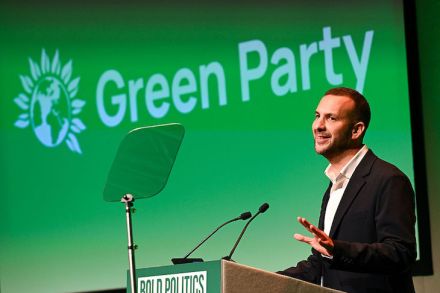
It was only a matter of time before an ultra-progressive, hard-left party with a fondness for voguish identity politics, enthusiasm for multiculturalism and morbid obsession with Israel came to preeminence in this country. This inevitability is the consequence of a demographic time-bomb just waiting to make its effects known. It’s no surprise that the Greens offer hope to that portion of a generation As a YouGov survey has revealed this week, the Green Party has now overtaken both Labour and the Conservatives to take second place in the polls, two points behind Reform UK. Their support now stands at 21 per cent, up four points in the week since their historic win in the Gorton and Denton by-election.

Were fans wrong to boo the Ramadan fast-breaking footballers?

So much of what is commonly understood to mean multiculturalism has in truth been class warfare by other means. A great deal of it has entailed affluent, white middle-class types telling the white working-class that their culture and values are of unexceptional or lesser worth. Much state-sanctioned multiculturalism has been an exercise in scolding the proletariat for being unenlightened, denouncing them as bigots and racists when their behaviour fails to fall into line with modern, cosmopolitan, metropolitan mores.

‘Family voting’ allegations cannot be ignored

If allegations of ‘family voting’ taking place at Thursday’s Gorton and Denton by-election prove substantiated, the incidents will not only mark a grave infraction of the law, they will give further weight to the fear that this country is becoming perilously fragmented, terminally Balkanised and mired in sectarianism. Polling had scarcely closed when, a few minutes after 10 p.m., Sam Coates of Sky News posted on X intelligence related to him by a team from Democracy Volunteers, a group of voluntary election observers, in which they claimed to have witnessed a total of 32 cases of family voting in 15 of the 22 polling stations in the constituency.

What Esther Rantzen needs to know about ‘religious people’

In politics, there has always been an assumption held by atheists, humanists and many liberals in general that those of a modern, secular persuasion act with autonomy and reason because they are unencumbered by religious belief. They believe themselves in possession of an intellect that needs no external crutch or sanction. While this enables them to achieve objective detachment, those who cling to religion can never attain such a refined plateau of enlightenment: their convictions are indelibly shaped and clouded by religious dogma.

How Britain learnt to turn a blind eye to shariah

The more excitable and less well-educated elements of the liberal left are forever apt to observe that politics today resemble those of the 1930s, being prone to denounce a development or policy they disdain as being ‘just like Nazi Germany’. To be fair, they have a point. It’s not just the street brawls we’ve seen in Manchester and Lyon over the last week, between hard left and hard right youths, that should arouse such unnerving comparisons. It’s also because we are living in an age of appeasement. And this time it’s the liberal left who are doing the appeasing. This was a textbook case of appeasement: not a tactical retreat to be dismissed as a one-off, but an action consistent with a sustained process of surrender This trend continues to make itself more obvious.

What Louis Theroux’s Netflix show won’t tell you about the ‘Manosphere’

There once was a time when you couldn’t move for some progressive voice complaining in superior tones about the latest ‘moral panic’ bestriding the country, stoked in their imagination by right-wing neurotics fearful that Britain was going to the dogs. Whether it be concerns related to pornography, video nasties, Mary Whitehouse’s latest campaign to clean up television, or Mods and Rockers fighting on the beaches, liberals were forever fond of dismissing such worries as reactionary, risible nonsense. It’s widely assumed that there is a problem with men today. Yet that’s not the underlying issue You don’t hear the phrase ‘moral panic’ much these days. That’s not surprising.

Would you be friends with a Reform voter?

Most of us have had disagreements with friends over politics at some point in our lives. Or worse. One of the constant threats to friendships is that such differences could one day spill over into acrimony or result in a full-blown falling-out. In my youth, the election night parties held by my parents seldom ended without raised voices and tearful eruptions – aided, admittedly, by the vast consumption of alcohol – and who could forget the divisions and severed friendships occasioned by the EU referendum in 2016?  At least most folk above a certain age have been able to establish and sustain friendships with those of contrasting political persuasions. The same can’t be said for Gen Z.

Why Gen Z is troubled by Jesus

Many teenagers today find Christianity off-putting because Jesus seems too fond of ‘mansplaining’. He appears to have a ‘God complex’, while the Almighty is alienating on account of being ‘really violent and aggressive’. These are the findings in the report Troubling Jesus, the third part of Youthscape’s ‘Translating God’ project, based on a recent survey of 14- to 17-year-olds. Drawing on five reading groups, in which teenagers reacted to passages of scripture traditionally understood as conveying ‘good news’, Youthscape faced reactions ‘radically different’ from what it says might have been expected. While Jesus was not only seen as a condescending male chauvinist and God the Father as a bully, many youths discerned other issues in the readings.

The British countryside isn’t racist

In the fevered imagination of those obsessed with implementing ever greater ‘diversity’, there is seemingly no object or aspect of life they won’t seek to change at all costs. Thus it’s no surprise to hear that the latest target of opprobrium is the British countryside itself. It epitomises the blundering ignorance of the global, Anywhere class who have been in charge for too long Following a Defra report in 2019 that revealed that some saw the countryside as 'being for white people and middle-class people', officials have spent the last few years working on changing that – by making the great outdoors more welcoming to ethnic minorities. National Landscapes, a charity mostly funded by Defra, has been busy overseeing the diversity drive.

Woke language obviously doesn’t change the way we think

From our US edition

It’s been a cherished belief of progressives over the decades that you change the way we think, and in turn transform society, by changing the kind of language we use. This stretches back to a 1980s strand of feminism determined to jettison default masculine terms such as "chairman" and "headmaster" and replace them with gender-neutral equivalents. Then there are today’s hyper-liberals, who believe they can erase binary thinking on sex by introducing expressions such as "pregnant people" or forgo "he" and "she" altogether and substitute everywhere with "they." Many radicals have imagined that linguistic revolution is essential to actual revolution. Unfortunately for these idealists, new research suggests that their faith has been misplaced.

language

Woke language obviously doesn’t change the way we think

It’s been a cherished belief of progressives over the decades that you change the way we think, and in turn transform society, by changing the kind of language we use. This stretches back to a 1980s strand of feminism determined to jettison default masculine terms such as ‘chairman’ and ‘headmaster’ and replace them with gender-neutral equivalents. Then there are today’s hyper-liberals, who believe they can erase binary thinking on sex by introducing expressions such as ‘pregnant people’ or forgo ‘he’ and ‘she’ altogether and substitute everywhere with ‘they’. Many radicals have imagined that linguistic revolution is essential to actual revolution. Unfortunately for these idealists, new research suggests that their faith has been misplaced.

Stop shoehorning diversity into BBC dramas

At last, the BBC has been forced to admit what even the dogs on the street know to be true: that the corporation is guilty of ‘shoehorning’ diversity into its television drama output, in series such as Shetland and This Town, and making them feel ‘preachy’ and ‘inauthentic’ as a consequence. Productions which distort history deliberately and cynically are even more exasperating A large swathe of the viewing public believe that the BBC tries too hard to represent diverse groups in its drama, according to a report commissioned by executives, involving a survey of 4,500 adults.

Labour is the nasty party now

Labour has long prided itself on being the party of compassion. Indeed, ever since Thatcherism, personified in the minds of many by the fictional television character Alan B’Stard – and ever since Theresa May gave her 2002 speech admitting that the Conservatives were the ‘nasty party’ – being compassionate has been a trademark and a selling point of the Labour party. Labour politicians constantly bleat about how caring they are. Sometimes it seems that the only people they care about are themselves This is why those who lead it are always reluctant to cut welfare spending, and why those further to the left on its parliamentary backbenches are ideologically hostile to it.

Will the new Mock the Week actually be funny?

Heaven knows we could all do with a laugh right now, what with 2026 having begun in such an inauspicious manner, with tumult abroad and a stream of grim headlines at home. It would be a relief to be able to make light of it all, and to skewer the powers that be with a wry and irreverent take on the news. While the show was in its early years a reliably spirited and raucous affair it lost much of its edge over time. It became partisan and repetitive, obsessed by Nigel Farage, forever deploring the imbecility of Brexiteers and making tiresome jokes about the Daily Mail It’s therefore timely to read, following an absence of more than three years, that Mock the Week is making a comeback.

Why are teachers so obsessed with the ‘far right’?

Much has been written in recent years, and even recent days, about the threat posed to the mental wellbeing of children by malign external forces, whether it be X generating nude images of women, the misogyny spread by influencers such as Andrew Tate, or the welter of ‘misinformation’ available online. But a story at the weekend reminds us of one of the most formidable actors in this department, one that continues to warp and taint young minds: our education system. This constant drip of revelations and pronouncements merely reflects the dismal state of our education system A state-funded computer game, developed with government backing by councils in East Yorkshire, reminds teenagers they risk being referred to a counter-terrorism programme if they question mass migration.

Cadavers will always captivate. Museums need to chill out

Is it right to put human remains on show? It’s a question that museum curators and the public have been asking themselves ever since European institutions began displaying bodies of the dead – notably Egyptian mummies – in the early 19th century. It’s the same question that continues to be posed today in Canterbury. Here, an exhibition at the Beaney House of Art & Knowledge chronicles and collates the significant archaeological discoveries in and around the city over recent decades. Finds that have unearthed skeletons of the city’s previous occupants – mostly Anglo-Saxon nobility and Roman soldiers and civilians from the 2nd and 3rd century AD. The question remains the same: what to do with these remains?

Woke isn’t dead – and here’s the proof

In one respect, the scaremongers are right: Racism is alive and well in this country, being imbedded in our institutions and abetted by the arms of the state. But this scourge manifests itself not in the hackneyed and often illusionary variety forever invoked by the liberal-left. This is the benevolent, ‘nice’ form of racial discrimination, one which bizarrely presents itself as an extension of anti-racism. Those with a morbid fascination with skin colour are being actively encouraged in their hobby Race obsessives not only remain a real presence, but those with a morbid fascination with skin colour are being actively encouraged in their hobby. Taxpayers are now funding a music festival which bans white people from its leadership.

Reform and the real populist threat

We’re scarcely into the new year and already luminaries on the liberal left have resumed one of their favourite pastimes: issuing alarmist forebodings about the threat posed by populism, and imploring everyone that Reform UK must be stopped.

Iron Maiden at 50: how heavy metal became mainstream

The death of the Black Sabbath singer Ozzy Osbourne this July, and the huge reaction it provoked worldwide, represented something of a landmark to us heavy metal fans. After decades of having been shunned, scorned and ridiculed, this genre had not only become acceptable, but the passing of the frontman of heavy metal’s founding fathers became an occasion for national mourning. How different it had been in the 1980s. In that decade, heavy metal was deemed a form of music made by morons, for morons. And the undisputed kings of the genre in that decade were Iron Maiden. They were certainly my favourite band at the tail end of that decade – I first saw them live in concert at Wembley Arena in 1990. But I was an outlier. Being a rare metaller aged 15 wasn’t much fun.