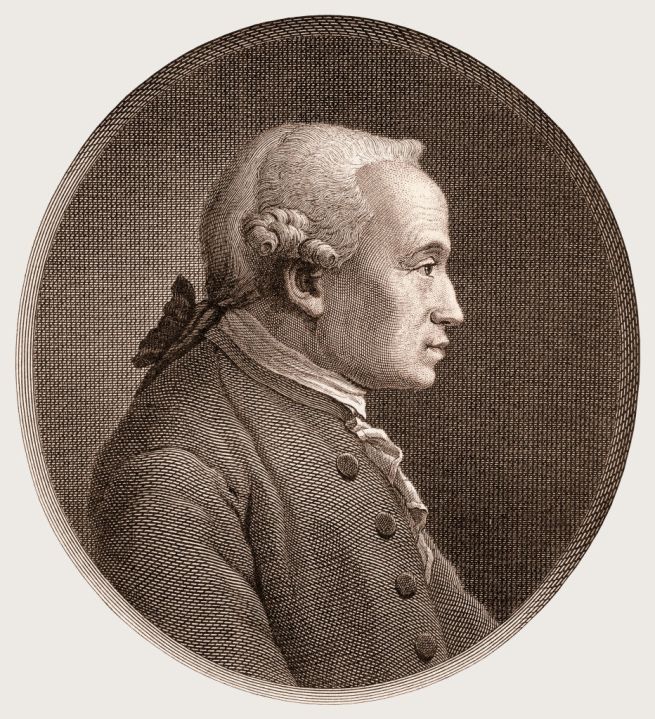
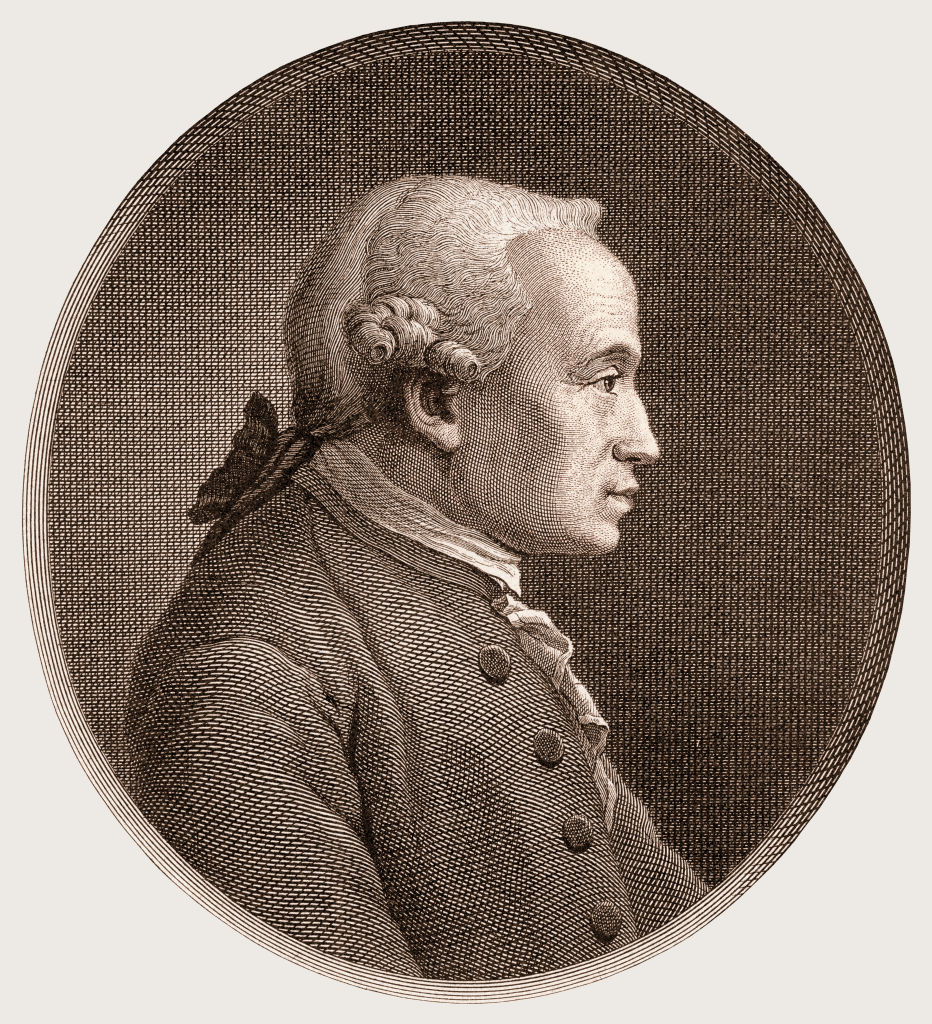
Immanuel Kant, who was born on 22 April 1722, is perhaps best known for two things: writing The Critique of Pure Reason (1781) – one of the most important and most difficult books in Western philosophy, and for being a man of such clinical regularity that the residents of his native Königsberg in East Prussia (present-day Kaliningrad) would set their watches according to the unvarying trajectory of his daily walks. Yet these two facts have helped to nurture a not entirely warm image of the man, leaving the impression that he was something of a cold fish.
As is often the case, the man who appears to us in print and the man who was known to friends and intimates were somewhat at odds. By all accounts, Kant was a warm and engaging character, whose forbidding writings even occasionally reveal flashes of humility and whose lectures were renowned for their wit and humour.
Kant and Green were united by a similar disposition – a love of regularity and self-discipline
Nowhere was this more conspicuous than in his long-standing attachment to and affection for an Englishman named Joseph Green. Such was Green’s personal and intellectual sway on the philosopher that some contend that he should be given credit as a collaborator on The Critique of Pure Reason.
Born in Kingston-upon-Hull in 1727, Joseph Green came to Königsberg, then a Baltic trading port, as a young merchant, where he traded in grain, herrings, coal and manufactured goods. Yet he was also a keen polymath, taking a keen interest in the latest geopolitical developments of the day and reading up on the latest developments in philosophy, particularly those expounded by David Hume and John-Jacques Rousseau.
Green and Kant mixed in the same learned circles, and they first met in the summer of 1765, during the time of the first stirrings of revolt in Britain’s North American colonies. The two happened upon each other in a public garden during a discussion on the matter. A fierce debate ensued, with Kant taking the side of the Americans and Green that of the British. Yet so ultimately impressed was Green by Kant’s argumentative powers and facility for logic that he was determined to pursue an acquaintance with the thinker, at that time a lecturer at Königsberg University.

By the following year, the two had become firm friends. Kant was now a constant visitor at Green’s house, eventually taking his main meal of the day, every day, with his English friend. They were united not only by a similar disposition – a love of regularity, self-discipline, enthusiasm for open enquiry – but by their common interest in the writings of Rousseau and especially Hume. Most famously, it was the latter’s sceptical empiricism and denial of causality which awakened Kant from his ‘dogmatic slumber’ and prompted him to write his Critique of Pure Reason.
If that masterpiece could not have happened without the great Scot, neither could its first edition have arrived in its finished form without this unassuming Englishman. According to Kant’s friend and authorised biographer, Reinhold Bernhard Jachmann, in Green, ‘Kant found so much nourishment for his intellect and his heart’ that he discussed the Critique of Pure Reason page by page with him prior to its publication. Writing of Jachmann’s claim in his 2001 biography of the philosopher, Manfred Kuehn concludes:
If this is true, and there is no reason to doubt it, then Kant’s Critique is not so much the work of a solitary and isolated thinker as the product of a collaborative effort.
While the ideas and the idiosyncratic system of twelve arbitrating, inbuilt mental ‘categories’ which interpret knowledge derived from experience were Kant’s, we may reasonably speculate on Green’s considerable influence – his erudition and common touch. There are, for instance, many phrases and idioms borrowed from the language of merchants in the book, such as ‘borrowing’ and ‘capital’, and Kuehn also observes that Kant’s later books written without Green’s help are more difficult to read.
If we are to regard Green as Kant’s collaborator, perhaps we need to rethink our entire impression of the philosopher. Certainly, the story of the burghers of Königsberg setting their timepieces by his movements seems to be unfounded. While Kant did stick to a constant routine, especially in later years, it was the punctilious Green whom their mutual friend Theodor Gottlieb Hippel caricatured as ‘The Man Who Lived by the Clock’ in a comedy of that name – the play which gave birth to the legend.
Green’s death in 1786 came as a bitter blow. Now deprived of his daily meetings with his companion, Kant began to organise instead his own ‘at-home’ luncheons with a rotating roster of guests. Yet even six years after Green’s death, Kant could still write of his lost and lamented ‘best friend’. As Jachmann put it in 1804, the year the philosopher died: ‘The nearest and most intimate friend that Kant had in his life, was the English merchant Green.’






Comments