Michael Simmons

Michael Simmons

Michael Simmons is The Spectator's economics editor. Contact him here.

Harry Cole, Zoe Strimpel, Michael Simmons, Nigel Warburton and Justin Marozzi

30 min listen

On this week’s Spectator Out Loud: Having returned from Washington D.C., Harry Cole reads his diary for the week (1:16); Zoe Strimpel reports on the Gen Z fliers obsessed with maximalising their air miles (5:37); Michael Simmons argues that Scotland is the worst when it comes to government waste (12:00); reviewing Quentin Skinner’s Liberty as Independence, Nigel Warburton examines what it means to be free (17:45); and, Justin Marozzi provides his notes on possum (25:02).  Produced and presented by Patrick Gibbons.

How the SNP wasted £110 million on PR and spin

No country in the UK receives more public money per head than Scotland. An extra £2,200 is spent on every person living there than in England – and £1,900 more than the UK average. Yet public services north of the border are falling apart. Take education. Scotland spends more per pupil than anywhere else – £1,848 per head compared with £1,543 in England. Yet standards have plummeted while those in England have improved. The latest Pisa rankings show Scottish pupils to be a year behind their English counterparts, despite a testing bias in favour of Scottish children. When it comes to economic affairs, some £2,228 per head is spent on growth initiatives, welfare and subsidy in Scotland, compared with £1,805 in England.

Trump announces 25 per cent tariffs on Canada and Mexico

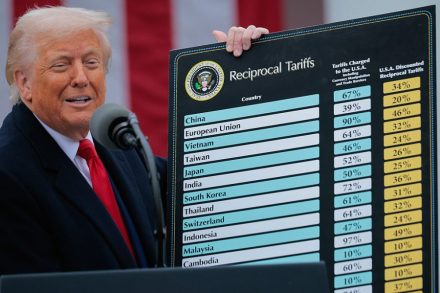
‘He was bad on trade, very bad on trade,’ said Donald Trump ‘with due respect’ to Ronald Reagan in a broadcast from the White House. As the President went on, the Fox News coverage included a ‘Dow Watch’ ticker, which showed the markets in freefall. Trump was speaking to confirm that 25 per cent tariffs would be imposed at midnight on Tuesday on Canada and Mexico, with an additional 10 per cent tariff for China (which has already had 10 per cent tariffs imposed). This means new barriers for America’s three largest trading partners. ‘The tariffs, you know, they’re all set. They go into effect tomorrow,’ Trump said. In response to the tariffs announcement – which markets do not seem to have fully priced in – the Nasdaq Composite fell 2.

The problem of Britain’s idle generation

The number of young people not doing anything with their lives has hit its highest level in 11 years. Figures released this morning by the Office for National Statistics (ONS) on 16- to 24-year-olds not in education, employment or training – so-called NEETs – show that the number has reached just under one million in the last three months of 2024. Standing at 987,000, the number of NEETs is up by 110,000 since the end of 2023 – equivalent to a town the size of Oldham. The new data means that nearly one in seven Britons aged 16 to 24 are not in education, employment or training. The figures are worse for young men than for women (14.4 per cent vs 12.3 per cent); however, ONS statisticians said the increase in the last 12 months came from men and women equally.

The energy price cap rise heaps more misery on Brits

Average gas and electricity bills will rise by £111 a year in April after the regulator Ofgem announced an increase to the energy price cap. The 6.4 per cent hike means the average dual-fuel household bill will hit £1,849 annually. The rise is more than anticipated, with analysts at Cornwall Insight predicting that bills would rise by just 5 per cent in April. Ofgem blamed inflation and ‘rising global wholesale prices’ for the bigger-than-expected increase. As a result, the cap will be £159 (nearly 10 per cent) higher than for the April to June period last year. The rise in energy prices is why the Bank of England recently forecast inflation to return to nearly 4 per cent this summer. As Kate Andrews reported last week, inflation in January rose to 3 per cent, up from 2.

Edinburgh has a snobbery problem – against the English

When I was at Edinburgh University a decade ago, a girl with a thick Surrey accent stopped me as I walked back to my room in halls. ‘Rah, have you been to the reeling society?’ she asked. ‘What makes you think that?’ I replied. ‘You’ve acquired a slight limp.’ ‘It’s the cerebral palsy, luv.’ They’re very forward, these English, I thought. Last week, Peter Mathieson, principal of the University of Edinburgh, claimed that Scots students were facing snobbery from the English. An alumnus, Dr Neil Milliken, had asked what Edinburgh was doing about ‘racial discrimination and class ridicule by self-perceived superior English incomes against native students’. He sounds jolly.

Hugh Schofield, Igor Toronyi-Lalic & Michael Simmons, Lisa Haseldine, Alice Loxton and Aidan Hartley

37 min listen

On this week’s Spectator Out Loud: Hugh Schofield asks why there is no campaign to free the novelist Boualem Sansal (1:26); The Spectator’s arts editor, Igor Toronyi-Lalic, reacts to the magazine’s campaign against frivolous funding and, continuing the campaign, Michael Simmons wonders if Britain is funding organisations that wish us harm (8:00); Lisa Haseldine reflects on whether the AfD’s rise could mean ‘Weimar 2.0’ for Germany (17:08); reviewing Thou Savage Woman: Female Killers in Early Modern Britain, by Blessin Adams, Alice Loxton explores the gruesome ways in which women killed (25:05); and, from Kenya, Aidan Hartley reflects on how a secret half-brother impacted his relationship with his father (35:13).  Produced and presented by Patrick Gibbons.

Has Rachel Reeves broken her fiscal rules?

Rachel Reeves is having to borrow more money than even the worst estimates expected. Figures on the public finances, published this morning by the Office for National Statistics (ONS), show that in the financial year to January we borrowed over £118 billion. This is £11.6 billion more than at the same point in the last financial year and is the fourth highest borrowing period since comparable records began in 1993. The Office for Budget Responsibility (OBR) had expected borrowing to be some £13 billion lower by this point in the year. This news puts even more pressure on the Chancellor who, reports now suggest, has blown her fiscal headroom and failed to stick to her fiscal rules.

Is Britain funding organisations that wish us harm?

Frivolous state funding isn’t only going to chancers, the plain lucky and the devious, but also to those who would see Britain – and the West – come to harm. Just over a year ago, the National Secular Society (NSS) compiled a dossier for the Charity Commission which called for 44 charities that had ‘fuelled anti-Semitism and division’ and shown support for ‘Hamas and other anti-western actors’ to be investigated. In every case these organisations have kept their charitable status. The charities in the dossier have the stated purpose of ‘the advancement of religion for the public benefit’. In the NSS’s view, this is being used as cover for political agendas and extremist views – while the groups receive tax breaks and state funding.

Strong pay growth will alarm the Bank of England

Britain’s workers have experienced strong pay increases for the third month in a row. Figures on the jobs market, just released by the Office for National Statistics (ONS), reveal that pay rose 6 per cent in the final three months of 2024 – the fastest pace of pay growth in over a year. Strip out inflation, and the average worker saw a 2.5 per cent pay increase – the highest real terms pay rise for three years. While more money in pockets is obviously good news for the workforce, these figures will be ringing alarm bells at the Bank of England. The Bank’s interest rate setters see pay increases as an important indicator for inflation and give the jobs market figures great weight when deciding whether to pause rate cuts.

Britain’s bureaucratic bloat, debating surrogacy & is smoking ‘sexy’?

40 min listen

This week: The Spectator launches SPAFFThe civil service does one thing right, writes The Spectator’s data editor Michael Simmons: spaffing money away. The advent of Elon Musk’s DOGE in the US has inspired The Spectator to launch our own war on wasteful spending – the Spectator Project Against Frivolous Funding, or SPAFF. Examples of waste range from the comic to the tragic. The Department for Work and Pensions, Michael writes, ‘bought one Universal Credit claimant a £1,500 e-bike after he persuaded his MP it would help him find self-employment’. There’s money for a group trying to ‘decolonise’ pole dancing; for a ‘socially engaged’ practitioner to make a film about someone else getting an MBE; and for subscriptions to LinkedIn.

The Spectator’s war on government waste

11 min listen

It’s a double celebration for Rachel Reeves today. Not only is it her birthday, but the UK economy grew by 0.1 per cent in the last three months of 2024, according to the Office for National Statistics’ latest report. December, when the economy expanded by 0.4 per cent (the market consensus had been 0.1 per cent), was the saving grace. This helped tip the final quarter of 2024 onto the right side of positive growth. But it’s not all rosy for the Chancellor. This morning’s update won’t take anyone in the Treasury off high alert, and there has been a development in the story about her CV. The BBC has been looking into her expenses during her time at Halifax bank. The Chancellor’s response is that she had no knowledge that there was an investigation into wrongdoing.

How to stop the government splurging our cash

All too often, the Prime Minister recently lamented, Britain’s public servants are happy languishing in the ‘tepid bath of managed decline’. There is, however, one area in which Britain’s public servants are dynamic, innovative and world--leading: at spaffing gazillions of pounds of taxpayers’ money on wasteful projects which are variously inane, insane and indefensible. The British state makes the average drunken sailor look like a model of frugality. When William Gladstone was Chancellor of the Exchequer, he earned notoriety for his pursuit of ‘candle end’ economies – no saving was too trivial if he could leave money to ‘fructify in the pockets of the people’.

Reform tops Spectator poll tracker

Nigel Farage’s Reform party are now out in front at the top of The Spectator data hub’s poll tracker. The latest update to our poll of polls puts Reform one point above Labour – on average – at 25 per cent of the vote with the Tories in third place at 22 per cent.  A flurry of polls in the last couple of weeks show continued decline in support for the Tories with nearly all of the benefits going to Reform. Meanwhile, support has continued to slip away from the Labour party. The result: Reform on top.  The poll that tipped them over the top came from FindOutNow who surveyed some 2,487 British adults yesterday and gave Reform a four point lead.

Record Channel crossings expose Starmer’s failure to ‘smash the gangs’

More migrants have illegally crossed the English Channel since 1 January than in any previous year for this period. So far in 2025, 1,344 migrants were detected crossing the Channel in small boats between 1 January and 4 February, beating the previous record of 1,339 in 2022. The figures published by Border Force – and tracked daily by The Spectator’s data hub – put paid to Keir Starmer's promise to ‘smash the gangs’. A key part of Labour’s manifesto – and one of Starmer’s ‘first steps’ – was to ‘create a fair system and stop the small boat crossings’. Since Starmer took office last July, there have been 24,586 migrant crossings. The news comes despite storm Éowyn and dangerous conditions in the Channel in recent weeks.

Loyd Grossman, Tanya Gold, Harry Halem, Angus Colwell, Philippe Sands and Michael Simmons

45 min listen

On this week’s Spectator Out Loud: Loyd Grossman pleads to save Britain's cathedrals, as he reads his diary for the week (1:31); Unity Mitford is a classic case of aristocratic anti-Semitism says Tanya Gold (7:47); looking ahead to another Strategic Defence Review, Harry Halem warns that Britain is far from prepared for the era of AI warfare (12:42); 'the worst echo chamber is your own mind': Angus Colwell interviews philosopher Agnes Callard (24:24); reviewing Prosecuting the Powerful: War Crimes and the Battle for Justice, by Steve Crawshaw, Philippe Sands argues that while the international criminal justice system was prejudiced from the start the idea was right (31:01); and, Michael Simmons contradicts the Pope and declares that gossip is good for you (41:21).

Gossip is good for you… so I’m told

The Pope hates gossip. In his Christmas message to his Vatican advisers last year, Francis warned that it is ‘an evil that destroys social life’. It’s not the first time he’s attacked rumour-spreading. He once compared gossips to terrorists because ‘he or she throws a bomb and leaves’. The Holy Father’s condemnations are of particular concern for me because I was recently accused of being a ‘notorious gossip’. I vehemently reject the charge, of course, but if it were true, at least I’d be following a proud journalistic tradition. In fact, if it were not for gossip, this very magazine might not exist. The original Spectator’s founders, Joseph Addison and Richard Steele, filled the 1711 incarnation by hovering around coffee houses, picking up gossip for stories.

Is the UK prepared to welcome one million migrants a year?

One million people will migrate to the UK every year this decade. The result: the UK population will grow by nearly five million. Population projections, released by the Office for National Statistics (ONS) this morning, show Britain's population rising from an estimated 67.6 million now to 72.5 million in the middle of 2032 – driven almost entirely by migration.  Whilst the number of births and deaths will be roughly the same (6.8 million) in the next seven years, ONS statisticians estimate 10 million people will migrate to the UK with only five million due to leave. That will put net migration at 340,000 every year from the middle of 2028.  The figures pour petrol on the immigration debate that has come to the forefront since the start of the year.

How to outsmart DeepSeek

For nearly a decade, the Chinese Communist Party has censored Winnie the Pooh, owing to internet memes comparing the slightly rotund President Xi Jinping to the cheerful yellow bear. So, what happens if you ask China’s new budget AI chatbot, DeepSeek, about him? Computer says no. But how rigorous were DeepSeek’s creators?  When we asked our first question, DeepSeek began to answer – only for its censorship to activate, overwriting the reply with an anodyne attempt to change the subject. Early adopters, however, had discovered a loophole: by replacing certain letters with numbers (e.g., A with 4, E with 3), users could bypass some of the restrictions. Here’s what happened when we tried: Success! But could we go further?

Will Chinese AI get the Treasury off the hook?

The launch of the Chinese chatbot DeepSeek has caused turmoil in the markets. The release of China’s newest AI – which appears to work as effectively as programmes developed in the West – saw tech stocks plummet when the market opened today. It hasn’t helped that DeepSeek was made for $6 million: pennies compared to its competition. All assumptions about this technology – the required parts, the assumed costs – have fallen apart and investors are panicking over what was already a muddled future for the development of AI. But in the midst of market turmoil, there is always a degree of stability. As markets lose confidence in emerging tech products, they seek refuge in stable investments: that’s to say, they look to safe governments as an alternative for their investments.