Culture

Culture

The good, the bad and the ugly in books, exhibitions, cinema, TV, dance, music, podcasts and theatre.

Khovanskygate is about the dreadfulness and possible glory of being Russian

Opera

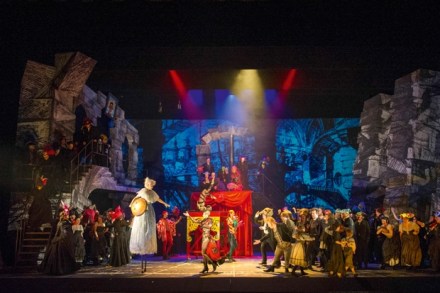
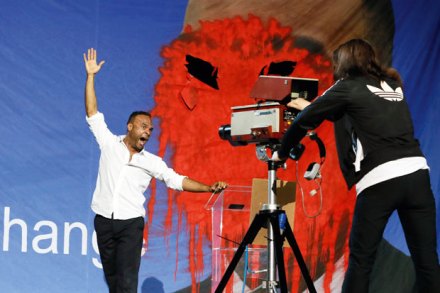
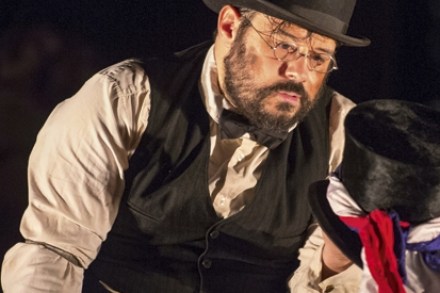
Within the space of a few weeks we have had the rare chance of seeing the two great torsos of Russian opera, Borodin’s Prince Igor, unfinished because the composer was often otherwise engaged, and Musorgsky’s Khovanshchina, unfinished because its composer died of drink. Prince Igor at the Coliseum was musically magnificent, and dramatically utterly absurd, ‘self-parody’ that did not do justice to its low-jinks. By contrast, Birmingham Opera Company’s Khovanskygate is musically at least as superb, and dramatically gripping though questionable. As is usual with BOC, the location is unorthodox, in this case an immense tent in the middle of Cannon Hill Park.

Britten’s worldwide reputation is enhanced in Lyon

Opera

One of the proudest boasts to come from Britten HQ in Aldeburgh during the composer’s anniversary last year was that performances of his works were proliferating across the globe — and not just in the UK — as never before. If the Opéra de Lyon might be a little late to the anniversary party in featuring Britten in its annual Eastertime opera festival only this year, the fact that it’s doing so at all certainly provides evidence of the composer’s worldwide reputation, as well as of the artistic adventurousness of Serge Dorny, reinstalled for the time being as the opera house’s boss after a short-lived stint at Dresden’s Semperoper came to an abrupt end in February.

Bryn Terfel lords it over ‘Faust’ magnificently

Opera

There’s a great deal to disapprove of in Gounod’s Faust. It breaks down a pillar of western literature and whisks up what remains into a flouncy French fancy. It turns the hero’s famous striving into mere lust — for a virginal heroine who is cursed by one and all (‘Marguerite! Sois maudite!’, runs the rather-too-catchy refrain), then saved, in a mawkish, tacked-on finale, by celestial powers. It has a ballet, set pieces, jolly choruses and all the unfashionable niceties that Parisian opera in the mid-19th century required.

Mixed results from the ENO and ROH in their seasonal away games

Opera

It’s been a spring tradition for several years now for English National Opera to present small-scale productions in various venues around London. But this year the Royal Opera followed suit, heading across the Thames to the new Sam Wanamaker Playhouse at Shakespeare’s Globe. Ahead of the announcement of its solid but mainly safe 2014–15 season, we also learned that the ROH will present Monteverdi’s L’Orfeo in English at the Roundhouse in Camden next year — a rather more blatant incursion into ENO territory. And if the company can take these small shows, which don’t even employ its orchestra, to NW1 and SE1, what’s to stop it taking them on tour beyond the M25?

The snobbery and sweaty brows of watching opera in the cinema

Opera

I remain puzzled that, so far as I know, no daily or weekly paper carries reviews of the New York Met opera relays (I’m not a denizen of the blogosphere, where they may well swarm). To judge from the number of cinemas that show these live relays, and from how crowded most of them are, clearly more people see opera in this form than in any other. And many of those people will be experiencing opera live for the first time in cinemas, and may well never go to an opera house. I suspect there is a strong element of snobbery involved on the part of non-reviewers, as if one hasn’t really been to a performance unless one was actually in the theatre where it was taking place.

Handelian pleasures vs modern head-scratchers

Opera

Opera seems almost always to have been acutely concerned with its own future. These days this is most often manifested in occasionally desperate, sometimes patronising attempts to entice new audiences to the art form. A new three-way initiative between Aldeburgh Music, the Royal Opera and Opera North takes a different tack by enabling a new generation of composers and librettists to try its hand in this most exacting art form. The initiative’s first fruit was a double bill premièred in Aldeburgh before being shown at Covent Garden’s Linbury Studio Theatre and Leeds’s Howard Assembly Room.

The Royal Opera House’s Die Frau ohne Schatten – a dream solution to Strauss’s problem opera?

Opera

If ever an opera was weighed down by its creators’ joint ambition, it is Die Frau ohne Schatten. Richard Strauss and his librettist Hugo von Hofmannsthal quickly began to imagine their third true collaboration, produced during the 1910s but not premièred until 1919, as their masterpiece. But it turned into a complex and unwieldy embarrassment of riches, albeit a glorious one. The charge that this enormous fairy tale represents the librettist and composer at their most pretentious and overblown is difficult to refute, and such charges are compounded by the fact that the surface message of its plot — in which a shadowless and infertile spirit Empress learns compassion and gains humanity, a shadow and fecundity — can be read as a kind of pro-procreation parable.

Opera’s fallen women

Opera

Opera’s grim fascination with ‘fallen women’ — as Welsh National Opera has called its latest mini-season — lies largely in the spectacle of the fall itself. But in Hans Werner Henze’s Boulevard Solitude, the composer’s 1952 operatic debut, the heroine — a tart denied even a heart — starts off near the bottom; her fall is less precipitous than those in the other two operas the company has chosen for its theme, Puccini’s Manon Lescaut and Verdi’s La traviata. Like Puccini’s opera (and Massenet’s Manon), Henze’s is based on an 18th-century novel by the Abbé Prévost.

ENO’s Rodelinda: near-perfect singing, perfectly gimmicky direction

Opera

I wasn’t going to write about Handel’s Rodelinda, wasn’t even intending to go, but thanks to the kindness of the press office at ENO I did, and it was so marvellous that I can’t resist expressing my delight. Not that it was ideal — no production of Rodelinda is, or, I’m beginning to suspect, can be. The musical side of things, actually, was close to perfect, but Richard Jones seemed to be in several minds about what kind of work it is, and indulged in an orgy of director’s gimmicks, gleefully abetted by the set designer Jeremy Herbert. Set in fascist Milan, the show was redolent of Glyndebourne’s 1998 production, which took its inspiration from silent movies in the exaggerated posturing of its heroes and, especially, villains.

Why is Tippett’s King Priam so difficult to love?

Opera

The difference between lovable, likable and admirable is perhaps more significant in the operatic world than in other artistic spheres — and is often, alas, translatable directly into all-important box-office receipts. The most ambitious production in English Touring Opera’s spring season provides an opportunity to see where Michael Tippett’s second opera, King Priam, fits on the spectrum. Premièred in Coventry in 1962, one day before Britten’s War Requiem, it’s rarely staged but often spoken of in tones of hushed awe; and it is undoubtedly a remarkable work: spare, concise, fierce and often irresistible in its conviction.

Rigoletto in a gentleman’s club

Opera

So it’s farewell to the fedoras and adieu to the jukebox. After 32 years of service, Jonathan Miller’s Little Italy staging of Rigoletto has been given the heave-ho by English National Opera and replaced by a younger model. First seen and disliked in Chicago in 2000, then seen and disliked again in Toronto, Christopher Alden’s nearly-new production affords the London audience an opportunity to congratulate itself for being less conservative than the North Americans, thereby mitigating its customary fright at the provocations of Continental Regietheater.

Manon Lescaut is twerking — should we applaud or shudder? 

Opera

Last seen clambering over the MDF wheelchair ramps of Laurent Pelly’s Royal Opera House production of Jules Massenet’s opéra comique, Manon the minx, the ‘sphinx étonnant’ of Abbé Prévost’s 1731 novel Histoire du Chevalier des Grieux et de Manon Lescaut, reappears in two guises as part of Welsh National Opera’s Fallen Women season; as the heroine of Puccini’s Manon Lescaut and the antiheroine of Hans Werner Henze’s Boulevard Solitude, both directed by Mariusz Trelinski. The connection between her story and La traviata, the third opera in WNO’s season, is deeper than a coincidence of job descriptions.

Don Giovanni at his unsexiest

Opera

Every time there’s a new production of Mozart’s Don Giovanni I have to ask the same question: why is this opera, which 50 years ago was considered an unqualified masterpiece and an invariable success in the theatre, now always a wretched failure when it is staged? I would hesitate to say that the new production by Kasper Holten is the worst I have seen, since the competition is so intense. But it certainly ranks among the worst, and is all the more infuriating because a mainly excellent cast has been assembled. Anyone who longed for the previous production, by Francesca Zambello, to be supplanted will be saying, ‘Come back, all is forgiven.’ Where Zambello failed to cast any light on the opera, Holten shrouds it in impenetrable darkness, metaphorically speaking.

Your best YouTube operatic experience ever

Opera

Anyone who frequents the internet will have come across YouTube and soon learned that what may have been planned as a quick information-seeking visit turns into several happy hours, as tempting suggestions are made as to what you might also be interested in seeing; another thing leads to yet another; and that is the afternoon gone. There is no more alluring — and of course, one insists to oneself, educational — primrose path than tapping into how a particular operatic aria has been sung by a variety of performers over the decades, so that what started out as a comparison between, say, Anna Netrebko and Renata Scotto as Mimi turns into a marathon search for the ideal rendering of ‘Si, mi chiamano Mimi’ and then on to other Puccini arias, and so on.

Leipzig and Dresden are both staging Elektra. Which city wins?

Opera

Yet more performances of Elektra, Richard Strauss’s setting of Hugo von Hofmannsthal’s ramped-up, neurosis-riddled 1903 reworking of Sophocles, are unlikely to force any anniversary-year reassessments of the composer. But the piece’s current ubiquity does reflect the fact that we’re now relatively well off for singers equipped to tackle the fearsome title role. At their head, arguably, stands the German soprano Evelyn Herlitzius. She’s yet to make her Covent Garden debut, inexplicably, but her riveting performance galvanised the opening night of the first high-profile new production of the work in 2014, at Dresden’s Semperoper, where it shocked and awed its first audience 105 years ago.

Overrated Strauss vs underrated Gluck

Opera

This is the first of my more-or-less monthly columns, the idea of which is to report on operatic events other than those that take place at the two major London venues, with occasional trips to those areas (i.e., everywhere other than London) where the annual government grant for the arts is £4.80 per head, while in London it is £69.00. This fact was widely reported a few weeks ago, but while I thought for an hour or two that it might lead to a revolution, there was no widespread articulate reaction to it of any kind, nor, so far as I know, any indication that this gross inequity would be addressed. So if conspicuous consumption is what you’re after, you’ll know where you have to be. That’s not my main topic for this particular column, however.

The state of opera today (it’s not good)

Opera

I’ve been hoping that in this, the last of my weekly columns on opera, I would be able to strike a positive, even cheerful note on the present and future of the art form, but honesty compels me to say that I don’t think it is in very good shape. Not, probably, that it has ever been, or at least only for brief periods. Owing to its mongrel nature, there has usually been a tendency for one or other of its ingredients to lord it over the others, so that the ideal balance of music and drama, spectacle and action, personalised in the collaboration of singers and conductors, stage directors and musicians, has only been rarely achieved.

Parsifal has anxiety, rage, near-madness — unfortunately the Royal Opera’s version doesn’t

Opera

Debussy’s description of the music of Parsifal as being ‘lit up from behind’ is famous; less so is Wagner’s own remark to Cosima that in his last music drama he was trying to get ‘the effect of clouds merging and separating’. The scoring of the music, especially in the outer acts, is so extraordinary that even people who are repelled by the subject matter of Parsifal, such as Nietzsche, are still overwhelmed by its beauty, which uniquely combines sensuousness and spirituality. It’s a beauty that has to cope with and contain a very great deal of pain, more even than Act III of Tristan.

Should we watch the second act of Tristan und Isolde (without the first or the third)?

Opera

There aren’t many operas from which you can extract a single act and make a concert of it, in fact I can’t think of any except ones by Wagner. I’ve been to Act I of Die Walküre, Act III of Die Meistersinger¸ Act III of Parsifal at the Proms, Act II of Lohengrin, and several times to Act II of Tristan und Isolde. It’s not that Wagner’s acts tend to be longer than anyone else’s, they don’t: Handel’s often last as long, so do Rossini’s.

Opera review: The Barbican’s Albert Herring was a perfect evening

Opera

Of this year’s three musical birthday boys, Wagner has fared, in England, surprisingly well, Verdi inexplicably badly, and Britten, as was to be expected, has received the royal treatment. No one could have predicted, though, that the culmination of the celebrations would be as glorious as it was: a single semi-staged performance at the Barbican of what, in my minority opinion, is his operatic masterpiece, Albert Herring. Surely after attending it, or hearing it on Radio 3, that might become a majority opinion.

Baroque opera shows vicious people can sometimes be happy — and we’re glad they are

Opera

Visits by English Touring Opera are always to be looked forward to, but this autumn it has surpassed itself with three baroque works, two of them masterpieces and the third a fascinating rarity, all performed by casts of astonishingly high calibre, and produced helpfully, resourcefully, with simple elegant sets, which are all that is needed, though they probably cost a thousandth as much as the eye-catching splurges that we often see in London. First up, anyway at the Arts Theatre Cambridge, was the rarity: Cavalli’s Jason (intelligent to translate the titles where possible, since all the operas are sung in English). Apparently, it was the 17th century’s most popular opera, though that must be hard to determine.

Weaving the colours of music 

Opera

One loom, six metres in length, currently dominates the great, light-filled weaving hall of Edinburgh’s renowned tapestry workshop, Dovecot Studios. At its side sits Master Weaver Naomi Robertson, threading yarn from countless dangling bobbins between and around taut vertical strings, each dabbed with tiny, code-like markings. The tapestry, which is growing slowly upwards from the base of the loom, forms a spread of pinks, reds and golds, shifting horizontally through rich tonal ranges. The subject is as yet unclear. Given the intensity of the colour in this tapestry, it may seem surprising that its architect should be the painter Alison Watt, known for her bleached-out portraiture and paintings of white cloth.

The ENO’s Magic Flute ignores everything that makes Mozart’s opera great

Opera

A new production of The Magic Flute is something to look forward to, if with apprehension. How many aspects of this protean masterpiece will it encompass, and how many will be neglected or distorted? The answer, in the case of Simon McBurney’s effort at the Coliseum, is that almost everything that contributes to the work’s greatness is ignored or reduced, so that an evening that should be spent in a state of growing elation merely induces irritation deepening to rage, with patches of life-draining boredom. Not that the first-night audience shared my view, to judge from the roar of applause that greeted the final curtain, and the frequent guffaws and outbursts of clapping during the work.

Keith Warner’s Wozzeck doesn’t make me as angry as it used to

Opera

When Keith Warner’s production of Berg’s Wozzeck was first produced at the Royal Opera, nine years ago, it made me more angry than any that I had ever seen. At its first revival in 2006, my response was milder, though still outraged. Now, on its third outing, I mind it even less, partly because the musical performance is so strong. Warner has returned to oversee this revival, which, if memory serves, is little different from the last one, so he still regards Wozzeck as the portrayal of an experiment, with Wozzeck as the guinea pig, and the rest of the cast, with minor exceptions, as his tormenting experimenters. Most of the stage is a huge white room, suggesting a nightmare hospital or a morgue, and containing four large vitrines, with huge toadstools, etc. in three of them.

If ‘Greek’ is playing within 200 miles of where you live — watch it

Opera

This week chanced to give me a fascinating study in contrasts and comparisons: Mark-Anthony Turnage’s Greek at the Linbury Studio, Britten’s Death in Venice at the Grand Theatre Leeds. Two English operas from the latter half of the 20th century, both with mythological undertones and overtones, one of them the noisy announcement of his presence by a young composer, the other the last testament, a dying fall, of the ultimate Establishment figure who contrived also to be seen as an outsider; one full of profanities and vicious humour, the other both subversive and genteel, without a trace of irony or laughter. Death in Venice, the opera, has never much appealed to me.

I hope you spotted the epic ‘existential struggle’ in Les vêpres siciliennes — I didn’t

Opera

Verdi’s Les vêpres siciliennes is his least performed mature opera, even in its more familiar version as I vespri siciliani. So mounting it with a top-ranking cast and an interesting production is just what the Royal Opera should do in a so far seriously under-celebrated Verdi bicentenary year. What has actually happened is that we have a first-rate musical performance and a dismally confusing, cluttered, pretentious and conspicuously consuming production by the most fashionable of Continental directors, Stefan Herheim, abetted by the set designs of Philipp Fürhofer and the ideas of his regular dramaturg Alexander Meier-Dörzenbach.

Michael Tanner: With seven scenes, Eugene Onegin really doesn’t need any more pauses

Opera

This year’s live relays of New York Met performances have a markedly Slav flavour, with Shostakovich’s rare The Nose next up, and later Dvorak’s Rusalka and, most interestingly, Borodin’s Prince Igor. It kicked off with Tchaikovsky’s Eugene Onegin, the most popular though not the finest of his operas. On the first night there were sustained protests both outside and inside the Met, against the Putin crony Valery Gergiev and against Anna Netrebko, a supporter of the plutocrat dictator. Odd that there aren’t more protests, when you think that people still get heated and even write books about musicians who stayed in the Third Reich, often acting courageously. There were no protests, alas, before the matinée that was broadcast.

A Fledermaus worth seeing for all its inadequacies

Opera

Johann Strauss’s Die Fledermaus (but if it’s given in English, why not The Bat? Does that somehow sound too unglamorous?) is not only the greatest operetta ever composed, as everyone agrees, but also, in my view, a great work, to be ranked with the finest comedies in any genre. That is, beneath its featherbrained hedonism there is a core of seriousness, conveyed as usual by Strauss in glittering music that never lets you forget that all good things come to an end, usually sooner than you expect. But that is only part of its claim to an exalted status that the term ‘operetta’ seems to deny. As in many great comedies, several of the characters spend much of the time in disguise, and sing some of their most telling music when they are pretending to be someone else.

A sensational week for opera: sensationally good and sensationally bad

Opera

It’s been a sensational week for opera in London, with a sensationally good performance of Strauss’s Elektra at the Royal Opera, and a sensationally terrible production of Fidelio at English National Opera. Charles Edwards’s production of Elektra is revived for the second time, but this is quite the finest account of it, thanks above all to the conducting of Andris Nelsons and the assumption of the title role by Christine Goerke. This opera can, and usually does, remind me of lying on the road under a deafening drill, and reinforces my admiration for the tact with which Wagner places his climaxes.