Universities

Tuition fees set to spoil summer

Tuition fees are lowering in the distance, threatening the stability of the coalition. A straw poll by the BBC suggests that a majority (two-thirds) of institutions are planning to charge the full whack of £9,000 a year. It's unclear which universities the BBC contacted, but the results follow a developing trend. 39 universities have stated that they want to charge the full amount on all of their courses, which prompts the Guardian to claim that the potential average tuition fee currently stands at £8,679.20, well above the £7,000 predicted by the government, which has led to fears of a black hole in the universities budget. Above all, this threatens to destabilise the coalition.

A question of access

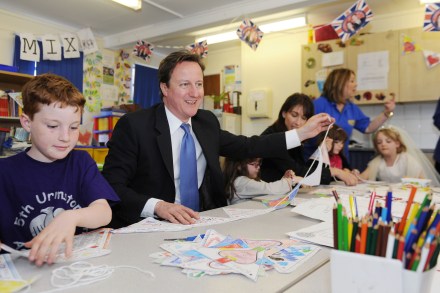
When a Prime Minister gets his facts wrong as spectacularly as David Cameron did yesterday with his comment that  ‘only one black person went to Oxford last year’ everyone wonders why. Now, the simplest explanation is that it was a straight cock-up. One of the pitfalls of these Cameron Direct events is that errors can come out. Another theory doing the rounds this morning is that Cameron is giving a speech on immigration later this week, with some tough language in it, and so was trying too hard to show that he is anti-racist. But whatever the explanation, Cameron needs to be careful about how he approaches the university access issue.

Blame the schools system, not Oxford

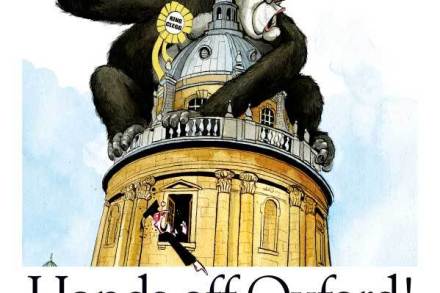
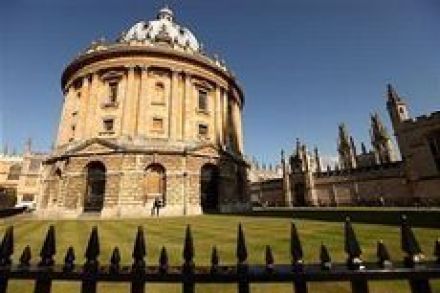
The most extraordinary row has broken out after the Prime Minister appeared to suggest that Oxford University has a racist admissions policy. He today said that, "I saw figures the other day that showed that only one black person went to Oxford last year. I think that is disgraceful." But the university has since hit back, pointing out that, "the figure quoted by the Prime Minister is incorrect and highly misleading — it only refers to UK undergraduates of black Caribbean origin for a single year of entry, when in fact that year Oxford admitted 41 UK undergraduates with black backgrounds.

Short term solutions to Britain’s long-term education problem

The most important planks of the coalition’s social mobility strategy are its education and welfare reforms. Raising the standards of state education in this country will give far more children a chance to get on in life. While reducing the number of children brought up in workless households will, hopefully, halt the development of a hereditary non-working, benefit-dependent class.   But these measures will take time to work. Which raises the question of what should be done in the meantime?   One thing would be allowing academics to use discretion in admissions. We don’t expect the England cricket selectors to pick the side based solely on county averages and we shouldn’t expect universities to select pupils purely on exam results.

Shaky dealings are damaging the reputation of Britain’s universities

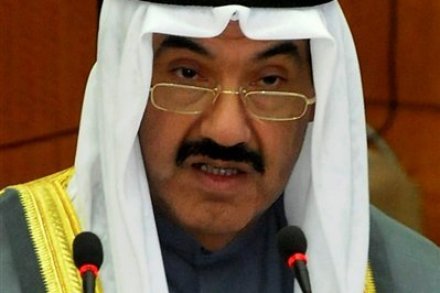
A delegation from Durham University flew to Kuwait in February to build what it termed ‘academic partnerships’. They succeeded. On Monday afternoon, Durham University announced the formation of the ‘Al-Sabah Programme in International Relations, Regional Politics and Security.’ In an internal document sent to academic staff, the Vice-Chancellor, Professor Chris Higgins, revealed that that this seat had been ‘funded personally by Sheikh Nasser Al-Sabah of Kuwait’, the Kuwati Prime Minister, and that the ‘£2.5million endowment will support the Al-Sabah Chair, associated research and two PhD studentships in perpetuity’. Al-Sabah has made what is politely termed a singular contribution to democratic traditions.

The grade inflation scam

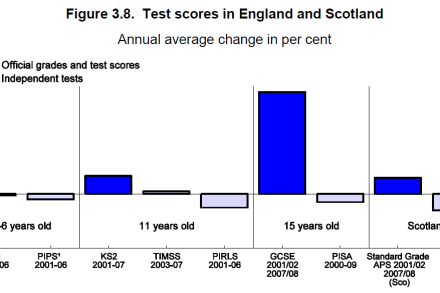
Today’s OECD Economic Survey of the UK (download the complete pdf here ) contains some devastating passages about our education system. As it's 148 pages in size, we thought CoffeeHousers might appreciate some highlights. Here's your starter for ten: “Despite sharply rising school spending per pupil during the last ten years, improvements in schooling outcomes have been limited in the United Kingdom.” This is rather a staggering indictment of Tony Blair's "education, education, education" policy. But what about the ever improving exam results that we hear about each summer?

Clegg’s cure for the tuition fee trauma

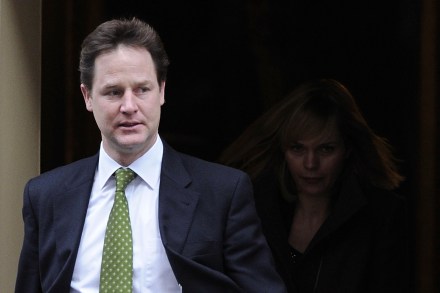
The Liberal Democrats are still traumatised by what happened over tuition fees. Nearly every fringe meeting contained a long discussion of the issue and how the party could have handled it better. Clegg’s plan to heal the wound is to show that the new system will go hand in hand with a broadening of access to the best universities. The deputy prime minister seems to be straining for a fight on this issue. In his speech, he laid into those at Oxbridge ‘who shrug their shoulders and say: That’s just the way things are’ about how dominated these institutions are by the children of the well-off. He demanded, ‘fair access now.’ But the problem is that access can only be as fair as the schools system allows.

Levelling higher education’s playing field

Last summer I was showing some 17 year olds around the House of Commons. They were bright and engaged and all wanted to go to university. But as they told me what they were doing for A-Levels my heart sank. They were all doing subjects that were going to put them at a massive disadvantage in applying to a top-rank university. The most worrying thing was that they were completely unaware of this. So it is welcome news that the Russell Group, made up of the 20 best universities in the country, has now published a guide advising students on which A-Level subjects are held in the highest regard by universities. This is the kind of information that schools that regularly send children to top universities pass on almost automatically to their pupils.

Hughes’ social engineering crusade

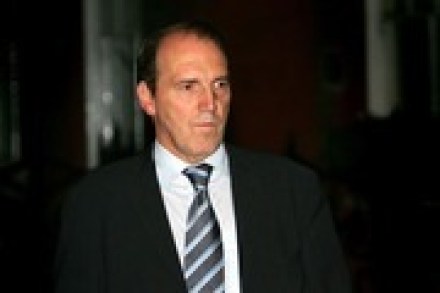
No wonder some backbench Tory MPs are apoplectic: courtesy of David Cameron, Simon Hughes has been elevated from soapbox to pulpit. Hughes' first statement as the government's university access adviser is to suggest that universities should limit their intake of students from private schools. He told the Guardian: 'I think my message to the universities is: You have gained quite a lot in the settlement. Yes, you've lost lots of state money, but you've got another revenue stream that's going to protect you. You now have to deliver in turn. You cannot expect to go on as you are. It has failed miserably.'   Hughes' appointment was controversial, another instance of well qualified, determined and loyal Tories being denied preferment to placate Lib Dem egos.

Tzars and advocates

The coalition’s attempt to talk to two audiences at once is on full display today. The Times reports on the appointment of the Tory Lord Heseltine as a growth czar and his warning against bashing the bankers. Meanwhile, The Guardian reveals that Simon Hughes, the deputy Lib Dem leader, is to be the coalition’s access advocate. Hughes’ appointment is intriguing. On one level, the appointment of Hughes—who abstained in the fees’ vote—is a way of trying to draw a line under the matter within the Liberal Democrats. Clegg clearly hopes that having abstained Hughes will be better able to sell the package to sceptical party activists.

Another item for the coalition’s to-do list: intergenerational unfairness 

With an uncanny sense of timing, the latest annual British Social Attitudes Survey suggests that the "conflicts of the future may be between today's young and their parents' generation." And the thinking behind this conclusion? Simple: that, in so many ways, young people have never had it so good as the babyboomers did. From tuition fees to house prices, those born after 1975-80 have always tended to fall on the less favourable side of the divide – and that has, in turn, fuelled the sense of injustice that we saw erupt onto the streets last week.

Clegg suffers the backlash

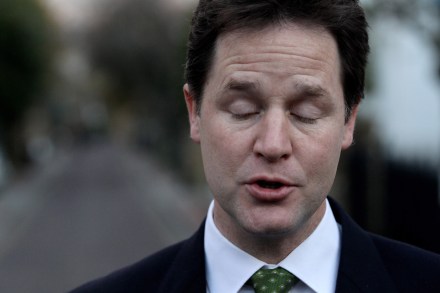
If this morning's papers are anything to go by, Nick Clegg is in freefall. The man who was the Lib Dems' biggest electoral asset is now a magnet for all sorts of political digruntlement. Exhibit A: the Ipsos MORI poll (£) in today's News of the World, where 61 percent of respondents say that they don't trust Clegg, compared to 24 percent in April. He has gone from being "the most trusted politician since Churchill," to one of the least since ... well, ever. It is no small irony that the leader who sailed most capably on the winds of "change" and "new politics" in the TV debates has, whether rightly or wrongly, delivered this Parliament's most stunning example of a broken pledge – and is suffering the fallout from it.

The students vs the Lib Dems

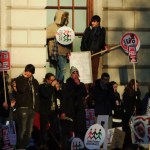
One of the things I heard yesterday when I strolled around the edges of the protests, particularly from older people, was how the coalition's policies had politicised Britain’s young. “It has really made my children wake up”, said an elderly bystander with a wistful look in his eyes.  Student leaders say they now hope to punish Lib Dems who voted for the tuition fees, targeting MPs in seats such as Bath, Burnley, Bradford East, Bristol West and Brent Central.   The sense of rage directed against the Liberal Democrats comes, I suspect, from a deeper sense of betrayal - and not simply student dissatisfaction over today’s issue.

From the archives: The student protests of ’68

No, not Paris, but the University of Essex – where, in early to mid-1968, students rallied angrily against Vietnam and all that. The situation was aggravated when three students – including David Triesman, later Lord Triesman – were summarily suspended from their studies, and The Spectator duly dispatched a correspondent to investigate. The resultant article came in the issue dated 24 May 1968; a few pages on from an editorial headlined "How to deal with the student problem", and alongside coverage of events in France.

Sifting through the wreckage

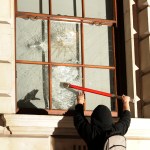
The revolution may not be televised, but protests certainly are – and the process magnifies the drama. Since last night, the news broadcasts have all had footage of two thugs trying to smash the windows of the Treasury and, in the process, familiarising themselves with the properties of bombproof glass. The attack on Charles and Camilla's royal limo is splashed across all this morning's front pages. The script is so well-rehearsed now that I hesitate to repeat it: the vast majority are peaceful protesters, infiltrated by vandals who soak up the attention. Many of the protesters yesterday looked like they’d get a cab straight back home to their Notting Hill trust-fund houses.

The divisions laid bare

When The Speaker called a division, the Labour side roared a passionate No while the coalition benches delivered a rather muted Aye. I did not see a single Lib Dem open their mouth at this point. Instead, they sat on their benches looking emotionally exhausted. Even those Lib Dems who have been proved right in their warning about the party’s position on fees—notably, David Laws and Jeremy Browne—appeared downcast.   In the end, the government won but with a much reduced majority. 21 Lib Dems voted against the coalition, as did six Tories. Simon Hughes abstained despite Ed Miliband’s entreaties to come with him into the no lobby.   This meant that the Lib Dem’s three senior figures split three ways.

Exclusive: the fee hike won’t create a market

The fee vote really comes down to two questions. First, will the fee hike proposed by the coalition government actually create an internal market in higher education? Second, what will be the effect on the public finances? There is good reason to be doubtful.   First, the market: the idea, I suppose, is that world-class universities might charge higher fees than second and third tier ones. But, in the last few days, I've spoken to several very senior higher-education sources who privately report that universities like Leeds Met, Bolton and Worcester are very seriously considering charging the full £9,000 tuition for their courses once legislation is in place. The government is extremely concerned.

Putting the Lib Dem rebellion into context

A useful guide from Philip Cowley and Mark Stuart: If 11 Liberal Democrat MPs vote against the whip, it will be the largest Lib Dem rebellion so far this Parlaiment. (The current record is 10, on an amendment to the Parliamentary Voting System and Constituencies Bill in November). If 16 Liberal Democrat MPs vote against the whip, it will be the largest Lib Dem rebellion since the party was founded in 1988-89. If 30 Liberal Democrat MPs vote against the whip (something we doubt very much), it will be the largest rebellion by the Liberal Democrats or any of their predecessor parties since the Maurice Debate of 1918, which saw the Liberal Party split in two. More here.

Live-blogging the protests

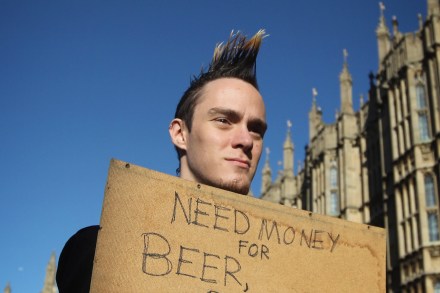
1540: Heading back to Spectator HQ but it's blocked off. They appear to be kettles in parliament square. The horses appear to be keeping the crowd back. Fence is being thrown around again. 1530: Milbank is full of police vans, they have to put them somewhere. Police are turning away people from Parliament Square. Police are using riot-proof cameras for evidence. 1455: The Met are shouting and trying to get everyone back on the planned route, but the crowd are beyond caring. A bystander pointed out Parliament Square is being used (more likely destroyed) for the first time in months. 1445: A view from a parliamentary researcher: "Life goes on inside the Palace of Westminster.