Ukraine

Biden’s weak words on the Russian invasion

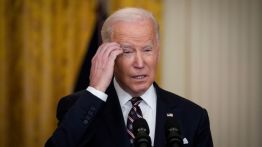
Vladimir Putin has invaded Ukraine, a chilling moment that cries out for a tough response. Thankfully, the president of the United States has deployed his usual silver tongue. "The world will hold Russia accountable," Joe Biden said last night. "I will be monitoring the situation from the White House this evening and will continue to get regular updates from my national security team." Cue Cockburn nearly collapsing from the sheer rhetorical power of that statement. It's a wonder the Russian tanks didn't screech into reverse and roll back over the border. Cockburn understands this is a dangerous situation that calls for delicacy and forethought. But were such bland bromides really the best the leader of the free world could do?

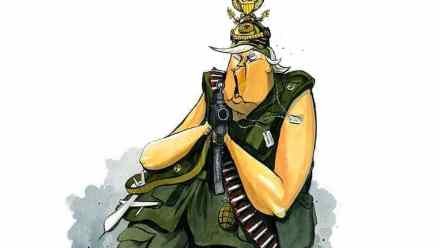
Vlad the Invader: Putin is looking to rebuild Russia’s empire

From our UK edition

‘War’, in Prussian military theorist Carl von Clausewitz’s most famous dictum, ‘is nothing but a continuation of politics with the admixture of other means.’ A generation of Democrats — the American variety, but also European Christian and Social Democrats — have sought to ignore that truth. Appalled by the violence of war, they have vainly searched for alternatives to waging it. When Vladimir Putin ordered the annexation of Crimea in 2014, Barack Obama responded with economic sanctions. When Putin intervened in the Syrian civil war, they tried indignant speeches. When it became clear that Putin intended a further and larger military incursion into Ukraine, Joe Biden and his national security team opted for sanctions once again.

Sanctions on Putin will hit Britain’s cost of living. Are we ready?

From our UK edition

No British soldiers will go to fight in Ukraine. The UK’s military involvement will be limited to weapons shipments and more forces to Nato’s eastern flank to try to deter further Russian revanchism. Despite this, domestic opinion in Britain — and other western countries — will be hugely significant in this conflict. The West is trying to use sanctions to influence Vladimir Putin’s behaviour. However, there are clear limits to deterrence through economic measures, as Niall Ferguson writes in his article. The threat of sanctions was not enough to stop Putin unilaterally recognising the two breakaway republics in the Donbas, Donetsk and Luhansk, and agreeing to send troops there.

The West missed its chance to help Ukraine

From our UK edition

Yet another east European tragedy is unfolding before our eyes. We have watched this movie for more than 80 years. In 1938, Czechoslovakia was abandoned to its fate by Neville Chamberlain at ‘Munich’. In 1945, at the Yalta conference, it was Poland’s turn — and the eastern half of our continent lost to Soviet domination. Then the Soviet invasions of Hungary in 1956 and Czechoslovakia in 1968, followed in 1981 by a ‘state of war’ in Poland. ‘Goodbye to all that’ we naively thought after the end of the Cold War, but in 2008, Vladimir Putin’s Russia seized chunks of Georgia.

rape

Was Russia’s ‘rape’ of Ukraine inevitable?

In a press conference earlier this month, Vladimir Putin noted that the Ukrainian government does not like the Minsk agreement and then added: "Like it or not, it's your duty, my beauty." The saying has well-known sexual connotations: Putin appeared to be quoting from “Sleeping Beauty in a Coffin” by the Soviet-era punk rock group Red Mold: “Sleeping beauty in a coffin, I crept up and fucked her. Like it, or dislike it, sleep my beauty.” Although the Kremlin press representative claimed that Putin referred to an old folkloric expression, reference to Ukraine as an object of necrophilia and rape is clear.

Joe Biden is no Jack Kennedy

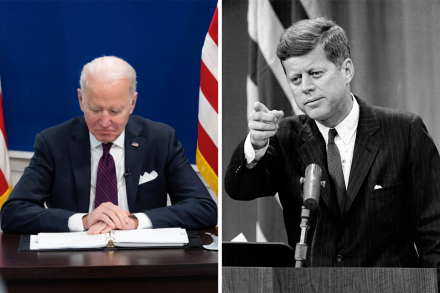
As the Ukraine situation heats up, you can already picture the insider account Vice President Kamala Harris will publish one day in her 2025 bestseller Thirty-One Days in February. But then, as any survivor of the Cuban Missile Crisis is bound to tell President Joe Biden, “I knew Jack Kennedy, Jack Kennedy was a friend of mine, and you, Joe Biden, are no Jack Kennedy.” One of the clichés if not the myths about the Cuban Missile Crisis was that President Kennedy and Soviet leader Nikita Khrushchev were playing chicken and Khrushchev “blinked." Under threat of potential nuclear war, he then decided to withdraw the Soviet nuclear missiles from Cuba. We now know that what really happened was more complicated than the initial reports made it appear.

How Starmer is using the crisis in Ukraine to his advantage

From our UK edition

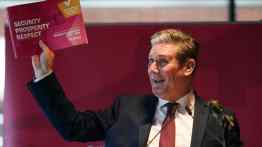
Boris Johnson and Keir Starmer had one thing in common at PMQs: they were both keen to talk about the escalating situation in Ukraine. While the Prime Minister wants to use the crisis to show there are more important issues than parties, the Labour leader views it as an opportunity to put some clear blue water between himself and his predecessor, Jeremy Corbyn.  Starmer is using the Ukraine situation this week to emphasise Labour’s return to the centre His call at Prime Minister’s Questions to ban Russia Today has already received some criticism from figures on the left and right of the party who believe it would be self-defeating.

The Ukraine debacle showcases Joe Biden’s many failures

Snap quiz: who was president when Vladimir Putin gobbled up Crimea? If you said Barack Obama, go to the head of the class. What countries did Putin invade while Donald Trump was president? If you said “None,” you get to stay at the head of the class. This is a harder one: who was president when Putin once again violated Ukraine’s borders, sending in Russian troops to two breakaway regions in Eastern Ukraine? I say that this is harder because the obvious answer — “Joe Biden” — is not really, or not wholly, correct. Joe Biden is an empty shell. On good days, he looks like a mannequin. Really, though, he is a puppet, a creature controlled by others. I have called those others “The Committee.

biden ukraine

PMQs: Boris Johnson faces pressure to be tougher on Russia

From our UK edition

Boris Johnson came under sustained pressure at PMQs today to introduce tougher sanctions against Russia. Both Sir Keir Starmer and Ian Blackford pressed the Prime Minister on the matter, with the Labour leader opening his questions by arguing that given a sovereign country had been invaded, ‘if not now, when’ would the government unleash a full package of sanctions. Starmer repeatedly said the Labour party was supportive of what had been announced so far but that it wanted much more from the government. This included cracking down on the Russian state-backed broadcaster RT, which he said should be prevented from spreading Vladimir Putin's propaganda around the world.

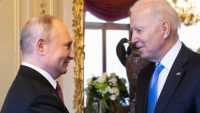
U.S. President Joe Biden and Russian President Vladimir Putin (Getty Images)

Biden exploits the Russia conflict for political gain

President Joe Biden is preparing to buck responsibility no matter the outcome of the brewing conflict between Russia and Ukraine. Biden's statements about Russia have been anything but cohesive. One day he is giving up the game by stating publicly that he has no appetite for war and would allow a "minor incursion"; the next he's focusing exclusively on diplomatic channels; the next he's warning of force if Putin makes another move. All the while, White House officials have planted news stories and touted vague "intelligence" warning of an imminent Russian invasion. The message is this: war with Russia is inevitable, unless it isn't, in which case Biden gets all the credit. So who gets the blame if Putin does invade Ukraine and the US responds with military force?

Putin’s next move

From our UK edition

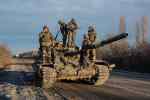
Budapest Russian troops, many apparently without insignia, began advancing into the disputed Donbas region yesterday. The question now is how much further they will go. The Donbas rebels claim an area three times the size of the territory they currently hold, which is roughly equivalent to the area of Devon. If Moscow were to try to take control of the larger territory, it would mean overrunning the Ukrainian frontlines. It is unlikely that Kiev’s military can mount a serious defence if the Kremlin orders a full-scale attack. The call to advance came in the form of a belligerent speech by Putin to the Russian people. In it, he strongly suggested that his aim was to reintegrate the country of 45 million into the motherland.

Why the silence over Biden’s links with Ukraine?

From our UK edition

‘He has been wrong on nearly every major foreign policy and national security issue over the past four decades.’ So once said Robert Gates, the former US defence secretary, of the now president Joe Biden. We don’t yet know if Biden is wrong about the current Ukraine crisis. We may be about to find out. His speech on Tuesday was at least competent, if not entirely coherent. ‘Who in the Lord’s name does Putin think gives him the right to declare new so-called ‘countries’ on territory that belongs to his neighbours?’ asked the president, in one of his now all-too-familiarly infirm attempts to sound firm.

Putin must look at the West and laugh

From our UK edition

Whatever the West’s response to Russia’s attack on Ukraine’s sovereignty, the crisis demonstrates the limitations of western politics and policy across the board. If Vladimir Putin understands any demographic better than the Russian people, it is the governing class of the West: that Harvard-Oxbridge-Sciences Po axis of toweringly smug and practically interchangeable global-liberals who weep for international norms they weren’t prepared to defend. Their ideas and their sanctions are tired because they are civilisationally tired. Putin knows this, but none of the rival ideologies aiming to replace liberalism have anything better to offer.

Five of the worst responses to the Ukraine crisis

From our UK edition

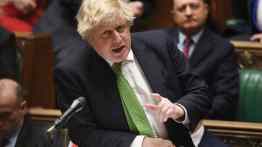
Boris Johnson has just got up in the Commons to announce Britain's response to the ongoing Ukraine crisis. Vladimir Putin last night ordered troops into two breakaway regions of eastern Ukraine run by Moscow-backed separatists, prompting fears that the balloon is about to go up. There are a lot of grim faces in Parliament today as MPs meet to ponder the future of the region. Gulp. Johnson told the House that he was announcing sanctions against five Russian banks – Rossiya, IS Bank, General Bank, Promsvyazbank and the Black Sea Bank – and three Russian high net-worth individuals. While many across Parliament want the PM to go further, it's by no means the worst response to the ongoing situation in the Baltic.

Britain’s Russia sanctions are underwhelming

From our UK edition

The sanctions that Boris Johnson has just announced in response to Russia’s breach of international law are fairly underwhelming. Five banks are being hit, three rich individuals and those members of the Duma who voted to unilaterally recognise the breakaway republics. They will not make Moscow take notice in the way that the decision end certification of Nord Stream 2 has. Johnson’s defence of the limited nature of these sanctions is that they are the ‘first tranche’ and the UK needs to hold things back to try and deter Russia from further action. But given that the UK, rightly, considers what Russia is up to an invasion of Ukraine, these sanctions are nowhere near robust enough. The three oligarchs hit have been on the US sanctions list since 2018.

Sanctions won’t stop Putin

From our UK edition

The Lithuanian prime minister, Ingrida Šimonyte, put it well yesterday: 'the way we respond will define us for the generations to come'. The invasion of Ukraine started last night with Vladimir Putin’s order to send troops into eastern Ukraine. He had earlier recognised the breakaway provinces of Donetsk and Luhansk, which together constitute the Donbas region, as independent republics. The two self-proclaimed states declared their independence — something neither Kiev nor any other third country save Russia has yet recognised — following 2014 following the Maidan revolution. The US, UK and EU say they will announce fresh sanctions as early as today. What we know is that the technicalities have been drawn up.

Will Putin now roll on to Kiev?

From our UK edition

The White House told us with absolute certainty that there would be an invasion of Ukraine this week — instead Vladimir Putin bit off a chunk of Ukraine without firing a shot. Perhaps it seemed to him that recognising the two breakaway territories of Luhansk and Donetsk was a clever move: he had not, after all, ignored the warning that — in Boris Johnson’s phrase — one Russian soldier putting a toe-cap over the border would make sanctions inevitable. But sanctions will come anyway — the issue is only about how severe they will be — imposed because, as Johnson says, there has been a clear breach of international law.