Ukraine

The Ukraine invasion is nothing compared to Iraq

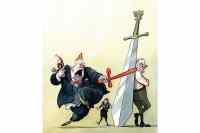
Of the war in Ukraine, New York Times columnist Thomas Friedman writes, “Our world is not going to be the same again because this war has no historical parallel.” In the very next sentence, he describes the Russian invasion of Ukraine as “a raw, eighteenth-century-style land grab by a superpower,” thereby acknowledging that the episode actually has innumerable historical parallels — just not ones that Friedman cares to acknowledge as legitimate. Friedman figures prominently among those claiming to have divined the essential character of the present age. His key finding: tech-driven globalization has rendered old-fashioned power politics obsolete. The rules of the game have changed irrevocably. Practically speaking, nations have no choice but to submit.

invasion iraq

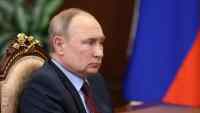
Putin understands America’s moral decay

Last October, Vladimir Putin aired a speech to the Russian nation chiding the United States for its moral decay. He observed an America “blotting out whole pages” of its history, pursuing “reverse discrimination against the majority in the interests of minorities,” and renouncing time-honored values in an effort at “public renewal.” “It’s their right, but we are asking them to steer clear of our home,” he warned. “We have a different viewpoint.” This iteration of family values and conservative critique went barely noticed by the American press at the time.

Putin

Are Poles really against immigrants?

From our UK edition

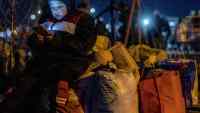
Krakow The invasion of Ukraine is being felt across Europe. Already hundreds of thousands of displaced Ukrainians are spilling out west in an attempt to flee Russian hostility. Polish society and the conservative government have, on the whole, supported refugees from their troubled eastern neighbour. A recent poll shows that 53 per cent of Poles are in favour of taking in Ukrainian war refugees, compared to just 22 per cent against. In Germany, attitudes are more divided, with 41 per cent supporting the settlement of Ukrainian refugees compared to 38 per cent against. More than half of the supporters of the radical right nationalist Confederation party, whose detractors have long accused it of being pro-Putin, are in favour of bringing Ukrainian refugees to Poland.

The crisis in Ukraine is strengthening the EU

From our UK edition

The EU has a knack for turning a crisis into an opportunity. The Eurozone crisis led to the centralisation of economic powers in Brussels; Brexit consolidated the Franco-German push for EU integration; and Covid became the pretext for EU funds being made dependent on members adhering to the ‘rule of law’ for the first time. It's looking likely that the bloc will repeat this trick with the war in Ukraine. Prior to Russia’s invasion, the EU was being mocked for its divisions: on Russian gas dependency, on proposed economic sanctions, and on political links with the Kremlin. Now, the bloc is trumpeting its unity.

Watch: MPs give Ukraine’s ambassador standing ovation

From our UK edition

Another day and still Ukraine holds on. Russia last night stepped up its attacks on key target cities, with fighting raging for a seventh day in the north, east and south of the country. It was in those sombre circumstances that MPs in London met today for the ritual weekly jousting of Prime Ministers' Questions. But before the usual punch and judy show kicked off between Boris and Keir, Speaker Lindsay Hoyle had a few words to say first, as he welcomed the Ukrainian ambassador Vadym Prystaiko to Parliament. Barely had the Speaker begun then a wave of applause rang out across the chamber, building to a crescendo as members across the House rose to their feet to applaud Ukraine and its people for their resistance to the Putin regime.

europe nikole hannah-jones

Is Europe a continent? Does it matter? 

Nikole Hannah-Jones, who is never at a loss for a tweet, ridiculed Americans who are expressing alarm over the threat to Europe implicit in Putin’s invasion of Ukraine. She put down those spoilsports for their referring to Europe as a “continent.”  Quoth Hannah-Jones, under her nom-de-plume Ida Bae Wells: What if I told you Europe is not a continent by definition, but a geopolitical fiction to separate it from Asia and so the alarm about a European, or civilized, or First World nation being invaded is a dog whistle to tell us we should care because they are like us. The triumphant silliness of the author of the 1619 Project always comes down to her desire to find racism at the root of whatever happens.

No-fly zones won’t work, but what about aid to Ukraine?

From our UK edition

Vladimir Putin's forces are encircling the cities of Kharkiv, Kherson and Mariupol, and a 40 mile-long convoy of Russian armoured vehicles is north of Kiev on the seventh day of fighting in Ukraine. The coming days are likely to see greater barbarity from the Russian President after he failed to get his way in the first few days of the invasion. Those days are also likely to stretch into weeks as Putin lays siege to these cities until they are his. The debate about what the West should be doing to needs to widen out So far the political debate in the West has been dominated by a noisy argument about a no-fly zone: something all leaders have repeatedly ruled out on the grounds that it would lead to direct combat between Nato and Russia.

The Putin apologists of the European parliament

From our UK edition

Never underestimate Vladimir Putin, and certainly never underestimate his advisers. Well before the first Russian rockets exploded in metropolitan Kiev, he had achieved a major foreign policy success by sabotaging the EU’s ability to present a united front against him. Ever since the days of Gerhard Schroeder, Russia had deftly weaponised German politicians’ commitment to Ostpolitik and German people’s desire for a comfortable bourgeois life, and this undoubtedly paid off. Before the invasion the EU’s paymaster was less than enthusiastic about sanctions when reminded of the sunk costs of Nord Stream 2 and its short-sighted but temporarily lucrative decision to depend both on Russian gas and the profits it made by selling the machinery to extract it.

Joe Biden’s gung-ho State of the Union speech

From our UK edition

It’s arguably not the right moment to focus on Joe Biden’s verbal slips, but it is a little unnerving when the leader of the free world says ‘Iranians’ — or possibly ‘Uranians’ — when he means to say ‘Ukrainians’. These are dangerous times and we need politicians to speak clearly. Still, Biden got in his point across in his State of the Union address. He announced that he was closing US air space to Russian aircraft. He led a standing ovation for the Ukrainian ambassador to the US, Oksana Markarova. He said that Putin is ‘now more isolated from the world than he has ever been’.

Putin is making the EU great again

The Europeans have been jolted awake from their deep Pax Americana slumber, when the continent was largely content to eat the spoils of economic prosperity and allow the United States to do the heavy lifting on all things security. And we have Vladimir Putin to thank for it. Russia’s nearly week-long invasion of Ukraine has shocked the conscience of many who believed Europe would never return to the dark days of large-scale land warfare.

No, Scottish independence is not like the war in Ukraine

From our UK edition

Perhaps it’s the absence of any oppression of their own country that compels Scottish nationalists to latch onto the oppression of others. On Monday, Michelle Thomson, an SNP MSP, retweeted news of Ukraine’s emergency application for EU membership, adding: ‘Delighted for Ukraine. It’s [sic] just goes to show what political will can achieve. Remember this Scotland!’ The SNP’s current position is for Scotland to secede from the UK then apply for membership of the EU, a process nationalists have previously suggested Brussels would fast-track. Thomson came in for a barrage of criticism and later deleted the tweet, admitting it was ‘insensitive’. She is taking all the flack but she’s hardly alone in dabbling in such rhetoric.

Britain is paying the price for its fracking panic

From our UK edition

Between 1980 and 2005, the UK produced more energy than it needed. Today, we import more than a third of our energy and over half of our natural gas. Households are facing an increase in their annual tax bills from £1,500 to an eye-watering £3,000. While the Business Secretary may have tweeted this week that the current situation is a matter of high prices rather than security of supply, families already struggling to heat their homes are unlikely to tell the difference as they decide whether to heat their homes or pay for food. This was never a foregone conclusion. A decade ago, the US shale gas revolution was well underway, with fracking creating hundreds of thousands of jobs and driving down gas prices.

Even Hungary has soured on Vladimir Putin

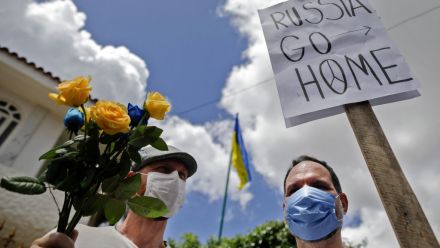
As Russian tanks rolled across the Ukrainian border, the front page of the Hungarian tabloid Pesti Hírlap revived an old rallying cry to capture the national mood. “Ruszkik haza!” (“Russians go home!”) was the headline, with Budapest 1956, Prague 1968, and Kyiv 2022 listed below the fold. The line was borrowed from graffiti scrawled on Budapest street corners during the 1956 anti-Soviet uprising, a heroic but doomed effort that has since entered into Hungarian national lore. Is it 1956 all over again? Despite some eerie parallels, the political geography of Europe has changed considerably since the bad old days of the Cold War. Budapest is two hours from Vienna by train and Prague is actually further West than the Austrian capital.

llya Kaminsky

Ilya Kaminsky’s poetry in a time of war

There is currently a poem going viral on Twitter. “We Lived Happily During the War” is by the Ukrainian-American poet Ilya Kaminsky, and it is the first poem of his prize-winning collection Deaf Republic (2019). It is easy to see why it feels particularly relevant: Kaminsky was born in the former Soviet city of Odessa, which is now under attack from Russia. The poem opens: “We Lived Happily During the War” And when they bombed other people’s houses, we protested but not enough, we opposed them but not enough. It is a heart-breaking meditation on the way normal life continues despite crises. The speaker describes how “I took a chair outside and watched the sun.” But he ends with a plea: “we (forgive us) / lived happily during the war.

Yvette Cooper’s refugee record

From our UK edition

As the Ukraine crisis rages, Labour has chosen to focus on the issue of visas for fleeing Ukrainian refugees. Shadow Home Secretary Yvette Cooper went for her opposite number Priti Patel on it in Parliament yesterday, demanding 'clear answers' for those 'urgently seeking sanctuary or to rejoin relatives.'  It looks like Patel will now be forced to give a ministerial statement today, updating the government's position on the issue: a win for Cooper and those demanding more action. Still Mr S couldn't help but think back to Cooper's own record when it comes to refugees.

taiwan

What does Ukraine really mean for Taiwan?

No one should think that Vladimir Putin’s invasion of Ukraine means that Xi Jinping will decide to use force against Taiwan anytime soon, if ever. China is not Russia, nor Taiwan Ukraine. Yet neither should policymakers presume that Beijing will not be influenced by what happens on the other end of Eurasia. Washington must consider whether and how Putin’s aggression has raised the stakes in defending Taiwan from the People’s Republic of China. At the least, US strategists will seriously have to assess whether a global environment in which norms of international behavior are regressing may serve to spur Beijing to military action that once seemed unlikely.

The GOP isn’t quitting on Trump

Will he or won't he? Americans tired of the rampant speculation are surely having a relief-filled two months. First Tampa Bay Buccaneers quarterback Tom Brady responded to a hasty ESPN report by announcing his retirement from the NFL. Then, former president Donald Trump told a roaring crowd at CPAC that he intends to run for America's highest office a third time. "We did it twice, and we’ll do it again,” Trump said. “We’re going to be doing it again." Trump's announcement is a gut punch for other 2024 contenders who secretly hoped he'd step back and play kingmaker.

Putin’s endgame is preserving ‘his’ Russia

Vladimir Putin’s war in Ukraine does not appear to be going well, and the Russian economy is about to experience the full force of Western sanctions. American social media is already in a celebratory mood. But caution is in order — it’s never smart to underestimate your opponent. Putin was expecting sanctions, and he and his war planners could not have discounted Ukrainian resistance, even if they underestimated its intensity. Maybe they did expect the invasion to be a cakewalk and are taken aback by how difficult it’s proved to be in just these first few days. But as of now the invasion still seems to be on its timetable, and its military objectives are achievable. Russians are surrounding Kyiv.