Ukraine

The West should follow Eastern Europe’s lead on foreign policy

From our US edition

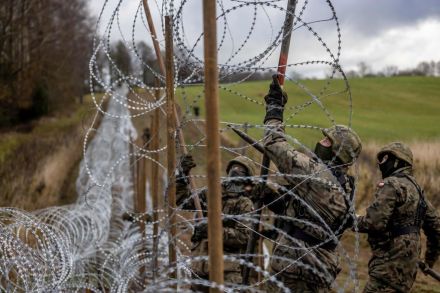
Few countries know Russia’s brutal imperialism better than Poland and the Baltic states. These nations are among a handful in the West to have responded to Putin’s invasion of Ukraine with the decisiveness and clarity of vision that the security environment demands. This is why the United States, as it faces a dual threat of China and Russia, should look to Eastern Europe for inspiration. Poland has undergone the most dramatic transformation of the bunch, increasing its defense budget and boosting the size of its military, in addition to supplying Ukraine with a vast array of materiel. Warsaw has pledged to raise defense spending to 3 percent of gross domestic product (GDP) within a year, up from 2.2 percent, which will be nearly on par with the United States.

NATO acquits itself well in the Poland missile crisis

From our US edition

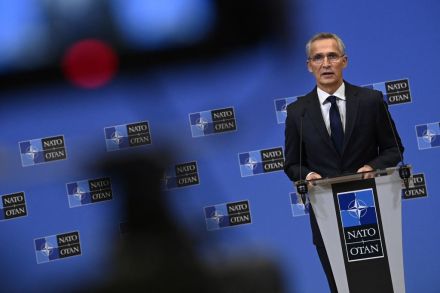
Mid-afternoon Tuesday, a missile struck the town of Przewodow in eastern Poland close to the Ukrainian border, killing two. The incident immediately set off alarm bells around NATO and the world, as Poland, a member of the military alliance, could invoke Article 5 of the North Atlantic Treaty, bringing all 30 members to its defense. The Polish government is considering invoking Article 4 of the treaty, which allows any member state to call a meeting of all members to discern if "territorial integrity, political independence or security… is threatened." NATO was due to meet on Wednesday anyway, but the tragedy in Poland has superseded the gathering’s planned lineup.

Winter is no time for weakness in Ukraine

From our US edition

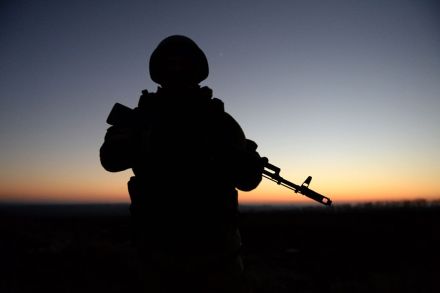
With the recapture of the key southern port city of Kherson, Ukraine has achieved yet another success in its nearly nine-month war with Russia. But as winter approaches and conditions worsen, both sides will face new challenges, and the West’s support will be tested. As the Institute for the Study of War indicated in a recent assessment of the conflict, it is unlikely that combat activity will drop significantly in the coming months. As the early winter rains roll over Ukraine, the region’s infamous mud will prove to be an impediment to maneuver warfare. That period will then give way to the freezing temperatures that characterize the Eastern European winter. Those temperatures will put an end to the mud, allowing forces to more effectively continue operations.

Don’t expect the midterms to change our foreign policy

From our US edition

President Joe Biden and his Democratic allies were expecting a romp on Tuesday. So were many of the career prognosticators surveying the election landscape. Instead, many of the close Senate races, including in all-important Georgia and Nevada, haven’t been called. Those of us who have been staring at the returns for hours on end still don’t know the full extent of the results. But what can be said with reasonable certainty is that however the balance of power stacks up, foreign policy is likely to be the same as it ever was. The status quo is an all-powerful force inside the Beltway, where conventional wisdom rules the roost and any tilt away from the mainstream is usually corrected before an honest discussion can be had on the merits. Part of this is institutional.

Republican support for Ukraine is fading

From our US edition

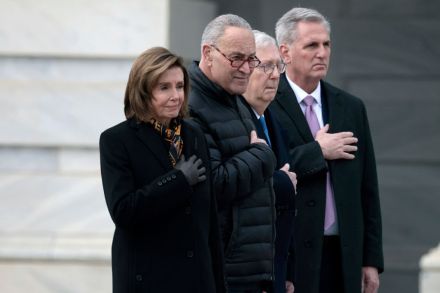
There is much that is uncertain about Tuesday’s elections, but it seems all but certain that the GOP will take the House. They may well do the same in the Senate. What the new majority will stand for, however, is far from clear, particularly on foreign policy — and it is foreign policy that will likely prove to be the most impactful area of the 118th Congress. With Biden in the White House, there is not much on the policy front that a GOP legislature can do beyond budgeting, but as the war in Ukraine drags on, the power to set budgets will be crucial. When the Congress is sworn in on January 3, Ukraine will be in the dead of winter, and — if Russia’s strategy remains the same — home to millions without access to heat and water.

Xi’s nuclear warnings are a coup for Scholz

Checks and balances on Vladimir Putin don’t come from inside Russia. The people around him supported forced mobilisation, pushed his plans to annex eastern Ukraine, and wanted more nuclear posturing. Xi Jinping and Narendra Modi, of China and India, can do a much better job at constraining Putin. They’re the only two leaders of major powers that haven’t completely ostracised the Russian leader. He needs them to keep his struggling economy afloat. The pair are putting pressure on the Putin to avoid nuclear conflict. This morning, Xi warned Putin off using nukes for the first time, after saying in February that China and Russia’s friendship had ‘no limits’.

Putin’s war has exacted a terrible toll on Ukraine

Putin badly miscalculated. The Russian army terribly underperformed. Kyiv has shown unexpected resilience in the face of what experts thought was far superior Russian firepower. This, we’re told, is the story of Russia’s invasion of Ukraine, and all of it is true. Vladimir Putin’s talk of a ‘dirty bomb’ is evidence of how badly the war is going for him. Russia has been taught a bitter lesson, one that other trigger-happy, self-proclaimed great powers would be wise to heed. But one part has been missed. For all of Russia’s difficulties, it is in a far better shape than Ukraine. Fighting has left Ukraine in ruin.

The strange alliance between progressives and natcons on Ukraine

From our US edition

If you listened only to the rhetoric of so-called national conservatives, you would think progressives were their polar opposites. But on the issue of foreign policy, it seems like they can find some common ground. It was reported on Tuesday that the Congressional Progressive Caucus sent a letter to President Biden asking him to negotiate with Russia. It was later reported that the same letter had been hastily withdrawn after massive backlash within the Democratic Party. The missive was apparently written and signed in June, updated recently, and somehow carelessly published without all of the signatories’ consent. Either way, it seems to represent something real within the Democrats' progressive wing.

What Zelensky has taken from his former TV career

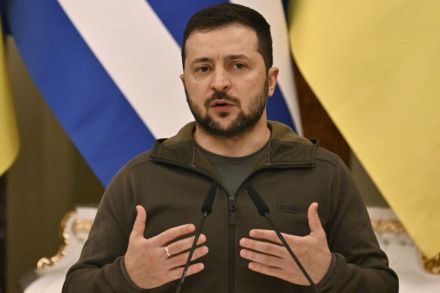
Volodymyr Zelensky is one of the few leaders of modern times whose charisma, determination and sheer cojones can be said, without exaggeration, to have changed the course of history. In the first hours of the Russian invasion the US famously offered to evacuate him from Kyiv to a safer location, to which his response was (in spirit, if not in actual words): ‘I need ammo, not a ride.’ His determination to remain in the heart of his besieged capital seriously confounded Putin’s invasion plans, which were predicated on quickly toppling or murdering him.

America and Russia are finally talking to each other again

From our US edition

Defense Secretary Lloyd Austin and Russian Defense Minister Sergei Shoigu haven’t really been on speaking terms. That is, until last weekend, when the two defense chiefs conversed with each other twice in three days. The readouts released by the Defense Department are about as brief as brief can get. They don’t tell us much about what was said, other than the general observation that Austin, a former four-star army general, swatted away Moscow’s explanations for the war in Ukraine. What the conversations illustrate more than anything is just how rare they've been. Indeed, the reason why so many news outlets wrote about the Austin-Shoigu calls was because they were extraordinary.

Welcome to the age of nuclear blackmail

From our US edition

Vladimir Putin’s recent announcement that he was not bluffing about using nuclear weapons against the West in his war on Ukraine is one of the strongest indications yet of the risks the liberal world now faces in opposing authoritarian aggression. In the face of Russian aggression, or in committing the United States to defending Taiwan, as President Joe Biden did yet again recently, Washington and its partners face the possibility of direct confrontation with the world’s most powerful, nuclear-armed militaries. For the first time in a generation, Western powers risk being checked by adversaries willing to threaten massive conventional and nuclear warfare. The era of cost-free intervention to uphold the liberal world order is over.

nuclear
crimea

What price must the West pay for Crimea?

From our US edition

For centuries before Vladimir Putin arrived on the scene, Russian foreign policy has been shaped by the country’s need for warm-water ports. To be a great power in Europe and the Near East, Russia must have access to the Mediterranean. Commercial as well as military considerations dictate this. In the eighteenth century Russia conquered the khanate of Crimea and acquired a splendid location for a new Black Sea port — what is now the city of Sevastopol. The Crimean peninsula had been a gateway from Asia to the Mediterranean since the days of the ancient Greeks, who built some of their northernmost colonies there. Russia made Sevastopol the permanent home of its Black Sea Fleet.

The US knows the main threat is China

China's President Xi Jinping opened the CCP’s 20th party congress by doubling down on four key issues: no let up on zero-Covid; no renunciation of force when it comes to Taiwan; a promise to build up China’s military strength; and no tolerance of any opposition to his rule. As he enters his third term, the most important new challenge he has to address are the export controls announced by the US on the eve of the congress that threaten to undercut China’s ability to develop semiconductors and supercomputers. Xi remains defiant: he promised to ‘resolutely win the battle in key core technologies.

What does Russia really want?

The question of ‘why’ Russia invaded Ukraine has been forgotten amid war’s fog. Greed and malice partially explains it. History, geopolitics and culture reveals more. A country which has more land than anyone else on Earth is not grabbing territory for territory’s sake. Logically, Russia should be giving away land to anyone who might manage it better. But that’s not how Putin thinks. He is pursuing a dogged policy of annexations – first in Georgia, then in the Crimea, and now of four further Ukrainian districts.

Why Israel won’t give lethal aid to Ukraine

From our US edition

Israeli defense minister Benny Gantz announced this week that Israel would maintain its policy of not supplying weapons to Ukraine. This drew criticism, including charges that Israel has a moral obligation to help Ukraine and is instead foolishly prizing its relations with Russia. Critics also note that Israel’s archenemy Iran is providing weapons and advisors to Russia. They further point out that Israel’s Ukraine arms embargo puts it out of step with Israel’s most important partners in the West, especially the United States. Yet aiding Kyiv is a far riskier bet for Jerusalem than for most Western capitals. This is no easy call, and the one Israel made is probably the right one.

Homage to Kyiv

From our US edition

It was 11:15 p.m. in Kyiv, just after the curfew, and the military had set up its checkpoints on the city streets. Finding your way home after hours can be a hazardous business. The city is paranoid about assassins and saboteurs, and in wartime few are above suspicion. Things were looking ominous until my friend Sasha declared: “we are late for breakfast.” The guards waved us through. This was the daily password, shared with those important enough to move around after curfew. Checkpoints and curfews were a few reminders of the war in Kyiv, where I was just before last week’s deadly air strikes. In the capital city, life was approaching some form of normalcy.

kyiv

Tsar Vladimir brings in martial law

Martial law can arrive with a bang: tanks on the streets, Swan Lake on the TV. It can also creep up on a country in the guise of a presidential edict with the title ‘The Decree On Measures taken in the Constituent Entities of the Russian Federation in Connection with the Decree of the President of the Russian Federation of October 19, 2022 No. 756’. Either way, Vladimir Putin has just moved Russia one step closer to totalitarianism. What is interesting is just how long and half-hearted a process this has been. When Putin invaded Ukraine in February, the sharpest-beaked hawks in his entourage were urging total war, and with it an imposition of tight state control over much of the economy.

How long can Europe’s support for Ukraine last?

From our US edition

Can Ukraine sustain a war effort that is proceeding far better than most military analysts ever expected? Part of that answer, of course, depends on the extent to which the Ukrainian army can keep their troops in the field equipped, supplied, and motivated. That challenge comes as the Russian military increasingly relies on so-called “kamikaze drones” to strike deep into Ukrainian territory (on October 17, a Russian drone attack killed four people in Kyiv during the morning rush hour). But another factor that will determine success or failure is whether Europe remains onboard — or, more to the point, whether Europe’s support to Kyiv will continue as the war enters a dreary, unforgiving winter.

The Russia-Iran axis that’s menacing Ukraine

From our US edition

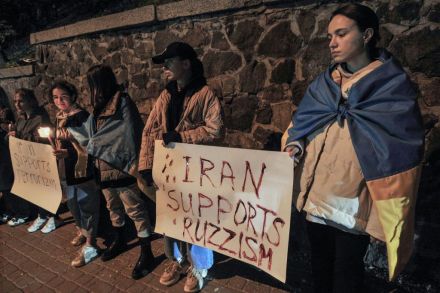
Russia’s brutal war in Ukraine is coming up on its eighth month, and the costs to the Kremlin’s military have been immense. Increasingly isolated on the world stage, Vladimir Putin has joined the world’s club of pariah states, the only group willing to give him support. Chief among his allies is the Islamic Republic of Iran, a state with similarly imperialistic designs and global isolation. This axis has been brewing for some time — the two nations worked together extensively in Syria, for example — but the relationship has reached new heights as the Russian armed forces buckle under the strain of war. Perhaps the most potent symbols of this relationship are the hundreds of Iranian drones flooding into Ukraine to fill a gap in Russia’s weapons inventory.

elon musk ian bremmer

Elon Musk vs Ian Bremmer: who’s telling the truth?

From our US edition

Cockburn wasn’t surprised to hear that Elon Musk had found himself in yet another spat, but he was somewhat shocked to hear that this one was a matter of national security. This week's he-said-she-said involved political scientist Ian Bremmer. In a newsletter sent to his Eurasia Group subscribers, Bremmer wrote that Tesla CEO Musk had told him that Putin was “prepared to negotiate,” but only if Crimea remained Russian, if Ukraine accepted a form of permanent neutrality — and Ukraine recognized Russia’s annexation of Luhansk, Donetsk, Kherson and Zaporizhzhia. So, not asking too much then. Musk hit back in response to a tweet asking whether Bremmer's statement was true, replying: “No, it is not. I have spoken to Putin only once and that was about eighteen months ago.