Talking Balls | 31 May 2010
This brightened the day. Alastair Campbell, courtesy of his complete diaries, on Ed Balls: “Ed Balls spoke drivel, a never-ending collection of words that just ran into each other and became devoid of meaning.
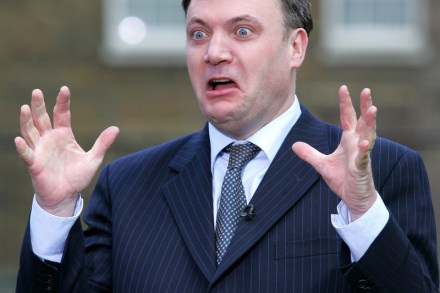
This brightened the day. Alastair Campbell, courtesy of his complete diaries, on Ed Balls: “Ed Balls spoke drivel, a never-ending collection of words that just ran into each other and became devoid of meaning.
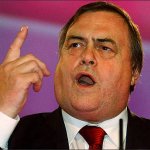
It’s John Prescott’s birthday – or Lord Prescott, as he will soon be. How odd of JP to don the ermine, given that he is on record saying that he hates titles, flunkery and ‘flooding’ the House of Lords with appointees - a practice in which he and Blair excelled as it happens. He appeared on the Today programme this morning to defend his lordly person and was emphatically unintelligible. Listen to it; it’s a classic. You know Prescott’s the EU's environment ‘rapporteur’? Terrifying. John Humphrys objected to Prescott’s hypocrisy, but if Prescott doesn’t want to retire from public life then he must sit in the Lords.
There’s something Galsworthian about Danny Alexander, the man of property. A downy press secretary for the Cairngorm National Park bought a south London hovel in 1999, re-designated it his second home in 2005 when he became an MP, and the Bright Young Thing then sold it in 2007 for £300,000. The dashing Cabinet Minister's recent mortgage claims of £1,100 per month suggest an existence amid more salubrious environs – Volvos, delicatessens and Oxfam. Alexander didn't cheat his way to Cheam, or wherever he lives. ‘There is no suggestion that Mr Alexander has broken any tax laws,’ opine the authors of this morning’s expenses expose.
The drowsy Hay festival has been shaken by two bespectacled academics igniting a rather too intricate political bomb. Under the guise of a literary interview, Philippe Sands QC and the French ambassador to London, Maurice Gourdault-Montagne, have connived to attack Jack Straw’s evidence to the Chilcot Inquiry. Straw was adamant that President Chirac was ‘unambiguous, whatever the circumstances’ in his refusal to back a second UN resolution. The Guardian reports that Gourdault-Montagne told the Hay festival: ‘Chirac had made it clear that he meant France could not have supported a new UN resolution at that time since it would have triggered an invasion despite the lack of evidence that Iraq possessed WMD.


I hope CoffeeHouse readers will forgive the attention I am heaping on the Afghanistan War these days, but the campaign is moving into a decisive phase with a July donor’s conference in Kabul that Hillary Clinton is reportedly attending, a “peace jirga” scheduled to consider plans to negotiate with the Taliban and only a year to go before the first US combat troops begin heading home. No 10 is now letting it be known that the Prime Minister, his key Cabinet ministers, generals and aides will gather shortly to discuss the mission. A sort of condensed Obama review of the UK contribution.
It was inevitable, but this is hugely regrettable as Laws is a star performer and I feel he has been the victim of a media gay-hunt that belongs to a bygone era. The sums of money involved are slight in comparison to some, and there are arguments that other ministers should resign for having committed similar or worse offences and for having shown markedly less contrition. But it is refreshing that a minister would resign over a personal transgression with haste and dignity. His successor is understood to be a Lib Dem, probably Chris Huhne or Jeremy Browne. Huhne made his money working on hedge funds so he is a more or less a like for like replacement.
David Cameron has made his first podcast since becoming Prime Minister. There are a couple of noteworthy points: he didn’t name-check any Lib Dems (a slight if perhaps telling oversight); and he reiterated his call for a ‘transparency revolution’, allying accountable public services with a new style of open politics. The coalition will 'rip-off the cloak of secrecy... and rebuild public trust in politics.' Oh the difference a day makes. Recorded on the train down from Yorkshire yesterday, pithy catchphrases such as ‘by the time we've finished, they (politicians) will have far, far fewer places to nowhere to hide’ sound a little insensitive today. But I’m nit-picking. It’s an excellent spiel: clear, direct and contrite.

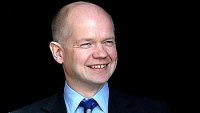
Four weeks into the new government and the National Security Council machinery is still being put in place and ministers are still getting read into their briefs. The visit by William Hague, Andrew Mitchell and Liam Fox to Afghanistan was important, despite the brouhaha over the Defence Secretary’s comments. Such a visit was simply not imaginable under the Brown government. On the other hand, insiders say there is no real difference yet from the NSID committee that Gordon Brown created and the National Security Council that David Cameron has convened - except that the latter meets weekly, producing a torrent of tasks for officials. Permanent Secretaries are meeting regularly to support the NSC, but the subordinate structures are still not in place.
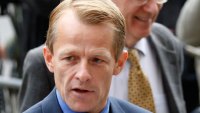
Paul Waugh and Matthew D’Ancona are debating whether David Laws will stay or go. D’Ancona is plain that Laws must go; Waugh wonders if this is an ‘Ecclestone moment’ and that Cameron and Clegg will dig in. John Rentoul agrees with Waugh. Laws’s situation looks bleak, and Andrew Grice concludes that Laws is no longer master of his fate. But it is not hopeless and Laws can survive. Laws is indispensible to the coalition - especially with left-wing Lib Dems Menzies Campbell and Simon Hughes increasingly intent on dissent. Second, who would replace him? There’s more talent on Virgin TV than there is on the blue and yellow benches, and the government cannot afford instability at the Treasury with the emergency budget looming.
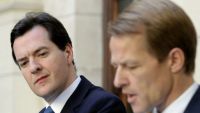
Even a general election could not shorten the expenses crisis’s shadow. The Telegraph has the scoop that David Laws apparently abused the second home allowance between 2006 and 2009, claiming tens of thousands of pounds for rooms owned by his long-term partner. MPs have been banned from leasing accommodation from their partners since 2006. Spice is added to the scandal in that Laws escaped exposure during last year’s witch hunt because he did not disclose that his landlord, James Lundie, was also his lover. Laws and Lundie have been involved since 2001; their attachment was kept secret from family and friends. Laws’s defends his actions as being designed to guard against revealing his sexuality.
Surprise, surprise – Menzies Campbell doesn't sound 100% taken with the coalition in interview with Andrew Neil on Straight Talk this weekend. This is, don't forget, the man who encouraged the Lib Dems to seek a deal with Labour at the last minute. And here he claims that he "would have found it very difficult to make the kind of arrangement with David Cameron that Nick Clegg has obviously found so easy." He adds that: "...there is this determination to make [the coaltion] work and nowhere is that more obvious than in David Cameron and Nick Clegg.
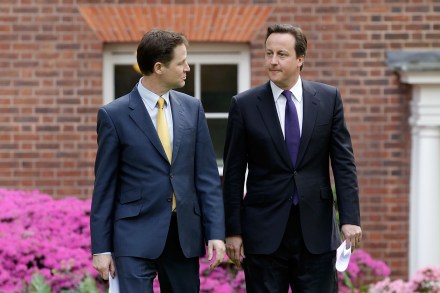
David Cameron's speech today was, in many respects, the one he needed to make: the clean-break speech, which trashed Labour's record on the economy while also outlining how the coalition would deliver us to the sunny uplands. As it happens, it was also quite effective: a blend of policy specifics and punchy rhetoric. And while we'd heard many of those specifics before – corporation tax cuts, reduced regulation, carbon capture, etc. – they cohered here as they rarely have done before. The most earcatching apsect of the speech, though, was the emphasis Cameron placed on government intervention. Yes, there was a solid core of small state fundamentals.
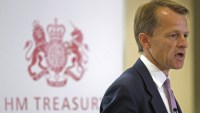
Wondering why David Laws put in such a convincing performance when defending the government's cuts at the dispatch box on Wednesday? This little detail from Allegra Stratton's excellent profile of him might help explain: "A friend confirmed that for the past six months, as the official Lib Dem party line decided on by Vince Cable was no cuts, Laws had been telling friends he believed the markets wouldn't tolerate it. 'He has been saying privately the cuts have to start straight after the election,' they said.
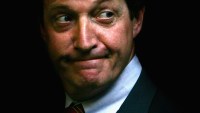
All kinds of hoohah about last night's Question Time, for which Downing St refused to put up a panellist because of Alastair Campbell's involvement. If he was replaced with a shadow minister, they said, they would happily get involved. But, as the excutive editor of Question Time explains here, the Beeb wasn't prepared to go along with that. So Campbell got to lord it up in front of the cameras. For the reasons outlined by Guido and Iain Dale, it was probably a slight mis-step by the coalition – but not one, in itself, that will have any important rammifications for them or the public. For while it's not the government's prerogative to decide on the entire Question Time panel, it is their prerogative to choose whether or not they join it.
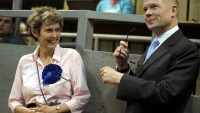
Was the delayed ballot in Thirsk and Malton a referendum on the coalition government? If so, the result released in the early hours of this morning will greatly reassure David Cameron and Nick Clegg. The Tory candidate Anne McIntosh won the seat with 52.9 percent of the vote (up from 51.9 percent in 2005), and the Lib Dems came second with 23.3 percent of the vote (up from 18.8 percent). Labour were pushed way down into third place on 13.5 percent (down from 23.4 percent). So, over three-quarters of the vote for the two coalition parties. I'd be hesitant to draw any firm conclusions from a one-off election, conducted under unusual circumstances.
The newly-elected 1922 Executive is another demonstration of the strength of the right wing of the Conservative party. Paul Goodman notes that of the seven MPs elected to the executive who were are not new to Parliament, six are on the right. The only one who isn’t is Nick Soames, who is a special case. As one member of the ’22 executive said to me earlier today, Soames, because of his immense popularity and standing in the party, transcends his factional labelling. Of the five new MPs elected to the exec, three — Robert Halfon, Charlie Elphicke and Priti Patel — are definitely on the right of the party. On the Today Programme this morning, Cameron signalled a welcome shift in his approach to party management.

In opposition, the Conservatives pursued an AfPak policy that can best be described as loyal criticism - while they supported the mission they criticised the means and methods employed to achieve it. It was an effective line of attack. But now that they have the internal documents and can call for further intelligence assessments, they should instead undertake a zero-based review of the current strategy focusing on: 1) the viability of the current US approach; 2) the likely timing and manner of a US shift; and 3) the best role for the UK in the next six months, in the next 2 years and in the next five years. In this discussion nothing – absolutely nothing – must be off the table.
Yesterday, it was Michael Gove's schools agenda. Today, it's the other main reason to get behind the coalition: IDS's plans for fixing the welfare system. The Secretary of State for Work and Pensions has given a speech outlining them this morning. You can read it here, and I'd certainly encourage you to do so. There are plenty of welcome ideas in there, but none more so than IDS's emphasis on removing disincentives to work from the tax and benefit system. We at Coffee House have banged on about his "dynamic" approach, developed at the Centre for Social Justice, for some time now - and with due cause.
Point six of ten on the Conservative-Liberal agreement reads as follows: “We will work to promote stability in the Western Balkans.” William Hague will get a chance to show what this means when he joins fellow European foreign ministers at a summit in Sarajevo on 2 June. As I argue in a new brief about Balkan policy, the meeting could not come at a better time. The region is beginning to look dicey once again. Though Balkan countries were asked by the West to proceed along the reform-laden route towards EU accession, which entails reforming their economies, making friends with erstwhile enemies and adjusting their constitutions, there is now uncertainty whether the EU actually wants them to join the club.
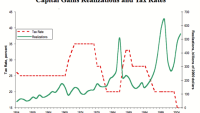
To address the deficit, George Osborne will probably have to raise taxes. This is a grim truth to which most people are reconciled. But raising taxes and raising revenue are two different things. If the Chancellor is serious about closing that deficit, then he would doubtless be interested in the idea that a Capital Gains Tax raise from 18 per cent to 50 per cent might be a chimera tax. That is to say, one which raises no money at all. Worse, in fact, the odds are that tax revenues will fall and the deficit will be made worse by this tax rise. The international evidence is absolutely clear. As sure as night follows day, tax revenues go down when CGT rates go up.