Uk politics

The Gove reforms grow even more radical

Local authorities are already doing their utmost to block the coalition's schools reforms, so just how will they respond to this story on the front of today's FT? It reveals how Michael Gove is planning to sideline local authorities from the funding of all state schools – not just free schools and academies. The idea is that state schools will get cash directly from the state, without any need for the council middlemen that currently control the system. Here's an FT graphic that captures the change: The money would be allocated to schools in proportion to the number of pupils they have, and headmasters would have much more freedom in how to spend it. This is the same simple but transformative dynamic that inspirits the rest of the Gove reforms.

The pledge divide

Over at the FT's Westminster blog, Alex Barker asks why it is that David Cameron's expensive personal pledge on pensioner benefits has survived the spending review while Nick Clegg's personal pledge to scrap tuition fees, which would have cost roughly the same amount, has been spectacularly ditched. As Alex argues, one reason is that Clegg himself was not particularly attached to his pledge on fees. Indeed, he had tried to change the policy several times in opposition. The other is that George Osborne, who is the Tories' chief election strategist as well as the Chancellor, is determined to protect the Cameron brand.

Going beyond the IDS reforms

Iain Duncan Smith deserves credit for fully understanding the nature and scale of the welfare problem. But that’s the easy bit. Finding a solution with the right balance of carrot and stick and making it somehow affordable in these austere times is the tougher part of the equation. And it’s not at all clear that the IDS proposals have either enough carrot or enough stick.   He has certainly gone some way to tackling the lunacy of huge withdrawal rates – if by entering the workforce your new post-tax pay packet is less than the benefits you stand to lose, then don’t be surprised when an entrepreneurial work ethic fails to emerge in some of the country’s poorest areas.

Ten things you need to know about the welfare White Paper

I've sifted through yesterday's welfare White Paper, and thought CoffeeHousers might appreciate a ten-point guide to its contents. This is by no means the entire picture – and some of it will be familiar from past Coffee House posts – but hopefully it should capture the broad sweep of IDS's reforms: 1) The problem. Fundamentally, the issue is that there are a lot of people stuck on out-of-work benefits: around 5 million at the last count. This means different things for different groups. For the Treasury and taxpayers it contributes towards an unwieldy working-age welfare budget that has increased by 45 percent, in real terms, over the past decade – to around £80 billion.

50p tax: the coalition’s most expensive policy

In my cover story for this week’s magazine, I say that the damage of the 50p tax, various bank levies and general banker-bashing is far greater than Osborne realises. Here are the top points I seek to make:   1. We may hate to admit it but the British tax base, and our chances of reducing the deficit, are heavily reliant on a handful of very rich people. The highest-paid 1 percent will generate 23 percent of income tax collected in the UK in the year before the 50p tax (see the table below). And spot the correlation between the top tax rate, and the burden shouldered by the richest and the poorest. Which are the most progressive – the figures on the right, or the figures on the left? 2.

Johnson’s deceptions and out-of-date figures

Oh, how Labour enjoy misleading the public about their record on the public finances. Ed Miliband did it a couple of weeks ago, with some very loose rhetoric about how the previous government had "paid down the debt". And now Alan Johnson's at it, with a fiery speech at the RSA which reheated many of the themes in his recent New Statesman article. The passage that struck me was this: "In 2007/08 as the crisis hit, we have the second lowest debt level in the G7 reduced by 14 percent in the 10 years we'd been in office... …The year before the crisis hit we were borrowing 2.4 percent of GDP compared to the 3.4 percent we inherited from Ken Clarke." Some points: 1) Second lowest debt level in the G7.

Poppy season

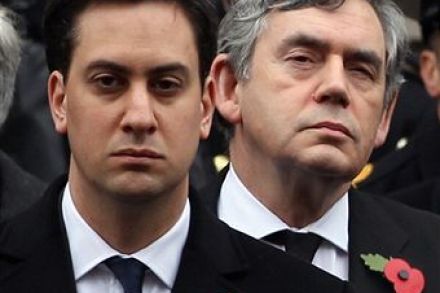
Keen-eyed spectators might have noticed Danny Alexander and Michael Gove wearing a slightly different type of poppy over the last few days: the Scottish Poppy. At the beginning of the poppy-wearing season they are for sale at the Scottish Office in Whitehall and are worn by certain Scots down here – any money that Andrew Marr will be wearing one on Sunday, for example.   What’s the difference? Scots poppies have four petals, and no green leaf.  The English version costs a little more to produce, and – one might argue – looks more sophisticated. But the Scots version can claim to be anatomically correct, because poppies don’t have green leaves. The Scottish poppy is also an early grower: it’s worn a bit earlier north of the border.

A considerable achievement

This morning's welfare event was one of the great "Who'da thunk it?" moments of this government so far. Here we had the Lib Dem leader providing backing vocals for a former Tory leader who has not only become a minister, but who is implementing an agenda that only a few months ago was little more than an idea in a think-tank report. Reviewing that Centre for Social Justice report for Coffee House at the time, I said it deserved to influence welfare policy for years to come. Now, it looks as though it will do just that. The immensity of Iain Duncan Smith's achievement should not be underestimated. No doubt, the path to a Universal Credit and a more robust version of workfare will be one that meanders into controversy.

What sort of country do we want to be? A soft one

Admiral Lord West’s intervention was most striking in its language. He promised that a ‘national humiliation on the scale of the loss of Singapore’ would ensue unless his advice was heeded. Writing in the Times (£), Sir Menzies Campbell notes West’s seething tone and concludes that his frustration was the product of a review of defence resources, not strategy. At no point, Campbell says, did the government ask ‘what sort of country do we want to be’ and plan accordingly. Campbell continues: ‘Is Britain ready now or likely to be ready to go to the aid, alone or with allies, of a nation that becomes the target of aggression, as we did in Sierra Leone and Kosovo?

The Lib Dems are spared by idiotic students

The violence at today’s student protest is, politically, a boon to the coalition. The story now is not the Lib Dems breaking their word but the storming of Millbank. The violence will also have cost the no-fees cause much public sympathy, we don’t like attempts at aggressive direct action in this country. There are questions that need to be answered after today, why were the cops so unprepared for the protest turning violent? I crossed through the protest at lunchtime and then it was quite clear that there was potential for trouble. I’m also bemused as to why it is taking so long to put a stop to the violence and deal with those involved. Given the political environment, this might well not be the last protest to turn nasty.

G-20 in Seoul: Beyond “Camerkelism”

David Cameron is now in Seoul for the first G-20 summit hosted by a non–G-7 member state. It will be the Prime Minister’s second G-20. But things have changed dramatically since he came to power and had to jet to Toronto for his multilateral baptism. Then the Prime Minister’s arguments for austerity measures were theoretical - and a minority position. Now, they are real and have become the majority view. “Camerkelism”, the idea that short-term fiscal consolidation will induce sufficient private-sector activity to more than fully offset the fiscal drag seems to be in the ascendant. Yet the forced smiles at the traditional G-20 class photo will belie a number of continuing problems. The biggest issue will be about the Chinese exchange rate.

The Big Society conundrum

The children’s minister Tim Loughton is in danger of having ‘gaffe-prone’ become his suffix. After rather putting his foot in it at conference by suggesting that the policy George Osborne had just announced on child benefit could be revisited, he has now suggested that not even ministers know what Cameron’s big idea, the ‘Big Society’ actually is. He told a dinner last night: "The trouble is that most people don't know what the Big Society really means, least of all the unfortunate ministers who have to articulate it.” A friend of Loughton tells me that this was meant as a joke.

Cheating on the students

Writhe, squirm, cringe and cower. The Commons wanted to inflict ritual punishments on Nick Clegg today for his broken pledges on student fees. The plan nearly succeeded. With Cameron in China, (finding out what happened to our manufacturing base), Clegg took his place at the dispatch box opposite Harriet Harman.    Long practice has given Harman some skill, and even self-possession, at the dispatch box. She had an exceptionally easy target today. As she stood up to give Slick Nick a roasting, the streets around parliament were swelling with angry university-goers waving photos of Clegg signing his fateful election pledge on fees. The LibDem manifesto was being burned in public. Yellow election placards were being trampelled and spat on.

The politics of the student protests

The student protests really are throwing up some extraordinary images. Who'd have thought that they'd end up smashing their way in to the lobby of Tory HQ, setting fire to placards, hurling bricks and other objects – and all as news helicopters buzz insistently overhead? It's not Paris '68, but it's certainly not traditional British reserve either. I'd be tempted to say that this is the fury of a generation which, as I've written before, has generally been excluded from the political conversation – if, like Iain Dale, I didn't suspect that this demonstration had been overtaken by a bunch of dubious fringe groups. So, instead, I'll refer CoffeeHousers to this argument made by the Guardian's Julian Glover a few months ago, and which I've highlighted before.

Labour’s Woolas trouble

This Phil Woolas business is fast becoming a rather large problem for Ed Miliband. Those Labour MPs who are organising a fighting fund for Woolas are effectively defying the party leadership. Remarkably, he is on course to raise £50,000 by Friday. There is a whole slew of explanations for why Labour MPs are, to borrow a phrase, standing by Phil. First of all, the idea of judges overturning election results isn’t popular. Second, he’s a well-liked and sociable colleague, and no one who has fought a Lib Dem has much sympathy with their complaints about dirty tactics. But after these explanations, we move into more murky territory.

PMQs live blog | 10 November 2010

VERDICT: Earlier today, I wrote that the coalition "has few better defenders of its cause than Nick Clegg". You wouldn't have guessed it from this PMQs performance. Harman had him on the back foot over tuition fees from the off, and he struggled to give concise, clear answers in return. A pity, because Clegg is right when he says that the coalition has a better policy than Labour's messy graduate tax – yet there was too much waffle, and too little directness, from him today. The deputy Prime Minister was better when he blazed with anger over Labour's hypocrisy. But, on the whole, this was a bout to cheer the Labour benches. 1233: And that's it. My verdict shortly.

Ten more highlights from the Bush serialisation

You know the drill: the second part of the Times's Bush serialisation (£) is out today, so here are ten more highlights from their coverage. The book is also out today, so we can, as the former President suggests, draw our own conclusions. 1) Watching the towers collapse. "I caught enough fleeting glimpses of the coverage to understand the horror of what the American people were watching. Stranded people were jumping to their deaths from the World Trade Center towers. I felt their agony and despair. I had the most powerful job in the world, yet I felt powerless to help them. At one point, the television signal held steady long enough for me to see the south tower of the World Trade Center collapse. The north tower fell less than 30 minutes later.