Uk politics

Cameron: ‘We have to end the sicknote culture’

The Prime Minister has backed the proposal for a new independent service to sign workers' long-term sicknotes, instead of GPs. The plan, which Pete wrote about at the weekend, is aimed at ensuring that people on sick pay or sickness-related benefits really are too ill to work. Cameron describes how it would work in today's Mail: 'The independent service would be free to all employers from four weeks of sickness absence, with the option for employers to pay for it earlier. It would provide an in-depth assessment of an individual's physical and mental function. So if they're unable to work, they’ll be helped – but if they are fit, they'll be identified and supported back into the workplace.

Paying for justice

To British ministers, the role that the International Criminal Court played over Libya was key – it made clear that Colonel Gaddafi's actions were unacceptable and would be subject to international law. Tory MP Dominic Raab even wrote a piece in The Times about the need for Libyans to rely on the ICC in The Hague, rather than seek retribution and revenge against Gaddafi and his loyalists. And it wasn't only the British government. German Chancellor Angela Merkel stated that the Libyan leader Muammar Gaddafi should be tried by the ICC: 'Gaddafi should have a trial according to the law, something he never did with his opponents,' Merkel said when asked by the weekly Bild am Sonntag whether she was in favour of such a trial.

In PMQs, a preview of next week’s battles

Today's PMQs was a preview of the debate we'll be having after next week's autumn statement. Miliband, struggling with a bit of a cold, tried to pin the economy's problems on Cameron. The Prime Minister's retort was 'who would want to put the people responsible for the current mess back in charge'. It was a simple message and one that carried him through the session. The other feature of today's joust was also a preview of next week: a tussle over the strikes. Cameron said strikes were the 'height of irresponsibility'. He also made sympathetic noises when Tory MPs asked about imposing minimum thresholds for strike ballots.

Opening Europe

It is an article of British faith that further liberalisation of Europe's market is a worthwhile goal. But few people realise the boost the UK economy would actually get from the finalisation of the EU's internal market – especially implementation of the Services Directive, creating an integrated market for energy, modernising public procurement rules and liberalising the digital market. Implementation of the Services Directive alone would add 1.5 per cent of GDP to the EU as a whole in the next nine years, according to European Commission calculations. As the UK has one of the strongest services sectors, this will have direct benefits here.

Huhne’s partner involved in lobbying row

Another lobbying scandal has hit the coalition. The Times is reporting that Carina Trimingham, Chris Huhne’s partner, boasted of having ‘excellent contacts… from Cabinet members to more junior ministers’ to a lobbying firm she was seeking work with. She also allegedly urged this firm to ‘make use of my skills and contacts.’ Trimingham has told the paper that she will not take on any role that involves energy and climate change so there will be no conflict of interest. She also points out that having worked in politics for more than a decade Huhne is not her only contact. A spokesman for the Energy and Climate Change Secretary says that Trimingham has offered assurances that she won’t work in any area under his department.

The dangers of ever-closer union

Yesterday, Fraser wrote that 'reporting of European issues tends to ignore public opinion'. Today, Philip Stephens has neatly illustrated Fraser's point in his Financial Times column. Musing on Britain's possible exit from the European Union, Stephens writes: 'I am not sure this is what the prime minister intends; nor, when it comes to it, that British voters will accept such an outcome.' Stephens' conjecture ignores the European Union's own polling, which, as Fraser says, shows most Britons to be hostile to the EU. That said, Stephens' article is substantial. He argues that 'fiscal union carries its own remorseless logic: the progressive exclusion of Britain from Europe’s economic decision-making'.

The government’s housing policies don’t match its strong rhetoric

Yesterday's housing strategy offered a mortgage guarantee for first-time buyers of new properties, one of the few new announcements in a document largely consisting of re-hashed policy. At best, the mortgage guarantee helps to provide a boost to house builders and welcome relief for some credit-worthy borrowers who simply can't build up a sufficient deposit. At worst, it encourages risky lending, subsidises high house prices and raises unrealistic expectations for young families. Unaffordable, reckless lending (at least, up until the credit crunch and collapse of the sub-prime market) threatened the stability of the financial sector and caused misery to thousands of homeowners who later found themselves falling behind on payments and threatened with eviction.

Osborne chooses more debt over more cuts

Reading today's newspapers, it seems that the biggest decision of Osborne's mini-Budget has already been made. Evaporating growth means lower tax revenues, so the choice is between protecting his deficit reduction plan or keeping total spending cuts at less than 1 per cent a year. Increasing savings to, say, 1.3 per cent a year would mean he could easily meet his deficit targets. But it seems the decision has been taken to borrow even more. In his March budget, Osborne laid out plans to increase government debt by 51 per cent over the course of a parliament – lower than the 60 per cent that Labour had planned. It now looks as if Osborne will increase debt by even more than that 51 per cent.

Party funding reforms won’t happen

The recommendations of the Committee on Standards in Public Life's review into party funding are not going to happen. Both the Labour and Tory members of the review have issued notes of dissent to it. Nick Clegg has, on behalf of the government, issued a statement gently rolling the report into the long grass. Interestingly, the Tory party - which was for a while attracted to additional state funding - has now ruled it out completely. Unlike Clegg's statement saying it shouldn't be done while economic times are so tough, the Tory rejection of it is not time limited. One other thing worth noting is that Labour, via Margaret Beckett's dissent, has not set itself against trade union members having to opt in to pay the political levy.

There’s merit in the Coalition’s housing proposals

The government's announcement on housing today is an attempt to square the circle. On the one hand, a return to excessive lending and sub-prime mortgages is clearly not a good thing. Critics say, with justification, look where government backed mortgages got America. But on the other, there are clearly problems when people who aren't fortunate enough to have parental help aren't getting on the housing ladder until well into their thirties. Conservatives who understand the importance of a property-owning democracy should be concerned about this. The Coalition's solution — and this is the most genuinely coalition piece of policy we've seen in months — is partial government indemnities for people taking out 95 per cent mortgages on new build properties.

How ambitious is Cameron on Europe?

Someone forgot to pack his handbag. We heard yesterday that David Cameron has agreed to let Merkel pursue full fiscal union – and in return she will... drum roll please... let him repatriate parts of the Working Time Directive. There's nothing official from Number 10, but the well-informed Ben Brogan suggests this morning that this could well be Britain's price for agreeing to Merkel's deal. If so, this would be an opportunity squandered on a massive – perhaps historic – scale. Let's recap. Cameron is in an incredibly powerful position: leading a government which is, in defiance of public opinion, giving £9 billion of overseas aid to EU member states each year.

The SNP hit the jackpot

Some political leaders might be a bit hesitant when it comes to approaching lottery winners in the hope of securing some of their dosh for the party cause – but not Alex Salmond. Back in July this year, when it emerged that a couple in Ayrshire – Colin and Chris Weir – had scooped a record £161 million on the EuroMillions, Scotland's First Minister reacted with astonishing speed. Within days Mr Salmond had written a letter to the couple congratulating them on their success and adding: 'When I heard the fantastic news that a Scot had landed the EuroMillions jackpot, I did wonder if this was the same Colin Weir who helped produce SNP party political broadcasts for a young party publicity vice-convener all those years ago.

The government’s airport conundrum

There is a growing acceptance in government that the South East needs more airport capacity. But, as today's Times outlines, there's nowhere near agreement on how best to achieve this. The big problem with a new airport on the Kent coast or 'Boris Island' is that the Dutch would not be prepared to open up the necessary air space. They control most of the air above the North Sea under international treaty because of Schiphol airport. I understand that feelers put out to the Dutch on this matter have been rebuffed. Another option is Heathwick. The idea is that an extra runway is built at Gatwick and then the two airports are joined together by a high-speed rail line. Initial work suggests that journey time between the two airports would be just 15 minutes.

Are we facing an American nightmare?

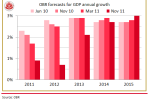
With the Chancellor’s autumn statement due next Tuesday, we're all talking about growth. The ECB and Bank of England now say the UK economy is set to grow at less than half the rate the OBR forecast back in March. That makes it all but certain that George Osborne will announce dramatic downward revisions to UK forecasts when he stands up in parliament next week. But before all the fighting about Plan As and Bs reaches fever pitch, it’s worth asking what the next decade looked like under the previous, more optimistic growth projections. The answer isn’t pretty and it helps highlight one major question that’s rarely asked in our debate about GDP: what kind of growth are we after? The chart below neatly sums up the problem.

The vote in Spain

The expected triumph of the centre-right Popular Party in today’s Spanish elections promises to have some interesting consequences for British politics. The PP have been in close touch with the Tories here and plan to introduce an emergency budget based on the Osborne model: a clear deficit reduction plan combined with an increase in the retirement age. They hope that this will reduce the ever-upwards pressure on Spanish bond yields. Certainly, if the PP approach does succeed in gaining Spain credibility with the bond markets, it will bolster the coalition’s arguments about the importance of sticking to Plan A.

Are the Lib Dems pro-EU?

This might seem a very odd question. A pro-EU position is part of the party's internationalist DNA. Listen to any EU-related speech by the likes of Nick Clegg or Paddy Ashdown and heartfelt support for the European project is apparent. The Liberal Democrats have also made a virtue of reining in Tory euroscepticism, for example rejecting a call for repatriation of powers in the Coalition Agreement. The Deputy Prime Minister remains, in private and public, pro-EU. And to many activists and MPs, the party's European stance is what makes it different to the Tories – and is the reason why they are Lib Dems. They see in Tory euroscepticism a boorish Little Englanderness they abhor and find out of synch with the way of the modern world.

Now will we learn the truth about Saif’s British ties?

Now that Saif Gaddafi has been captured, the race will be on to interview him from a prison cell and ask what his business was with the various figures of the British establishment with whom he was so close. CoffeeHousers will remember the 2009 party at the Rothschilds' manor in Corfu: Saif, Mandy and Nat Rothschild. A little later, Charles Moore revealed in The Spectator that the trio were later reunited in a shooting party at Lord Rothschild's Waddesdon Manor in Buckinghamshire. I spoke to Lord Mandelson a few weeks after the piece appeared, and thought CoffeeHousers may be interested in the transcript. The noble lord was outraged at Charles' piece – because it suggested he was also hanging out with Cherie Blair that night.

Riots and responsibilities

The riots are fast in danger of becoming the forgotten issue in our politics. The social and cultural problems that they laid bare have been knocked out of the news by the continuing financial and political drama in the Eurozone But if we, as a society, don’t work out how to address these problems then they will simply get worse. The essay by David Lammy, the MP for Tottenham, on what happened this summer in The Guardian magazine today is thought-provoking even if I don’t agree with all of its conclusions. . Interestingly for a man of the left, Lammy accepts the points that the riots were about culture as much as anything else. As he writes, ‘the mothers sitting nervously in my surgeries were not just talking about money.