Uk politics

QE comes to the fore

It’s roughly seven months until George Osborne’s Autumn Statement, so no better time to consider which political issues will come to the boil ahead of it. Fuel costs, I’m sure, will be one if them; because they never really go away, and the 3p rise in fuel duty will have just been implemented in August. But I’d say the safest bet is the finances of the elderly. If the furore over the frozen income tax allowance for pensioners didn’t put that voting bloc at the forefront of Osborne’s mind, then the demographics behind UKIP’s poll jump will surely do the trick. He will be under severe pressure to act. Actually,

After Abu Qatada

It has been a mixed news day so far as Britain’s relationship with the ECHR is concerned. There’s been the good stuff: Abu Qatada has been arrested and is set to be deported, with the government now confident that he can be shipped to Jordan without provoking the ire of Europe’s legal class. And then there has been the less than good stuff: according to the Times, which has a leaked document in its possession, Britain’s official proposals for reforming the ECHR have been diluted ahead of the Council of Europe meeting in Brighton this week. This outcome, as I suggested back in February, is hardly surprising — but it

No ‘poll shock’, but some interesting findings nonetheless

Despite the Times’s headline (‘Poll shock as new U-turn looms’), there’s nothing particularly surprising in the toplines of today’s Populus poll. It merely confirms the trends already exposed by other pollsters: a widening Labour lead (Populus has it at nine points, up from four last month) and increasing discontent with the coalition (Populus has the government’s net approval rating at minus 24, down from minus 3 in September). Beneath the toplines though, there are some interesting details. As well as asking respondents how well they think the government’s doing overall, Populus asked how well they think it’s doing on various issues: So, it seems the public thinks the coalition is

Anders Borg: Europe’s best finance minister

In the current issue of The Spectator I interview Sweden’s Anders Borg, perhaps the most successful conservative finance minister in the world — both in his economic track record, and the accompanying electoral success. His response to the crash was a permanent tax cut to speed the recovery. At the time, everyone told him it was madness. But Borg is unusual amongst finance ministers, in that he is a trained economist. To him, madness lay in repeating the formula of the 1970s and expecting different results. Last year, Sweden celebrated the elimination of its deficit. It’s perhaps worth mentioning a few other points which I didn’t fit into the interview.

America’s version of the ‘tax the rich’ debate

While the battle continues to rage over the government’s plan to cap tax relief, on the other side of the Atlantic the US bill that inspired it has been killed. The ‘Paying a Fair Share Act 2012’ — more commonly known as the ‘Buffett Rule’ after billionaire Warren Buffett — failed to get the votes it needed to be debated in the Senate. It was backed by a majority of senators, with 51 voting ‘Yea’ to 45 ‘Nay’s, but fell short of the 60 votes needed to break a filibuster. Fraser explained on Friday how Obama’s efforts to ensure that — as the President puts it — ‘If you make

Galloway swears in

Here, via the New Statesman’s George Eaton, is footage of George Galloway being sworn into Parliament today: And while we’re on the subject of Galloway and swearing, here’s one for CoffeeHousers to ponder. In his interview with the Big Issue today, the country’s latest MP says: ‘Because I don’t drink, I don’t swear, I’m not crude, sometimes male company turns me off. And from an early age I was the person who drove everybody home and I always saved the prettiest girl to drop off last.’ Others have already touched on the not drinking thing. But not swearing? What about this report, from 2006, by the Spectator’s own Hugo Rifkind:

Will Osborne stop at £10 billion?

On one side of the Atlantic, there’s Christine Lagarde begging for more cash for the IMF. On the other, there’s George Osborne more or less willing to hand it over on behalf of British taxpayers. This is how it’s been for months now. This is why it’s no surprise to read in today’s Telegraph that Osborne may be ‘close to agreeing’ an extra £10 billion for the fund. There are the usual caveats, of course: the Exchequer will only stump up if various other countries do likewise, and then the money has to go into one big pot for all the world, not into special mechanisms targetted at the eurozone.

Mayor for Muslims or the rich?

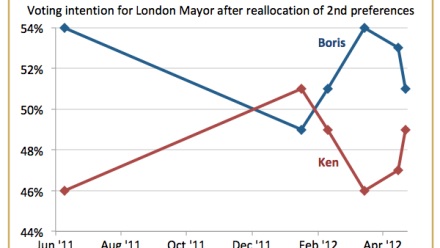
Does Boris not care for poor Londoners? A new question in today’s Evening Standard polling reveals that 40 per cent of voters believe that Boris is the candidate to aid rich Londoners. Ken has also carved his own niche, successfully winning over many Muslin voters — around 20 per cent state he is particularly keen to help them. Here are the full numbers: But such perceptions have made little difference to either candidate’s chances. The headline voting figures remain steady at 53 per cent for Boris and 47 per cent for Ken, despite the above and also the recent tax saga.

Another blow against the something for nothing culture

In the aftermath of the riots, the idea of withholding child benefit from mothers whose kids played truant was floated by Number 10. The aim was to link child benefit payments to getting your child to attend schools. This was meant to be part of a broader effort to end the something for nothing culture. Now, 8 months on from the riots — and after months of coalition wrangling — we have some flesh on the bones of this idea. Charlie Taylor, the government’s impressive adviser on behaviour, has proposed (£) that fines for children being persistently truant should be deducted from child benefit payments. At the moment, head teachers

The trade mission delusion

David Cameron has returned from what was a bit of a war-and-peace tour of East Asia. Taking arms dealers to Indonesia one day, posing with Aung San Suu Kyi the next. In today’s Sunday Telegraph he writes an almost-defensive piece about it all: ‘With the eurozone producing sluggish growth, we simply can’t rely on trade with Europe to generate the jobs and growth we need. We need to look south and east and do a much better job of winning business in places such as China, India, the Gulf, Africa and South America. That’s why I have been leading trade missions to some of the fastest growing parts of the world, including

The politics of taking big money out of politics

Ed Miliband is nothing if not persistent. Party funding has been a running theme of his leadership, necessitated by his cosy relationship with the unions. He has returned to the subject today, with a blog post and an appearance on the Andrew Marr Show. The news is that Miliband wants to cap donations from individuals, organisations and companies at £5,000. That is £5,000 less than was recommended by Sir Christopher Kelly, and £45,000 less than the Conservatives propose. Miliband claimed that this would dramatically reduce Labour’s funding from the trade unions, forcing his party to diversify its revenue sources. Obviously, it would also reduce the Tories’ funding sources. This is

The charity row intensifies

David Cameron finds himself in the midst of a blue-on-blue barney over the charity tax, which has prompted rumours that ministers may dilute the current proposals by adopting an American-style legacy deal. Tory party treasurer Lord Fink has said that the proposed changes would ‘put people off giving’, and some boisterous Conservative MPs are openly challenging the leadership. Zac Goldsmith has penned a diatribe in the Mail on Sunday in which he says: ‘I am ashamed that a Conservative Chancellor has not only announced measures that will undoubtedly depress giving in this country; he has spun a narrative in which philanthropists are now the enemy.’ Meanwhile, David Davis told the

Downfall

It did not take long. Last month, Matt Ridley argued in a Spectator cover story that the wind farm agenda is in effect dead, having collapsed under the weight of its own contradictions. The only question is when our ministers would realise. In an interview with the Sunday Times (£), climate change minister Greg Barker admits that his department has adopted an ‘unbalanced’ approach to wind farms and will now look at other options. ‘Far from wanting thousands more, actually for most of the wind we need… they are either being built, being developed or in planning. The notion that there’s some new wave of wind [farms] is somewhat exaggerated.’ Indeed, the phrase ‘somewhat exaggerated’

An independent Scotland could pay its own way<a id="fck_paste_padding"></a>

The Economist has some fun with Scotland this week, running a cover suggesting my motherland would go bust if it was independent. The map has lots of gags: the Outer Hebrides is renamed ‘Outer Cash’, ‘Edinborrow’ twinned with Athens etc. But it suffers from one central defect: the thesis is nonsense. Saying that Scotland would go bust without English subsidy is the clichéd unionist attack line, which has lost force over the decades because it is demonstrably untrue. The emergence of new nation states, many much smaller than Scotland, has shown it that small is viable (something that wasn’t as evident in the 1970s) and even the Economists’ own story

Why Lansley might hang on

Perhaps, the biggest question about the post-Olympics reshuffle is what happens to Andrew Lansley. In an interview with The Times (£) today, he makes it abundantly clear that he expects to stay at Health. Now, there are certainly those in Downing Street who would like to see him moved. But I suspect that he’s got a better chance of staying in post than most people realise. There are three reasons for this. First, Lansley is the person who understands best what the bill actually does. Anyone else on the Tory side would face a steep learning curve. Second, it is far from certain that a slicker communicator would actually fare

The Blair-Brown wars continue

It took the Tory party 15 years to recover from the bad blood created by Margaret Thatcher’s forced resignation. So it is, perhaps, unsurprising that five years on, the bitterness from Tony Blair’s being pushed out of office has not yet subsided. Phil Collins, who was a speechwriter to Blair, has today written a scathing piece about Tom Watson, the leader of the so-called curry house coup against Blair. Collins accuses Watson of putting the ‘occupation of internal power’ in the party by his faction above the interests of the Labour party. Watson, who is Labour’s election campaigns coordinator, exerts a huge influence over Labour’s internal processes and candidate selection,

How Mitt Romney inspired the British charity tax debacle

How is Mitt Romney linked to the charity tax debacle? I thought I’d pass on to CoffeeHousers an explanation which passed on to me about the origins of this latest mess. It dates back to the point in the Budget negotiations where Nick Clegg had finally persuaded Osborne to introduce a Mansion Tax. A major coup for his party — but Cameron vetoed, thinking it’d hurt Boris in London. Clegg is annoyed, tells Osborne he can’t have his 40p tax, but he still has a problem. A Lib Dem spring conference is coming up — so what will he announce? He hunts for a new idea. The Thursday before the

Cameron meets Aung San Suu Kyi

There aren’t many countries where meeting the leader of the opposition would rank above meeting the head of government — certainly this country isn’t one of them. But Burma is, because the leader of the opposition is pro-democracy campaigner and Nobel Peace Prize winner Aung San Suu Kyi, who spent 15 years under house arrest between 1989 and November 2010. And Suu Kyi’s stature is now higher than ever, with her National League of Democracy party having won 43 of the 44 seats they contested in the by-elections a fortnight ago. As Clarissa reported then, there’s even speculation that she may be offered a position in President Thein Sein’s new