Uk politics

Another case of Big Government trumping the Big Society

Exactly two years ago today, David Cameron launched the Conservative Manifesto — one of those rare moments in the Tory campaign where it all seemed to make sense. Cameron begged for a hearing: he was serious, he said, about changing government. It was about realizing that ‘Big Government isn’t the answer to the problems’ and that people outside government — like charities — were. This is why the charities debacle today is not just another Budget blunder. As I say in my Telegraph column, if Cameron tolerates the taxman’s proposed assault on philanthropy, he’ll be admitting defeat on what he described that day as his ‘fundamental tenet’. The best-paid 1

Planet London

In his cover piece for this week’s magazine, Neil O’Brien describes the great divide between London and the rest of the UK. One of the main differences he highlights is in their economies. He says: ‘In inner west London, economic output per head is £110,000 a year. In an important sense, these people are not living in the same country as the inhabitants of Gwent or the Wirral, whose output is just a tenth of this.’ In fact, London is set apart not just from those two poorest areas, but every other area in the country. You see, the second richest area — Edinburgh — has an output per head

The resistance to elected mayors shows how badly they’re needed

The old political establishment in the cities is fighting back against the idea of city mayors. They know that a directly elected mayor threatens their traditional power base. As Jill Sherman reports in The Times today, ‘In Nottingham, the Labour council has put up posters around the city to demonstrate its opposition while the Labour group has sent newsletters to residents saying that a “Tory Extra Mayor” will cost £1 million.’ But it is not just Labour councils who are desperately trying to stop yes votes on May 3rd. Lib Dem-run Bristol City Council is also fiercely against the idea of a directly elected mayor. The reason there is so

Want to know what tax transparency looks like? Look at Norway

If you take George Osborne’s plan for tax transparency to its natural conclusion, where do you end up? The answer is Norway, where details of every taxpayer’s annual income, wealth and annual tax return are publicly available — and it’s not a new thing. Norwegian tax returns have been publicly available since the 1800s, the idea being that financial transparency is seen a vital part of social democracy. Figures were traditionally released every October in a Yellow Pages-style book, available for anyone to read at the local town hall or tax office. As the internet evolved, they decided to take things online. The government initially came up with the idea

Hints of a U-turn on the ‘charity tax’

The pressure is ramping up on the government to reverse its decision to cap tax reliefs on charitable donations. The Times is against it — their leader this morning calls the move a ‘blunder’. And the Telegraph doesn’t like it either, saying that ‘Even from a distance of 8,000 miles, it must be apparent to David Cameron that the Government made a mistake in the Budget by capping tax relief on charitable giving’. Even Tory MPs are speaking out against the measure, including Mark Pritchard, Conor Burns and, in a piece on ConservativeHome, Chris White. And Number 10 does seem to be preparing the ground for a U-turn — or

Where will the disenchantment with mainstream politics lead?

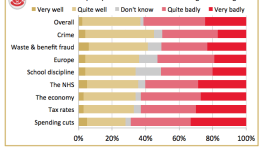
The big question in British politics right now is what happens when the voters are dissatisfied with all the three main parties and their leaders. According to a recent opinion poll, David Cameron’s approval rating is now down to minus 27. According to the invaluable Anthony Wells, this is the lowest it has been since Cameron became Tory leader. But the PM’s numbers look positively healthy compared to Miliband’s (minus 41) and Clegg’s (minus 53). Dissatisfaction with political leaders isn’t the only indicator that people aren’t happy. As I report in the column this week, senior Downing Street aides have been much struck by polling showing that more than 40

A welcome attempt to fix the broken energy market

Back in October, Ofgem produced a report exposing the failure of the UK’s energy market. It showed that the supplier’s profit margin on the average fuel bill had shot up from £15 to £125 in just four months. As I said at the time, ‘This wouldn’t be possible in a market that was working correctly. If customers were shopping around for the best deal, suppliers would have to undercut each other – and there’s plenty of room for them to reduce prices while still turning a profit (£125 of room, in fact). But Ofgem’s figures show this isn’t happening.’ And why isn’t it happening? Because, in Ofgem’s words, ‘Many consumers

Shapps has ‘deep reservations’ about the ‘conservatory tax’

There is deep unease among Tory ministers about the proposals for a so-called ‘conservatory tax’. The idea, which was pushed hard by Chris Huhne when he was Energy Secretary, is that when anyone does substantial home improvement work they would be made to make other changes to make their house more energy efficient. It is estimated that this would add about 10 percent to the cost of adding a conservatory or an extension to your house. The government is currently consulting on the policy. But I understand that Grant Shapps, the housing minister, has ‘deep reservations’ about it. He fears that the proposals are anti-aspiration and could risk bolstering the

The rise of UKIP

Who represents the biggest obstacle to a Tory majority in 2015? The natural assumption is Labour, but it’s looking more and more likely that the party David Cameron should be most worried about is UKIP. Tim Montgomerie has written in the Times this morning (£) about the reason behind this, the ‘split of the right-wing vote’: ‘Team Cameron has always believed that the Tories’ right-wing voters could pretty much be taken for granted. The theory was that they had nowhere else to go and that Mr Cameron had to devote all his energy to winning swing voters. This gamble worked as long as Tory-inclined voters were primarily motivated by a

What today’s Abu Hamza ruling means

The European Court of Human Rights has ruled that five terror suspects, including notorious Islamist cleric Abu Hamza, can be deported to the United States — a decision welcomed by both David Cameron and Theresa May. Last year, Hamza and three of the other men appealed to the ECtHR against extradition to the US on a whole host of grounds — including that they might face the death penalty and that their trials would be prejudiced. The Court found almost of all their grounds inadmissible, but allowed the appeal to proceed on two grounds: that they would be held in the ADX Florence ‘super-max’ prison and would face extremely long

When it comes to personality, Boris will always win 

The fight for London Mayor election has well and truly descended into a clash of personalities. Policies have all but disappeared while candidates trade attacks in the press. The Guardian, duly unimpressed, has written a scathing leader attacking both sides for this strategy: ‘The early days of the London campaign have fallen well short of what the voters are entitled to expect. Almost everything has been focused on the egos, lifestyles and personalities of the two main candidates, Boris Johnson of the Conservatives and Ken Livingstone for Labour. Mr Johnson, arguably a better mayor than some feared but evasive and woolly on the detail as ever, has run a deliberately

Motorman returns

  Guido Fawkes has caused a stir this morning by releasing a section of the Operation Motorman files, naming those News International journalists thought to have paid for private information. But so far, Guido’s splash tells us little that we didn’t already know: he has lots of information, but has only released the names of News International journalists. Back in July, Peter Oborne wrote a cover piece on the extent of all this for The Spectator entitled ‘What the papers won’t say’, in which he said: ‘The truth is that very few newspapers can declare themselves entirely innocent of buying illegal information from private detectives. A 2006 report by the

The teachers’ unions take on Ofsted, Osborne and Gove

I counted five issues which the NUT conference suggested that teachers might strike over. But in a conference full of the usual bluster, the most noteworthy threat was not to cooperate with Ofsted inspections. Ever since the new chief inspector Sir Michael Wilshaw — who was hugely successful as the head of Mossbourne academy — announced that a merely satisfactory grade would no longer be regarded as good enough, the teaching unions have taken agin him. But not cooperating with Oftsed would be unlawful. Anyone who tried to block an inspection would be liable to prosecution and a fine. Another issue exercising the unions is George Osborne’s proposals for regional

Osborne’s tax avoidance clampdown

So, George Osborne has taken a look at the tax arrangements of some of the UK’s wealthiest people. And his reaction? ‘Shocked’, apparently — or so he’s told the Telegraph: ‘I was shocked to see that some of the very wealthiest people in the country have organised their tax affairs, and to be fair it’s within the tax laws, so that they were regularly paying virtually no income tax. And I don’t think that’s right. I’m talking about people right at the top. I’m talking about people with incomes of many millions of pounds a year. The general principle is that people should pay income tax and that includes people

The Tory leadership is still fighting John Major’s battles

Bruce Anderson has written a typically trenchant piece today describing the Tory party’s treatment of John Major as ‘the most unworthy, the most shameful, period in Tory history.’ Based on both how close Bruce is to those around David Cameron and my own conversations, I would say that this is a verdict that many in the Tory leadership would agree with. Indeed, the way in which Major was treated by some Tory backbenches has informed — often with calamitous consequences — Cameron’s approach to party management. Take, for instance, Cameron’s effort straight after the election to neuter the 1922 Committee and turn it into the Conservative Parliamentary Party. This move was

A few Easter questions

Apologies for my absence from this area: I took my two boys away for an uplifting week of cycling on a windswept and pretty Dutch island. I suppose they might have burned off a few more calories if I’d let them loose in the Rossebuurt for a few hours, but I’m getting respectable and middle class in old age. We flew back into Southend Airport, which was was an absolute joy: four minutes from disembarking we were out of the airport building. This may be the best use yet that anyone has thought of for Essex. A few questions about puzzling news stories which occurred whilst I was away: 1.)

We need a crack down on tax avoidance

After the Budget there was a lot of anger over the pasty tax and the granny tax. Another big rise — in tobacco taxes — didn’t make as many headlines, because it wasn’t much of a surprise. But for someone smoking a pack a day it almost wiped out the entire value of the rise in the Personal Allowance. Given that most smokers earn relatively low incomes, it was probably the most regressive measure in the Budget. The idea is that smokers are supposed to be grateful for this impetus to give up. Many will keep smoking though, and this will just be yet another strain on their household budgets.