Turkey

The mess in Syria is putting America’s credibility on the line

 Beirut ‘If I had a world of my own, everything would be nonsense,’ said Alice. ‘Nothing would be what it is because everything would be what it isn’t. And contrary wise, what is, it wouldn’t be. And what it wouldn’t be, it would. You see?’ For the United States, and for the rest of us, Lewis Carroll is as good a guide as any to what is happening in northern Syria right now. Turkey — America’s Nato ally — has sent tanks rolling across the border to attack the Kurds, America’s ally against Isis. Thus the United States finds itself supporting both sides in the same war. You see? Some

Thank goodness Turkey is not in the EU

What, you might well ask, could possibly make the situation in Syria look much worse, after President Erdogan’s assault on the Kurds in Afrin? The Turks are, obviously, attacking the forces that did most of the heavy lifting when it came to dealing with Isis on the ground. Indeed, If it hadn’t been for the Kurds, it’s at least arguable that Isis would still be sitting tight in Raqqa rather than dispersed elsewhere. They are the only really reliable ally in the area for the US – though I take on board the argument that it was the US’s move in establishing a force of 30,000 border guards, dominated by

The West should beware encouraging Turkey to look to the East

Turkey’s decision to send troops into Syria to fight the Kurdish People’s Protection Units (YPG) shouldn’t come as a shock to anyone who has seen how the country is changing over the past few months. Turkey has become increasingly determined to forge its own way in the world, ignoring the entreaties of western countries, and indeed blaming the West for many of its troubles. The Erdogan government says the YPG is a terrorist organisation that, along with the PKK, is determined to do Turkey harm. When I visited Istanbul, Gaziantep and Izmir in December, the most striking thing about my meetings with political figures and members of civil society was

Recipe: The Perfect Leftover Turkey Curry

Turkey curry, as a means of using up festive leftovers, has become something of a joke: the turkey curry buffet in Bridget Jones is the true low point of Bridge’s festive calendar. The prospect can strike fear into the most Christmas-spirited of souls. But actually, on Boxing Day, or the day after, the last thing you really want is the same meal you’ve been eating for the past two days, looking a little tired and fridge-worn, all the best bits gone. Don’t get me wrong: I’ll be first to the table for cold roast meats and my fifth serving of stilton in 48 hours, and if you hesitate for a

Real life | 13 December 2017

If only I knew whether I would have a kitchen, I could order a turkey. But despite having an almost finished kitchen space, half the kitchen units are still stacked up in the dining room and a weighty impasse has developed over the delivery options for the rest of it. Naturally, the shop can deliver the cooker, dishwasher and worktops right now, but there will only be one man in the van and another man will be needed at my house to help him carry the worktops. I can’t carry them, and I am not remotely insulted by the gender bias this implies. Stefano, meanwhile, is refusing to come back

Russia damaged Turkey’s economy in the name of diplomacy. Is the US about to do the same?

Istanbul President Erdogan has spent much of this year slinging muck at Europe’s heads of state, and he has damaged a number of already precarious relationships. Now it looks as if he is about to come up against the force of US diplomacy and Turkey may find itself in trouble. Turkey and the US have been Nato allies since 1952. During that time, Turkey has played up its strategic position for military bases close to the Middle East. In turn, the US has downplayed a number of disputes between the two countries, particularly in recent years as the conflict in Syria has raged on. Even as they seemed to be

Well of sorrows

The Red-haired Woman is shorter than Orhan Pamuk’s best-known novels, and is, in comparison, pared down, written with deliberate simplicity — ostensibly by a narrator who knows that he is not a writer, but only a building contractor. Polyphonic narratives are replaced by a powerful, engaging clarity. This simplicity is the novel’s greatest strength, yet at certain points seems as if it might become a weakness. Part one, which takes up the first half of the book, is superbly concentrated. It describes one summer in 1986 in the life of Cem, a middle-class 16-year-old boy who takes on a summer job 30 miles outside Istanbul to earn money before cramming

Cypriot reunification still seems a distant prospect

In the early hours of this morning, the tired-looking Secretary General of the UN took to the stage in Switzerland to announce the first major failure of his tenure. “I’m very sorry to inform you that despite the very strong commitment and engagement of all the delegations and different parties, the conference on Cyprus was closed without an agreement being reached,” said Antonio Gutteres. The week-long talks in the mountain resort of Crans-Montana were the culmination of two years of negotiations to try to stick Cyprus back together. It is a daunting task: although tiny, with an area less than half the size of Wales and a total population of

A woman of some importance | 6 July 2017

It might seem unlikely that a Christian noblewoman could have had influence over a Muslim city in the 13th century, when women were considered by Muslim society as being ‘underlings without complete intelligence’ and by Christian society as ‘a fish hook of the devil… a source of evil… a treasury of filth’. However, Tamta — a woman of Armenian Christian heritage, who travelled extensively and acted as a link between people of various faiths and backgrounds — seems to have governed, influenced taxation, provided passage for pilgrimage and even, possibly, played a role in battles and military negotiations, in Akhlat, a Muslim city in what is now Turkey, in the

Holding court

A hundred years after the Russian revolution, Russia has a tsar and a court. Proximity to Putin is the key to wealth, office and survival. The outward signs of a court society have returned: double-headed eagles, the imperial coat of arms, the cult of Nicholas II (one of whose recently erected statues has ‘wept tears’), an increasingly wealthy and subservient Orthodox Church. In 2013, ‘to strengthen the historical continuity of the Russian armed forces’, the main honour guard regiment in Moscow was renamed Preobrazhensky, after the oldest regiment of the Imperial Guard, founded by Peter the Great in 1683. A statue of St Vladimir, founder and Christianiser of the Russian

Trump and Erdogan: the new populists

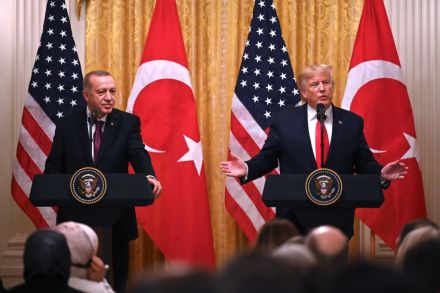
Istanbul The most dramatic part of President Erdogan’s visit to Washington this week was the punch-up between his security guards and Kurdish demonstrators on the lawn outside the Turkish embassy.  The protest was nothing unusual for a president who seems to provoke adoration and disgust in equal measure wherever he goes. Neither was the violent scuffle a surprise; Erdogan’s bodyguards did the same last time he was in the States. The news barely touched the Turkish press, and not only because there are few titles left on the news stands which offer opposition to Erdogan. When similar fights break out in the Turkish parliament, as they have done regularly over the past

Portrait of the week | 20 April 2017

Home Theresa May, the Prime Minister, having repeatedly said that there would be no election until 2020, surprised the nation by suddenly standing at a lectern in Downing Street, while the wind ruffled her hair, and saying that she sought a general election on 8 June. ‘Britain is leaving the EU and there can be no turning back,’ she said. ‘The country is coming together but Westminster is not.’ She said later that she had taken the decision after a walking holiday in Wales, and had spoken to the Queen on Easter Monday. The Fixed-Term Parliaments Act, passed in 2011, required a two-thirds majority of all MPs (or a motion

Erdogan keeps winning because his opponents never learn

Istanbul President Erdogan hardly swept to victory yesterday. But with 51 per cent of the electorate turning out in favour of his plans to transform Turkey into a state ruled by a hugely powerful presidency rather than the parliament, he now has his mandate to reshape the country in his own image – more religious, more authoritarian, and set to swivel away from Europe while forging new relations with its old Ottoman territories. His supporters celebrated well into the night, lighting flares, driving around the cities with their horns blaring, and waving flags bearing the face of their hero. Meawhile, thousands of distraught people took to the streets in my

Turkish democracy has just died; Europe could not have saved it

Well farewell then Turkey.  Or at least, farewell the Turkey of Kemal Ataturk.  It’s a shame.  Ataturk-ism nearly made its own centenary. But the nation that he founded, which believed broadly in progressive notions such as a separation of mosque and state, has just been formally snuffed out.  President Erdogan’s success in the referendum to award himself Caliph-like powers for life finally sees the end of Turkey’s secular and democratic experiment. Perhaps the poll which gave him victory was rigged.  Perhaps it wasn’t.  In the same way that perhaps the ‘coup’ last summer was real.  Or perhaps it wasn’t.  Either way, it’s all worked out very well for the man

Will Turkey dare to vote ‘No’ in Erdogan’s referendum?

Istanbul The Istanbul skyline is famous for being punctuated by mosques. Great domes of worship, with minarets reaching towards the heavens. The most famous is the mesmerising Blue Mosque. Built under the reign of Sultan Ahmet I, it was used as a symbol to reassert Ottoman power. Most people gasp in awe at its ornate ceiling, but I’ve always been fascinated by another feature; its minarets. There are six in total and in Turkey that’s unique, or at least it was. A few miles up the milky blue waters of the Bosphorus, another now stands to equal it. On the hills of Camlica on the Asian side, President Erdogan has

President Erdogan’s nationalist game plan

Ask any two Turkish nationalists how they will vote in their country’s upcoming referendum, and you’re likely to get two different answers. In just under a month, Turks will vote on a constitutional amendment that, if passed, will usher in the biggest political revolution since Kemal Ataturk founded the modern republic. It would shift the country from parliamentary democracy to executive presidency. This weekend I called round my contacts from Turkey’s various nationalist groups and asked them how they will vote. Exactly half said they will tick the box supporting President Recep Tayyip Erdogan in his bid to become executive president with almost unchallenged power, and a potential mandate until 2029. The

Europe’s elite rightly feel extinction breathing down their necks

Allahu Akbar! Greetings from Samsun, where Turkish protestors — their eyeballs spinning in orgasmic Islamic rage — tried to set fire to the Dutch flag while chanting the usual ‘Allah’s dead good’ stuff. They used cigarette lighters and some lighter fuel and up it went — and was then jubilantly trampled on by the inflamed, howling masses. Except that it wasn’t the Dutch flag — they had got hold of the French flag by mistake. I wonder if any of the similarly inflamed Turkish protestors in the Netherlands would have noticed? My guess is most of those demonstrating in Rotterdam had spent their entire lives in the Netherlands, but possibly

Europe’s politicians rightly feel extinction breathing down their necks

Allahu Akbar! Greetings from Samsun, where Turkish protestors — their eyeballs spinning in orgasmic Islamic rage — tried to set fire to the Dutch flag while chanting the usual ‘Allah’s dead good’ stuff. They used cigarette lighters and some lighter fuel and up it went — and was then jubilantly trampled on by the inflamed, howling masses. Except that it wasn’t the Dutch flag — they had got hold of the French flag by mistake. I wonder if any of the similarly inflamed Turkish protestors in the Netherlands would have noticed? My guess is most of those demonstrating in Rotterdam had spent their entire lives in the Netherlands, but possibly

How Erdogan used the Dutch as political pawns

Rotterdam What started as a minor disagreement between Turkey and the Netherlands has now expanded into an unprecedented diplomatic spat. Turkish attempts to hold rallies in Germany, Austria, Switzerland and the Netherlands have been blocked – and President Erdogan is now using this to his advantage. In April, Erdogan will hold a referendum on changes to constitutional powers in Turkey. This has been his goal for a long time. Even the slight possibility of losing terrifies him. In Turkey the electorate has effectively been told they are ‘terrorists’ if they vote against the motion. Yet despite that, polls showed until recently that the vote was still split. That’s why Turkish ministers were on a campaign across Europe

How the Turkey question could swing the Dutch vote

Douglas Murray and Melle Garschagen, UK and Ireland correspondent for NRC, discuss the Dutch election: The Dutch public go to the polls tomorrow, and the question of Turkey is on the menu. This past weekend the Dutch government forbade a plane containing the Turkish Foreign minister from landing in the country.  The Turkish minister had been due to address a crowd in Rotterdam.  Another Turkish minister – the hijabi Fatma Betul Sayan Kaya, due to attend a similar rally – was prevented from entering the Turkish consulate in Rotterdam.  All of which led the Turkish government to dismiss the Dutch people (and then the Germans as well) as ‘Nazis’. Last night,