Turkey

Rebuilding Artemis’s temple

As soon as the blaze that nearly brought down Notre Dame was extinguished, two questions were asked: how did it catch fire? And how will it be rebuilt? So too with a famous Greek temple. In 560 bc in Ephesus on the west coast of modern Turkey was built a massive temple to Artemis (Roman Diana), the largest building we know of from the Greek world and the first to be constructed out of marble. It was sponsored by Croesus, king of Lydia, a man so rich you could commit suicide by jumping off his wallet. But it was intentionally burned down in 356 bc by a man called Herostratus,

My least favourite countries in the world

Every year during Easter Week I draw up a chart of my least favourite countries and distribute the list to close friends and relatives. I’ve been doing this for thirty years now and I’m sure it has proved helpful to those close to me. So sure, in fact, that I intend, from now on, to post the same chart here. I hope in time my hate list will come to be seen as a familiar herald of summer, like letters to the Times about the first cuckoo or Christian names given to children. I never explain my reasoning: in most cases there is no need. And where there is need

Stone walls do not a prison make

There’s no getting away from that title. I will never see the world again. It catches your eye on the bookshelf. I will never see the world again. It’s there, at the top of every page. I Will Never See the World Again. It’s a killer opening, before the book has even begun, and it’s all true. Ahmet Altan, one of Turkey’s leading writers, in 2016 was arrested on charges of providing subliminal messages to coup supporters, and has since been sentenced to life imprisonment: Never again would I be able to kiss the woman I love, embrace my kids, meet with my friends, walk the streets. I would not

My Christmas nightmares

Christmas in our family seems to guarantee tears and tantrums as well as jingle bells and jollity. Indeed, in my childhood, ‘feeling Christmassy’ meant feeling thoroughly overwrought or bad tempered, the antithesis of the ‘Christmas Spirit’. I think my father invented it when my mother, who was a terrible cook, spent all day making marmalade to give as Christmas presents and was then beside herself with anger when she burnt the lot. My earliest Christmas disaster was my first attempt at cake icing. I’d proudly come home from school with a Christmas cake. It was covered with smooth royal icing on which I’d painted the Three Kings — but I’d

Why Erdogan is relishing making life difficult for Saudi’s crown prince

Jamal Khashoggi’s murder has been dissected by the world’s press, perhaps none more so than in Turkey, where the journalist met his grisly fate. Fresh information is still being leaked about his final moments inside the Saudi Arabian consulate in Istanbul. In a recording of his murder, Khashoggi can be heard putting up a fight. He orders his killers to release him and warns they’ll be brought to account. But will they? Or are there bigger fish to fry? And what is Erdogan hoping to achieve by making life uncomfortable for Saudi’s Crown Prince Mohammed Bin Salman. Khashoggi has been described by some as a Saudi dissident. Turkish media say he

Blood Brotherhood

 Istanbul In another time, in another place, we might never have known about the death of Jamal Khashoggi. In a Saudi consulate, the staff are guaranteed to say nothing. The reason we know so much is that Recep Tayyip Erdogan, the President of Turkey, has been willing to tell the world not just what he knows, but what he suspects. It has been clear from the offset that this isn’t just about the death of a journalist but a battle for political leadership of the Islamic world. On Tuesday, in his first full statement on Khashoggi’s killing, Erdogan said that the perpetrators should stand trial in Turkey, and that everyone

Let’s talk about how the Turkish government deals with dissidents abroad

The indignation over the disappearance of the Saudi journalist Jamal Khashoggi has taken an interesting turn now that Donald Trump has promised to inflict ‘severe punishment’ on the Saudi government should it turn out that he was in fact tortured and killed in the Saudi embassy in Ankara – though not obviously to the point of cancelling US military contracts with the kingdom. And the indignation is entirely justified. For agents of a foreign state to infringe the human rights of its subjects in another country is a calculated insult to the country in question quite apart from the unpleasantness of exhibiting abroad the behaviour visited on critics at home.

The Mesut Özil affair is an own goal for Erdogan’s critics

The morning after Mesut Özil’s shock resignation from the German national football team, his family’s ancestral home set to work. Enlisting the help of the local fire brigade, locals in Devrek, a small village near Turkey’s Black Sea coast, removed the large board at its entrance of the star midfielder in his Germany kit. The picture chosen as its replacement was a giant version of the image that first caused the furore – a photograph of Özil shaking hands with president Recep Tayyip Erdoğan. The response of this small village was far from unique in Turkey. Özil’s resignation has played out very differently here to how it has in Germany.

Erdogan, Trump and other fragile egos: Theresa May’s unenviable foreign policy dilemmas

Given the way her Cabinet ministers are behaving at the moment, Theresa May is really rather used to dealing with fragile egos. This will come in handy over the next month when the Prime Minister has to go from what promises to be an extremely tricky Nato summit straight into Donald Trump’s visit to the UK. As James says in his politics column this week, the challenges of these events, along with the ongoing problems both in the Cabinet and Parliament over Brexit, will make July one of the hardest months of May’s premiership to date. But trying to tell her warring ministers to shut up seems easy compared to

Erdogan’s victory means Turkey’s future is far from certain

Many people I know woke up yesterday morning with a knot in their stomachs. ‘Another five years,’ I heard one person mutter. They were referring of course to the victory secured by President Erdogan in Turkey. He won nearly 53 per cent of the votes in an election that many had hoped would see him defeated, especially as his regular ‘Ace’ card, the economy, has been rather rocky these past few years. The result showed his main rival wasn’t even close: Muharrem Ince garnered a little shy of 31 per cent in the poll. The 64-year-old president thanked the country for putting their faith in him once again. He told

How Europe’s Turks could sweep Erdogan to victory

President Erdogan can raise a crowd. As he travels to every corner of his huge country in the month before elections that could return him to the palace for another five years, tens of thousands turn out in sports halls, city squares and purpose-built rally grounds. His acerbic, bombastic public appearances, stage-managed with rock-star entrances and booming music, have become a hallmark of his brand of polished populism. The 15,000-strong crowd who gathered in the Bosnian capital Sarajevo earlier this month might have been smaller than Erdogan is now used to, but their dedication made up for their numbers. Most had come from Western Europe, Turks from Germany, the Netherlands

Erdogan’s influence is spreading across Europe

Two video clips did the rounds in the French media at the weekend. One went global, that of the heart-warming heroism of Mamoudou Gassama, a migrant who rescued a small boy dangling from a balcony in Paris; the other, being more feel-fear than feel-good, didn’t capture the world’s attention in quite the same way. This film was shot in the south of France, in a suburb of Avignon, and showed a group of men surrounding a newspaper kiosk. They were there to protest at a large poster advertising the latest edition of the current affairs magazine, Le Point, the front cover of which was adorned with a photograph of the Turkish president

The dilemma of Germany’s Turkish footballers

What’s the German for ‘The best laid schemes of mice and men gang aft agley’? Mezut Özil (Arsenal) and İlkay Gündoğan (Manchester City) are two of the finest footballers in England’s Premier League. They’re both of Turkish descent, so when Turkey’s president Erdoğan came to London on a state visit, a friendly meeting and a photo opportunity must have seemed like a good idea. However Özil and Gündoğan were both born in Germany, and both play for the German national team. The Deutscher Fussball Bund (and some German politicians and journalists) weren’t best pleased. Özil gave Erdoğan a football shirt, which was bad enough, but Gündoğan went one stage further. On

Theresa May’s tricky Turkish diplomacy dilemma

Turkey’s President Erdogan is in London this week, having tea with the Queen and praising Britain as a ‘real friend’. As Robert Ellis says in his Coffee House piece about the way the Turkish regime is becoming increasingly brutal and censorious, a clear benefit for Britain in this friendship is post-Brexit trade with the Turks. But campaigners are asking at what cost this comes, given the human rights abuses of the current regime, and want Theresa May to condemn the practices of the Erdogan government. This presents a tricky dilemma for the Prime Minister. Turkish political culture – and that of many of the Islamic countries that Britain has strong

What common ground will Theresa May find with President Erdogan?

When Turkey’s President Erdogan visits Theresa May in Downing Street on Tuesday, he will no doubt be on his best behaviour and control his baser instincts. Otherwise, as he will be met by a Free Turkey Media demonstration organised by English PEN, he could do as he has done earlier – as in Washington and Ecuador – and call on his bodyguards to beat up demonstrators. Of course, if it had been Turkey, they wouldn’t have been allowed to demonstrate, but if they had, they would not only have been beaten up but also incarcerated. Remember the Gezi Park uprising five years ago when over 8,000 were injured, 8 killed

President Erdogan’s Syrian dilemma

Istanbul It is a bad time to have an ally on the fence. With US military action in Syria looking more likely by the minute, and the West’s frosty relations with Russia in danger of deepening into a new Cold War, Washington is eyeing the actions of Turkey’s President Erdogan with concern. Turkey, a NATO member since 1952, the ally with the second biggest army and the only one to share a border with Syria, has spent the past two years cosying up to Russia. Ankara is part of the Astana troika alongside Moscow and Tehran – an initiative that has snatched the peace-broking lead in Syria from the UN

Erdogan is unravelling Ataturk’s legacy

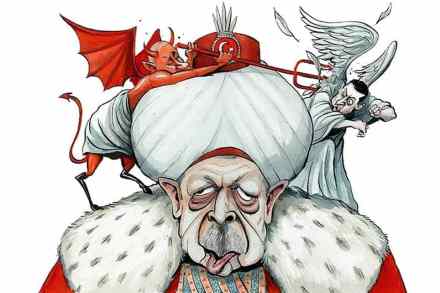
If there is a place in Turkey where Recep Tayyip Erdogan, the swaggering six-foot president, looks small it is at the tomb of the nation’s founder. Anitkabir, Mustafa Kemal Ataturk’s mausoleum, spreads over 185 acres in the heart of the capital Ankara. It is a monument to nationalism, towering modernism and the man who dismantled the Ottoman Empire and then rebuilt it as a nation state. Erdogan has made little secret of his distaste for elements of Ataturk’s project – particularly its staunch secularism – since he first rose to political prominence as mayor of Istanbul in the mid-1990s. Yet since 2003, as prime minister and then president, he has been

Turkey’s slide into authoritarianism continues

It took only a few hours for hope to turn to fresh despair. At lunchtime on Friday, the German-Turkish journalist Deniz Yucel was freed after more than a year in detention. An image of Yucel embracing his wife – who he had married while he was incarcerated – outside the concrete and razor-wire gates of Istanbul’s Silivri prison raced across social media, to widespread jubilation. But by the time the day’s evening call-to-prayer sounded, six other journalists had been convicted and jailed, three of them with aggravated life sentences. All have been accused of supporting terrorist groups, either the Kurdish militants of the PKK or the Gulenists, the Islamic sect

Turkey’s religious authorities tighten their grip

Turkey’s top religious body has issued a new fatwa, saying that ‘every pious Muslim must only use their right hand to eat and drink’ – because, apparently, only demons are left-handed. While it may seem like that line has been lifted directly from a medieval text, when southpaws were routinely accused of consorting with the devil, it hasn’t. The Turkish Directorate of Religious Affairs, known as the Diyanet, has qualified its new ruling based on some traditional teachings including, it says, because ‘the Prophet Muhammed did not regard eating with the left hand as pleasant’. It also says the Prophet warned ‘demons eat and drink with their left hand’. It

Turkey tightens control over Syria’s war narrative

Something has changed in the way we cover Syria. In 2015, Turkey began building a wall along the length of its 550-mile frontier with the war zone. The reasons were valid: Turkey wanted to cut the jihadi highway through which tens of thousands of foreigners had travelled into Syria and joined up with Isis. It also wanted to stop them travelling back the other way. The wall is now almost finished. It is three metres high, made of reinforced concrete topped with razor wire, and mounted with security cameras and automated guns. The area around the wall is heavy with soldiers and parts are periodically declared restricted military zones –