Travel

‘The lasagne is perfect’: Hotel La Calcina, Venice, reviewed

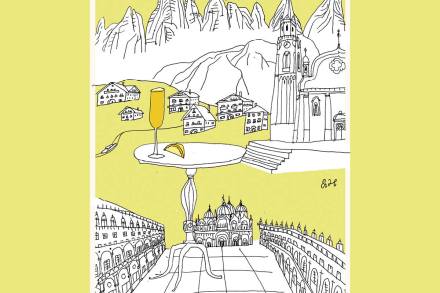
Pensione La Calcina is one of John Ruskin’s houses in Venice. He stayed here in 1877, after completing The Stones of Venice and going mad, and there is a plaque for him on the wall: a stone of his own. It is next to the Swiss consulate on the Zattere, but never mind them. I think the Zattere is for people who have tired of Venice. It has a view to the Giudeccacanal, and the waterbus to the airport: to the exit. You can breathe here. I am staying in San Marco, where I can’t. My son falls from a water gate into a canal, and Italian grandmothers tut at us, and we get sick, which my friend says is ‘very chic in Venice’. Before we get sick, we eat at La Calcina.

Robyn Davidson explores yet another foreign country – the past

Robyn Davidson never set out to become a writer. ‘It did not form my identity,’ she tells us early on in her memoir Unfinished Woman. ‘In my own mind I had simply pulled another rabbit out of a hat. As I had done all my life with everything.’ The rabbit, in this case, is the ability to capture an exciting and complex life with insight and humour. When she decided to leave the underworld, she was sexually assaulted at knifepoint Born in 1950 on a cattle station in Queensland, Australia, Davidson was the second daughter of a handsome war hero from a privileged background. Home was a place full of ‘dust and wide verandas, comfortable old chairs and good horses, though never adequate cash’.

With Diana Henry

41 min listen

Diana Henry is a critically acclaimed, multi-award winning cook, food writer and author of 12 books including the classic cookbook 'Roast Figs, Sugar Snow', which has just been updated and re-released twenty years after it was first published. Diana also writes for newspapers and magazines, and presents food programmes on TV and radio. On this podcast Diana shares childhood memories of her mother's baking, how 'Little House on the Prairie' influenced her writing and when, on a French exchange trip, she learned how to make the perfect vinaigrette. Presented by Olivia Potts. Produced by Linden Kemkaran.

Is your pet killing the planet?

As a travel writer, I used to joke about the so-called ‘downsides of the job’. The stupidly complex shower-fixture in the five-star Maldivian Paradise. The unexpected commission to go to Denmark in winter. The vague but real sting of disappointment upon realising that the free hotel pillow-chocolate is actually a mint. But in recent years a genuine and troubling downside has arisen. When I meet someone and tell them what I do, the listener often winces, perhaps with a hint of moral superiority, and says something like: ‘Don’t you feel guilty about your carbon footprint? You’re killing the planet!

Sticky, slithery, squelchy, smacky: the authentic Chinese food experience

During the early days of the pandemic, a video clip of a Chinese celebrity slurping bat soup went viral – no matter that it was taken from a travel show filmed in 2016 on Palau, a Pacific island some 2,000 miles from the Huanan wet market in Wuhan, and regardless of the fact that the Chinese don’t like munching on bats in any case. Wuhan was Covid ground zero, and filthy Chinese eating habits were to blame. In Invitation to a Banquet, Fuchsia Dunlop sets out to skewer misconceptions about what she calls ‘the world’s most sophisticated gastronomic culture’. This contention may surprise foreigners brought up on sweet-and-sour pork balls doused in Day-Glo red syrup, but it is a convincing one. I have yet to meet anyone who has spent more than a year or two in China who disagrees.

How to holiday like a Roman

For most people in the ancient world, holidays meant local public festivals – in Rome there were 135 a year – when politicians staged extravagant games and theatrical shows. But the elite mostly spent summers in their own or their friends’ villas, well away from the stench, heat and mosquitoes of Rome. We tend to go abroad to ‘get away from it all’, though Seneca would have doubted that would do us any good – because it was ‘a change of character, not of air’ that people needed. He also quoted Socrates asking, ‘How can you wonder your travels do you no good, when you carry yourself around with you and are saddled with the very thing that drove you away?’ For those who did travel abroad, as today, there was no escaping local guides.

Why don’t more tourists visit Ethiopia?

Standing on a cliff edge looking at where the Blue Nile is just a trickle, watched by a gelada baboon on a distant rock and staring over miles upon miles of some of the most beautiful countryside I’d ever seen, one thought struck me: why is there hardly anyone else here? Ethiopia is stunning to look at, once you get out of the capital, Addis Ababa. It offers history, culture, architecture, religion and everything in between. Yet when you tell anyone you’re going there the most common response is: ‘Really? Why?

Forget Amsterdam – spend a weekend in the Hague

I love Amsterdam. I go every year for the galleries, the opera, the beer, the genever, the rijsttaffel, the brown cafés and, well, the fun. I’ve had many a fine time there, sometimes with and sometimes without dear Mrs Ray. It’s a top place.  I was cut to the quick, then, on hearing recently that the good burghers of Amsterdam had asked any British tourists in search of a ‘messy night’ to stay away. Admittedly, this controversial campaign is aimed chiefly at 18- to 35-year-olds on stag parties, rather than senior railcard-holders like me.

I’m a holidaymaker… get me out of here!

Reading about all the travel chaos, I began to regret my summer holiday plans. Wouldn’t it have been more sensible just to stay in Acton? But Caroline and I had arranged to go to Ibiza fora friend’s birthday party the weekend before last; then, after returning to London, we were due back in the Balearic Islands, this time with the kids. There was no turning back. The first thing to go wrong was that our British Airways flight to Ibiza from Heathrow was cancelled. Not that BA notified us. The first inkling I had that something had gone awry was when I tried to check in using the BA app the night before and it said that wouldn’t be possible.

What Britain can learn from Romania

Romania gets a bad rap here, associated as it often is with organised crime. In recent years around half a million Romanians have settled in the UK, making them the fourth largest group of foreign-born residents. But the irony is that as Romanians head to Britain in search of a higher standard of living, we Brits should really be booking our flights to Romania to remind us of how our country once was. Romania has everything: fascinating medieval towns, unspoilt countryside, vibrant major cities and a 150-mile coastline. There are even still horses and carts on the roads. But the appeal is more than that: it’s the spirit of the place. If you want to go back to 1988 or even 1978 then a Wizz Air flight east is like a time-machine.

Hold the haggis: the changing face of Scottish food

Ask someone south of the border for their thoughts on Scottish cuisine and they’ll inevitably offer up thoughts of two Gaelic gastronomic inventions: haggis and deep-fried Mars bars.  Despite the wealth of produce available – and exported – from the country, Scottish fare has struggled to shake its tartan-clad clichés Despite the wealth of produce available – and exported – from the country, Scottish fare has struggled to shake its tartan-clad clichés. Take a table in London and you’ll find Orkney scallops, Isle of Mull oysters, highland venison and Outer Hebridean whisky on restaurant menus, while bonnie chefs like Quo Vadis’s charismatic Jeremy Lee and industry darling Adam Handling lead the capital’s kitchens.

The politics of sun loungers

The poolside was deserted when we passed on our way to breakfast. This time, I thought, as we ate at the still-quiet restaurant buffet, we’d triumph. Yet arriving back at the pool after eating, all the sun loungers closest to it had already been claimed – by owners who were nowhere to be seen. Reserving loungers might have been against the hotel’s policy, but removing the towels and beach bags that their claimants had placed on top of them felt like an act of aggression. Instead I sulked silently from my bed near the bins as, an hour later, the family of four who’d taken the plum spot I’d had my eye on for my own family finally sauntered over, ready to spend some time in their premium seats.

New York hotels with a literary twist

‘You really ought to read more books – you know, those things that look like blocks but come apart on one side.’ Perhaps F. Scott Fitzgerald was aiming for a motivational tone – literature was his livelihood, after all. He was also a seminal figure in the writers' movement that began in 1920s New York and, over the following decades, took root in hotels across the city. Hot on the heels of Spectator Life's guide to London's literary hotels, here are five New York hotels with their own tales to tell. The Algonquin Hotel [iStock] The Algonquin’s association with the infamous Round Table of the 1920s has provided it with more connections to literature and the arts than perhaps any other hotel in New York.

My culinary journeys: restaurants worth travelling for

Whenever it is suggested travelling south or north of the Thames to visit an ‘amazing’ restaurant I usually start conjuring up excuses. Across London seems a journey too far for food – but going across an ocean for it can be worthwhile. In NYC last year, I found myself with an evening off and, staying in the Lower East Side, made my way to the Bowery Meat Company. The menu was perfect: steak and seafood, excellent cocktails, and sides which included sublime creamed spinach and whipped potato that threatened to float off the plate. I usually eat oysters naked, but Bowery’s version – baked under a parmesan crust – was irresistible. The steak was thick, juicy and cooked to perfection, the fries hot and crunchy.

Welcome to the jungle: how Malaysia won me over

It’s approaching 6 p.m. at the Datai on Langkawi island, the tropical sun is still warm but no longer burny, and through my binoculars from my poolside lounger I’m watching the hornbills swooping down from the tall tree opposite and the sunbirds delving their long curved beaks in to some sort of exotic, colourful flora. By my side is a barely read copy of a classic work of literature and a half-drunk cocktail. I’m not sure that life gets much better than this. And that’s perhaps the main problem with staying in arguably Malaysia’s loveliest hotel.

How to join the beach hut brigade

They are expensive to maintain, plagued by tourists and influences seeking picture-postcard holiday snaps and cost more per square foot than houses in some of London’s most affluent neighbourhoods – despite lacking basic amenities such as running water. And yet such is the allure of the traditional seaside beach hut that, amid an otherwise shaky housing market, prices for these modest timber shacks just keep rising.  According to research by Moverly, which provides digital home information packs, the average asking price of a beach hut in England stands at £49,290 – up 43 per cent in the past year. In Dorset prices are up 101 per cent to more than £120,000.

How to combine city break and safari in Kenya

Nairobi is blossoming. With its vibrant art world, nascent farm-to-fork restaurant scene and unique hotels, east Africa’s biggest city is increasingly on the radar of international travellers. ‘We’re definitely seeing people wanting to stay longer in Nairobi,’ says Rose Hipwood of the Luxury Safari Company. ‘It’s absolutely a cosmopolitan city now. Rather than flying in and flying straight out on safari, people are wanting to extend their stays and see what restaurants, bars and museums there are.’ The country's safari offering is developing, too. Away from the crowds of the Maasai Mara, lesser-known hotspots are finding a following – devoid of people but brimming with nature.

Why now is the time to visit Aldeburgh

I have been reading Ronald Blythe’s Next to Nature which came out in October, just a few months before the great man’s death aged 100. And so a weekend holiday in Suffolk was calling to me. I went to Aldeburgh, on the coast, north of the river Alde. The town appears to be thriving – full of bustling cafés and London money. It is fashionable and chic. In many respects it is a world away from Blythe’s Akenfield. But there is much here to charm you. I lingered by a wonderful second-hand bookshop, Reed Books 4, its window display with Peter Kent’s Fortifications of East Anglia, George Ewart Evans’s The Farm and Village and Hugh Barrett’s recounting of a rural Suffolk morning in Early to Rise. Is this what Scruton meant by oikophilia? Here was heart-warming local pride.

How to spend 48 hours in Hiroshima

Tourism is well and truly back in Japan, with packed flights and full hotels during the popular sakura (cherry blossom) season last month. And from today, all eyes will be on Hiroshima as it hosts the 49th G7 summit – an event that Japan’s Prime Minister Fumio Kishida has promised will showcase the ‘charms of our country’. So what can visitors expect from the city best known as where the world’s first atomic bomb was used in warfare in 1945? While Tokyo will no doubt be top of the to-do list for anyone on a flying visit to Japan, during a recent tour of the country it was western Honshu, where Hiroshima is located, that charmed us the most.

How to get a passport in a hurry

Standing at the security check-in at the Passport Office in Peterborough, my hands felt suddenly clammy, despite having been made to wait outside in a chilly wind until my allotted appointment time. This moment had been a long time coming – but from eavesdropping on others in the queue I knew it could all yet go wrong. ‘I was here two weeks ago but I’d filled in something incorrectly on the form,’ said the woman in front of me to the staff member searching her bag. Meanwhile, the man behind flew into a panic when asked to show proof of an appointment booking on a mobile phone. ‘Oh hell, my wife booked this so everything’s on her phone,’ he told the security staff, only to be despatched back outside.