Theatre

Norman Mailer’s wife comes out of the shadows

‘It’s not as bad as I thought it would be,’ said Norman Mailer to his wife, Norris Church, after reading the first chapters of a novel she wrote in the 1970s. It took her decades to recover from this accolade and the book remained unpublished until 2000. Here’s a two-handed drama she drafted in the 1980s. The setting is a New York strip joint. A social anthropologist finds a girl in a booth and hires her to describe her daily life. He feeds her banknotes through a slot, like a zoo-keeper giving peanuts to a caged marmoset, and she prattles away at him earning a dollar every 60 seconds. She strongly suspects he’s not a scientist but a self-deluding voyeur who disguises his carnal appetites as an intellectual investigation. Happens a lot, she says to him.

Spectator books of the year: Roger Lewis on hating Sheridan Morley

Sheridan Morley was an old enemy of mine, so I was thrilled to see him brilliantly denounced and called to account by Jonathan Croall in his first-class book about writing a book, In Search of Gielgud: A Biographer’s Tale (Herbert Adler Publishing, £10.95). Morley is called an ‘arrogant, self-important and spectacularly lazy hack’, whose work was ‘sycophantic and severely lacking in depth’. One almost feels sorry for the old boy. Staying with the theatrical theme, Covering Shakespeare by David Weston (Oberon Books, £14.99) is a highly recommended rollicking account of being a jobbing actor.

Robin Oakley’s Twelve to Follow for 2015 (this year’s came out ahead)

November has never been my favourite month, not since the time when as a Rugby-playing student my face was rearranged by an opponent’s boot. At an Oxford hospital’s casualty department that 6 November fireworks lost their fun. Before they could see me the attendant clinicians were busy for hours tending children’s burns. November, too, is the reckoning time when I must reveal how the 12 animals whom I urged you to support through the Flat season have performed. Fortunately, as this column embarks upon its 20th year the news is good: had you invested £10 to win at starting price every time our Twelve reached the racecourse you would today be sitting on a comfortable tax-free profit of £171.

Yanks buy stacks of tickets in the West End. Why is Made in Dagenham so rude to them?

Go slow at Dagenham. The musical based on the film about a pay dispute in the 1960s starts as a sluggish mire of twee simplicities. We’re in Essex. Grumbling Cockney wage slaves inhabit cramped but spick-and-span council flats. Russet-cheeked kiddiwinkies are scolded and cosseted by blousy matriarchs married to emotionally reticent beer guts. The doll’s-house infantilism of Rupert Goold’s production is challenged by designer Bunny Christie whose set is an essay in conceptualism. She uses a vast plastic grid, like an unmade Airfix kit, to suggest the Dagenham car plant. It’s ingenious and intricate but irritating too. Trouble brews at the factory when the executives downgrade the leather workers, who stitch the car seats, to the level of unskilled labour.

An inept dud penetrates the Park Theatre’s dross-filters – and I blame Beckett

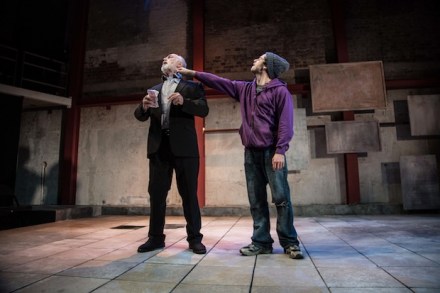
Jonah and Otto is a lost-soul melodrama that keeps its audience guessing. Where are we? The Channel coast somewhere. Indoors or out? Not sure. Near a church maybe? Violence barges in. Jonah, a mouthy scruff, shoves a knife in the face of Otto, a dignified old gent with Big Ears whiskers and a dark, elegant suit. This strange assault is followed by further peculiarities. Rather than calling the cops, Otto seeks a rapprochement with Jonah and they start a rambling, off-beat friendship. Later we discover that Otto, a Cambridge-educated vicar, has an adult daughter who was crippled in childhood by a road accident, and this detail lends credibility to his desire to befriend and redeem his mugger. But the relevant information arrives far too late.

To call this offering a book is an abuse of language

I picked up this book with real enthusiasm. Who cannot be entranced by those 20 years after the second world war when New York supplanted Paris as the cultural capital of the world? One thinks of the Beats, of Dylan and Greenwich Village, of Sontag and Trilling. Well think again, for none of the above feature in this book at all. Indeed the first thing to be said is that to call this offering from Thames & Hudson a book is a real abuse of language. It has covers and inside those covers one finds text and image but the three essays that cover visual art, architecture and design and the performing arts appear to have simply been placed together without either editorial brief or plan. Worse, the book lacks not only a credited editor but also a credited designer.

A Stratford Stalin: the nasty, aggressive and stupid world of Joan Littlewood

If Stalin had been a theatre director he’d have resembled Joan Littlewood. What an outstandingly unpleasant woman she was — yet I must admit it was fun making notes on her spitefulness. Few escaped her scorn and derision: Sybil Thorndike (‘a shocking actress’), Rachel Kempson (‘she had a face like a scraped bone’), Laurence Olivier (‘not trying’), T.S. Eliot (‘thin gruel’), Daniel Massey (‘a dud’) and John Gielgud (‘voice wanking’). Rather wonderful that last one, let’s be honest. Joan dismissed every one of the Redgraves (‘How do these untalented people make it?’) and when she saw Flora Robson, Cedric Hardwicke and Ralph Richardson, she was ‘appalled’.

Russians made the theatre space the most liberating imaginative device ever invented

You have to hand it to the Russians. They beat us into space, beat us to sexual equality, and a small display of early Soviet avant-garde theatre and film design, tucked away in the V&A’s ‘Performance’ area, proves that they beat us hollow in matters of the dressing-up box too. When you arrive (that is, if you arrive — it is a labyrinthine trek to find it) at Russian Avant-Garde Theatre, you should make straight for the little screen. It shows the amazing 1924 sci-fi film Aelita, in which an engineer living under ‘Military Communism’ builds a spaceship and flies to Mars where he falls for Aelita, Queen of Martians.

Neville’s Island: a play from the era of Men Behaving Badly – when women were seen as exotic excrescences

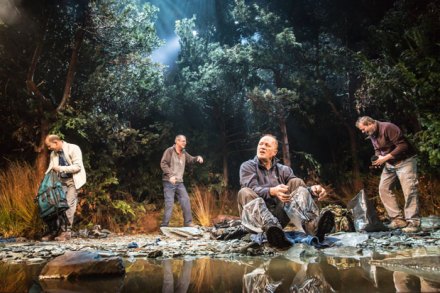
Start with a joke. Neville’s Island. Get it? Laughing yet? Are your ribs splitting into pieces? It’s a cracker, isn’t it? Well it’s a pun, at least, on Devil’s Island. Tim Firth’s play, regarded as a modern classic, premiered 22 years ago in Scarborough: Ayckbourn country, and it shows. Four corporate numbskulls on a team-building exercise get stranded on a remote islet with no hope of rescue. Their Alcatraz is located in the Lake District, which is known to millions as a dead-safe holiday habitat, and this seems to have unsettled Firth so he crams in extra snags to convince us the castaways’ predicament is genuine. Their skiff has capsized. Killer pike throng the lake-waters. Food supplies are limited to a sausage.

Is London’s West End Jewish enough for David Baddiel’s musical The Infidel?

David Baddiel has turned his movie, The Infidel, into a musical. The set-up is so contrived and clumsy that it has a sweetness all its own. A golden-hearted London cabbie, named Mahmoud, discovers that he was adopted at birth and that his real parents were Jewish. This strikes him as intriguing rather than alarming, and he starts to investigate Judaism with the sort of disinterested curiosity of a man taking up astronomy after inheriting a telescope and a star-chart from an eccentric uncle. Mahmoud wants an easy life so he keeps his secret from his wife, Saamiyah, and from his son, Rasheed, who plans to marry a girl named Ji-Ji whose father is a ranting Islamic bigot.

The best of Frieze Art Fair was free

Frieze and its ever-multiplying layers - some fantastically rich, others disappointingly dry - has expanded into a millefeuille so dense that you wonder whether organisers Matthew Slotover and Amanda Sharp have ever heard of museum fatigue. Today, 30 to 45 minutes is apparently the concentration cap – the point at which you can no longer bring yourself to give a shit yet keep walking past the frames. Knowing this, the majority of London’s public might feel they had been spared the ordeal of entering the tents in Regent’s Park, where half an hour will get you through almost nothing of the fair. By some freak of programming the best of the works curated to accompany this giant selling spree could be seen for free by anyone outside the fair this year.

When Irish nationalism meant sexual adventure

One of the easiest mistakes to make about history is to assume that the past is like the recent past, only more so. It’s a natural human tendency to project the outcome of events backwards, ignoring the fact that the arc of history really doesn’t work like that. In the case of Ireland that tendency to see the past in terms of outcomes is particularly misleading. The state that came about less than a century ago as a result of the Easter Rising, the war of independence and partition was socially conservative and strongly Catholic. Roy Foster’s achievement is to show that this need not have been so. This book — the title is from W.B.

Why, if Cecilia Bartoli invites you to a party, you drop everything and go

Classical music has a few certainties: Götterdämmerung will always be that little bit longer than you remember, it will reliably rain if you pack a Glyndebourne picnic, and if Cecilia Bartoli invites you to a party, you drop everything and go. Which is why I found myself in Paris earlier this week, along with most of the record industry, prepared for serious music and some even more serious thrills at the launch of Bartoli’s new disc St Petersburg. There are times when only a palace will do. For most of us those times are few and far between, but if you’re mezzo-soprano Cecilia Bartoli – ‘La Gioiosa’, a classical music phenomenon and one of its biggest-selling stars – then life, and art, are far from everyday.

Were the cast of the Old Vic’s Electra clothed by Oxfam?

First, a bit of background. Conquering Agamemnon slew his daughter, Iphigenia, in return for a fair wind to Troy. This rather miffed his wife, Clytemnestra, who bashed his head in with an axe when he came swaggering home. Her retribution laid a religious duty on their son, Orestes, to avenge his dad by slaying his mum, which, in its turn, put a bit of a crimp in his social calendar. Sophocles’ play opens during a lull in the butchery. Orestes, now in exile, throws Clytemnestra off her guard by releasing details of his death. The details consist of an urn containing his ashes delivered to the palace.

Will Marti Pellow attract enough tipsy hen parties to Evita to flog all 18,000 seats?

Tim and Andy are back. Their monster hit Evita opens the fully refurbed and re-primped Dominion Theatre, which is built on the scale of an airport terminal and needs a big production to fill it. This is a beautiful version of a show that marks a decline in the Tim and Andy alliance. It hasn’t the naïve and exuberant mischief of Joseph, nor the scope and the sustained dramatic force of Jesus Christ Superstar. Earnestness, and over-reverence for their subjects, are starting to creep in. It spoils the fun to know that the Perons weren’t a pair of sweet-natured do-gooders handing out beefsteaks to the underclass but a couple of egos on stilts running a dictatorship based on fear.

Charles III is made for numbskulls by numbskulls

Suppose Charles were to reign as a meddlesome, self-pitying, indecisive plonker. It’s a thought. It’s now a play, too, by Mike Bartlett. In his opening scene he bumps off Lilibet, bungs her in a box and assembles the family at Buck House to discuss ‘what next?’ Bartlett imagines them as stuck-up divs. William’s a self-righteous sourpuss. Kate’s a smug minx. Camilla’s a hectoring gadfly. Harry’s a weepy drunk. Charles is a colossally narcissistic nuisance. They’re too dim to understand the constitution so Camilla has to explain that a new reign commences with the death of the previous monarch and not at the coronation. (This is for the benefit of the audience, who are assumed to have the same poultry-level IQ as the Windsors.

I’m disappointed this director didn’t plunge the knife into Dustin Hoffman

At the age of 75, the theatre director Michael Rudman has got around to his memoirs, their title taken from the mouth of Willy Loman in Death of a Salesman, the play in which Rudman once directed Dustin Hoffman to great acclaim. The author is also Felicity Kendal’s other half, making him a figure of envy for much of male Middle England. A tall ‘Texan Jew’ who went to Oxford, Rudman has quite a CV. He started at the Traverse in Edinburgh, where with the approval of the theatre’s chairman Nicholas Fairbairn he put on drugs and porno plays. An award-winning stint at the Hampstead Theatre followed, then a spell at the National Theatre. He later ran the Chichester Festival Theatre before going to the Sheffield Crucible.

If you have teenage boys who loathe the very idea of theatre, send them to The Play That Goes Wrong

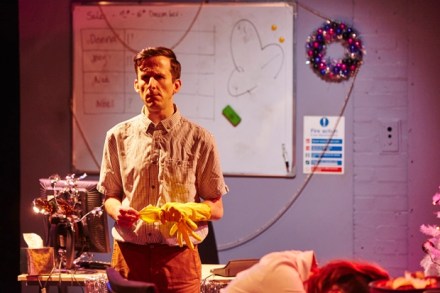
It’s taken a while but here it is. The Play That Goes Wrong is like Noises Off, but simpler. Michael Frayn’s cumbersome backstage farce asked us to follow the actors’ personal stories as well as their on-stage foul-ups, and the surfeit of detail proved a bit of a brain-scrambler. This is a badly rehearsed thriller played by useless amateurs on a disintegrating set. Good clean knockabout. Some of the background information is puzzling. The troupe calls itself the Cornley Polytechnic Drama Society even though polytechnics no longer exist. And their decision to put on a creaky 1920s murder mystery seems a little perverse. Aside from the booby-trapped props and collapsing furniture, they haven’t a clue how to bodge their way out of difficulties. This slightly mars the comic effect.

Tom Cruise deserves our support and pity

These are your lives. Yard Theatre, until 4 October Tom Cruise. That’s the big offer from a newish venue, the Yard Theatre, lurking on the fringes of Hackney Wick. The 80-seat space is located in an upwardly mobile sprawl of discarded warehouses and asset-stripped factories reinvented as artisan boozers. You can get there by train, cab or bike but the best people arrive by canoe. They tether their fibreglass tubs beside the Olympic Stadium and stroll along the canal overlooked by the knotted weirdness of the AcelorMittal Orbit which resembles a giant treble clef made of bubble gum. Inside, the venue is sensibly arranged in a horse-shoe configuration. The stage is roomy but intimate.

Can the Scots really be as small-minded, mistrustful and chippy as Spoiling suggests?

Referendum fever reaches Stratford East. Spoiling, by John McCann, takes us into the corridors of power in Holyrood shortly after a triumphant Yes vote. We meet a foul-mouthed bruiser named Fiona whose strident views and vivid language have propelled her into the public eye during the referendum battle. Her reward is Scotland’s foreign ministry. The most obvious and striking thing about Fiona is her personal ghastliness. A coarse, petulant show-off, over-endowed with self-belief, she has no wit, geniality or political intelligence. Asked how she feels about the birth of Scotland’s liberty, she rasps out her reply like a seagull with tonsilitis. ‘Rebirth!’ Her mistrust of Westminster is deeply engrained.