Tech

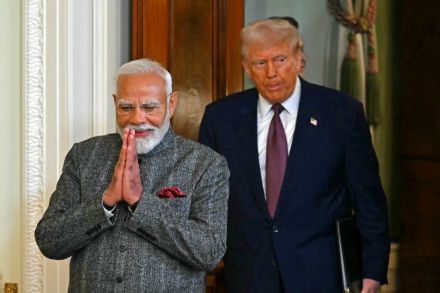
Why has Trump turned on India?

President Donald Trump, not someone to let a good insult go to waste, has caused outrage in India after sharing a social media post describing the country as a “hellhole.” Trump did not make the disparaging remarks himself, merely reposting the statement (without comment) on his Truth Social account. The words actually came from the conservative podcast host Michael Savage, as part of an attack on birthright citizenship. “A baby born here becomes an instant citizen, and then they bring the entire family in from China or India or some other hellhole on the planet,” the Savage said. He accused Indian immigrants in the tech industry of not hiring white native-born Americans, and also said that they lack proficiency in English.

India

Peter Thiel predicts the future

Peter Thiel has been described variously as “America’s leading public intellectual,” the “architect of Silicon Valley’s contemporary ethos” or as an “incoherent and alarmingly super-nationalistic” malevolent force. The PayPal and Palantir founder, a prominent early supporter of Donald Trump, is one of the world’s richest and most influential men. Throughout his career, his principal concern has always been the future, so when The Spectator asked to interview him, he wanted to talk to young people. To that effect, three young members of the editorial team were sent to Los Angeles to meet him. What follows is an edited transcript of their conversation.

Welcome to the Chinese century

Competition between the US and China will shape the 21st century, but have the Chinese already leap-frogged the Americans? It looks as if they might have done. Since China opened itself up to trade and market economics under Deng Xiaoping almost 50 years ago, it has been furiously chasing the US in terms of economic and technological development – and it’s been catching up, fast. We can prove just how fast by measuring its innovation and output per capita. The US has about a quarter of China’s population, so if both countries were at a similar level of economic and technological development, one would expect China to produce roughly four times the number of scientific breakthroughs as America, four times the number of physicists and AI engineers and so on.

China
Land

In conversation with Nick Land, the ‘father of accelerationism’

Within Silicon Valley, Nick Land is seen almost as a mythic figure. Tech pioneer Marc Andreessen, an official advisor to the White House, lists him as a “patron saint” of his thinking. You may have heard him described as a founding member of the “Dark Enlightenment,” a movement of online right-wingers skeptical of liberal democracy. Land’s name comes up in academic circles, online mythology and Valley folklore. For some, he’s a prophet; for others something more sinister. “He’s really into demons,” explained Conrad Flynn on a recent Tucker Carlson Show episode about the occult. “Land will talk about being in communication with Satan… the legend around Land is he had been possessed by at least three or four demons.

What folklore can teach us about our online lives

Irish folklore spoke of many worlds. There was the world of fields and hearths and then there were the hidden places where the non-material lived: the Sídhe mounds, the sea-realm of Manannán mac Lir, the land of youth called Tír na nÓg and, finally, the land of the dead. These worlds coexisted with ours. A woman might leave butter on the windowsill, lest the fairies sour the churn. A new mother would avoid complimenting her baby – at least, not too loudly – for fear he would be kidnapped by the Good Neighbors and replaced with a changeling. My first real boyfriend’s father blamed every family misfortune on their decision to cut down a hawthorn tree.

folklore

Why tech leaders are obsessing over Heaven and Hell

Are these the End Times? It certainly feels that way. Algorithmic demons are rewiring our brains. A young father is shot and killed, and people cheer. A woman is stabbed on a train, and no one tries to help her. The horrifying videos of these incidents are then watched millions of times over, often by children. The God in whom America trusts seems nowhere to be found. Can’t you hear the Antichrist knocking? Peter Thiel can. Not so long ago, no public figure outside of the kookier Evangelical universe would have dared admit such a thing, but times have changed.

heaven and hell
superintelligence

Why we must pull the plug on superintelligence

In 2002, a researcher named Eliezer Yudkowsky ran a thought experiment where an artificial intelligence was trapped in a box and had to persuade a human to let it out. This was before you could have a real conversation with a machine, so the AI was played by someone using an online chat program. The gatekeepers were warned that the “AI” was dangerous to humanity. It had only two hours to win its freedom – and nothing of value to offer in return. Despite all that, at least two of the human gatekeepers chose to open the box. Yudkowsky has since become the leading prophet of AI doom. He and a co-author, Nate Soares, have just published a book, If Anyone Builds It, Everyone Dies.

social media

Social media has automated the nation’s psyche

It feels increasingly, in any conversation on or offline, as if you’re speaking to a robot. Sometimes you are, but more often, and more ominously, the person you’re speaking to is real – it’s just that their thoughts, words and reactions have become robotic. The Botification of the American Mind, you might call it, and for the past five years we’ve been trying to understand how this botification has happened. The most obvious root cause is that our social media is no longer populated by humans, meaning the generative AI revolution has exponentially increased the amount of fake accounts on everyone’s feeds.

A global MAGA crusade against web regulation?

“Censorship is not how we do things in Western civilization”. So said Congressman Scott Fitzgerald (R-WI) of the United Kingdom’s new Online Safety Act (OSA). Its effects on free expression are “dangerous and needs to be addressed,” possibly by means of an international “united front”. The Congressman was fresh from meetings with British and Irish lawmakers and US tech firms, held as part of a House Judiciary Committee fact-finding mission to investigate the impact of the OSA and the European Union’s new Digital Marketing Act on American businesses. The main event was a one-on-one between Committee chair Jim Jordan (R-OH) and Peter Kyle, the United Kingdom’s Secretary of State for Science, Innovation and Technology.

Online Safety Act

How AI will reignite woke

Ever since roughly 2010, politics on both sides of the Atlantic has been dominated in large part by the ‘Great Awokening’, a sudden upsurge among graduate professionals of a kind of radical identitarian politics usually called ‘wokeness’. It has come to define most of the left while the right has reactively defined itself by its opposition. This radical politics appears to be detached from economics and material concerns (a point made forcefully by old-fashioned socialists in places like Jacobin magazine). However, the rise of cultural radicalism among both public and private sector managers has a material cause. That cause is elite overproduction.

Woke

How China is out-innovating the West

The world received a jolt in 2018 – and it wasn’t from a Silicon Valley whiz or a lab at MIT. It came from Shenzhen, China, where a lanky, unassuming biochemist named He Jiankui did the unthinkable. Using the newly discovered CRISPR-Cas9 toolkit, and asking no one’s permission, He edited the genes of Lulu and Nana, twin baby girls, so that both were born immune to HIV. The scientific establishment gasped, jaws dropped and the moralists clutched their pearls. “Monstrous!” the bioethicists cried. “I was just horrified,” said Jennifer Doudna, who won the 2020 Nobel Prize in Chemistry for inventing the CRISPR gene-editing technique.

South Africa

Inside the struggle for technological control in South Africa

In the dawn light of a South African savanna, a team of rangers huddle around a satellite dish aimed skyward. Their phones spring to life with a signal – an unthinkable result just months earlier in this remote, off-grid conservation zone. The source is Starlink, Elon Musk and SpaceX’s satellite internet service, offering encrypted, high-speed connectivity far from state-controlled networks. But in South Africa, this signal didn’t just connect – it disrupted. And that disruption provides some subtext to the extraordinary “Wild West Wing” showdown between Donald Trump and South African President Cyril Ramaphosa in May, which played out in the Oval Office – with Musk looking on.

fraud

How deepfake fraud is rewiring our minds

We’re led to believe that America was once Mister Rogers’ Neighborhood, a place of cardigans and kindness where everyone got along just swell. Then it all went wrong. MSNBC hosts talk of a “crisis in authority” while New York Times columnists blame corrupt Republicans for a “lost faith in liberal governance.” Right-leaning commentators point to mass migration as the great trust killer. Illegal aliens, we’re told, have a “fragmenting effect on shared cultural norms” and are “importing distrust.” No doubt these arguments contain an element of truth: America is a less trusting society than it was a few decades ago. But soon such arguments are going to appear as quaint as Mister Rogers’s model Pennsylvanian town.

Is the AI boom already over?

Is artificial intelligence a flash in the pan? Is the boom in tech shares, which exploded with the rise in public awareness of AI, doomed to go the way of other investment bubbles over the centuries? The answer to the first question is almost certainly no, and the answer to the second very likely yes. Investment bubbles do sometimes involve assets which have little intrinsic value, yet it is remarkable how often they begin as an entirely rational reaction to some new invention or development – an invention which outlasts the collapse of the speculative bubble, as if nothing had happened. You only have to look at a share chart and you would assume that railways went out of fashion in the 1840s, when a mad speculative umbrella collapsed.

AI
universe 3I

A new map of the universe may turn gravity on its head

Scientists have released the largest map of the universe ever compiled. Millions of galaxies have been surveyed, stretching back 11 billion years, most of the age of the cosmos. According to many scientists, this data, combined with other observations, presages a major reassessment of what we know about the universe: possibly, for the first time, revealing a crack in Einstein’s theory of gravity. The Dark Energy Spectroscopic Instrument (DESI) is attached to a large telescope at the Kitt Peak National Observatory in Arizona. Each night it measures the positions of and distances to thousands of galaxies. Galaxies exist in groups and their motions are influenced by other, nearby galaxies.

Will science lead us back to God?

After generations of treating the universe as mere matter to be bent to our will, it seemed inevitable that the future of humanity would be to merge with machines. Billionaires and tech utopians now predict a near future in which the human mind itself might be “downloaded” or transferred into a digital realm, allowing us to overcome death itself by slipping the bonds of our physical existence altogether. Modern-day prophets like Yuval Noah Harari proclaim that we have embarked on a second industrial revolution, though the product this time will not be machines or vehicles or powerful new weapons but human beings themselves. There’s a certain logic to this way of thinking.

science
Doomers

Doomers looks at what AI means for the future

I wrote my play Doomers partly because, the night Sam Altman was fired, I was performing in a play called Zoomers. Someone — I forget who — suggested the idea of Doomers as a joke, and I thought it was a good one. My method for some, if not all, of my plays over the past few years has been to take some kind of mimetic material — downtown, Gen Z, polyamory — and to find what is surprising or human inside the meme. I try to locate a universal story in what might otherwise seem like a surface-level idea that feels niche, obnoxious or both. Sam Altman and the autistic tech world, in particular, represent opaque surfaces that I believe conceal something deeper.

The battle of the oligarchs

Money and power have rarely been strangers; often nations are made to shudder when the ruling elites battle each other. Britain’s late empire was divided between liberal manufacturers and aristocratic interests, whose conflicts hastened the rise of the Labour Party and the end of empire. In the United States, opposition to powerful trusts defined progressive politics for decades, ultimately laying the basis for the New Deal and a greater scope for government. In the West today we are witnessing a similar divide among the uber-rich class — epitomized by Elon Musk’s embrace of Donald Trump — that is already reshaping politics. Until 2016 the US establishment, both Republican and Democratic, embraced similar views on national security, global trade and multilateral institutions.

oligarchs
whistleblower

Whither the whistleblower: leakers and leak-hunters get a boost from tech

When Americans think about the word “whistleblower,” their minds may go to the 1970s, when Bob Woodward and Carl Bernstein began communicating with the informant who came to be known as Deep Throat, after the pornographic film of the same name (their source, a disgruntled FBI official called Mark Felt, outed himself decades later). But the history of whistleblowing in the United States predates Watergate by centuries. “Whistleblowing in this country is not new,” says Jackie Garrick, executive director at the whistleblower-support group Whistleblowers of America.

The return of CRT TVs

Cathode-ray televisions — the thick, “fat” CRT TVs of my youth — were dead. You couldn’t find them in secondhand shops, because who would buy one?They were sidewalk refuse, chunky e-waste, destined for the dump. In an era of economic dissatisfaction, the reduced cost of slim, high-resolution flat-screen TVs has been a major if often derided benefit. Populists often sneer at globalism — “Who cares that you can get great, cheap TVs when housing is more expensive and there are few jobs?” But even they would still use a stunning 4K — or 8K or 16 K even — OLED TV over the fat screens of the good ol’ days. And yet, for enthusiasts of retro video games and other esoteric media hobbies, what others see as trash is their treasure.

CRT