Sculpture

The art of storing and unveiling

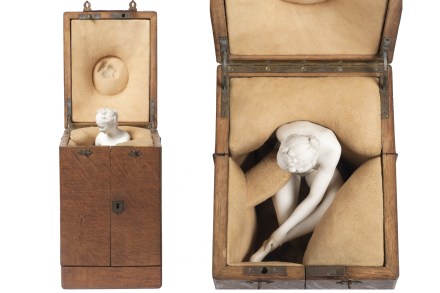
‘Put beauty first and what you get will be used forever,’ said Roger Scruton in his BBC documentary Why Beauty Matters. The philosopher’s neat elision of beauty and utility is perfectly embodied by Étienne Maurice Falconet’s nymph, who is to be the star of a forthcoming lecture by Waddesdon Manor curator Juliet Carey. This small marble figure would be far less remarkable were it not for the elegance of the 19th-century wooden box in which she is housed. Exquisite, flesh-like pillows of chamois fill the space around the nymph’s form: the box and the sculpture seem at one, as though locked in a dance. The nymph has been stored this way since the 19th century when Edmond de Rothschild commissioned a set of boxes for his collection from Chenue.

Maggi Hambling’s Wollstonecraft statue is hideous but fitting

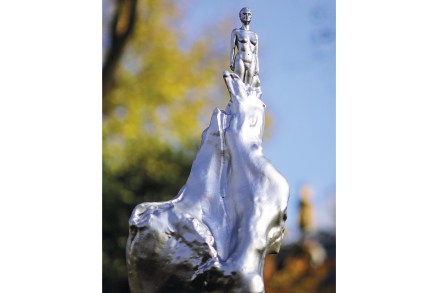
Frankly, it is rather hideous — but also quite wonderful, shimmering against the weak blue of a late November sky. The new statue ‘for’ Mary Wollstonecraft (1759-97), the radical writer, journalist, teacher and novelist, had drawn quite a crowd to Newington Green in north London when I went to see it. They were gathered round it, puzzled and questioning, trying to work out what to think of the tiny figure on top, the garish silvery finish, the heaving bulbous mass below. The memorial, designed by the sculptor Maggi Hambling, has been vilified since its unveiling a few weeks ago by critics who have focused on the nude female figure, bothered by the beautifully styled tits and perhaps perturbed by the very obvious bush of pubic hair.

Antony Gormley: why sculpture is far superior to painting

Antony Gormley: In the beginning was the thing! The reason I chose sculpture as a vocation was to escape words, to communicate in a physical way. It was a means of confronting the way things were, of getting to know them in material terms. The origins of making physical objects go back to before the advent of Homo sapiens, earlier even than the appearance of our Neanderthal cousins. Sculpture emerges from material culture. At the beginning there was an urge to make objects and you could argue that making them was the catalyst for the emergence of the modern mind.

A high-end car-boot sale of the unconscious: Colnaghi’s Dreamsongs reviewed

In 1772 the 15-year-old Mozart wrote a one-act opera set, like The Magic Flute, in a dream world. Il sogno di Scipione was based on an account in Cicero’s Republic of a dream experienced by the Roman general Scipio Aemilianus while serving in North Africa in 148 BC. In the dream the younger Scipio is visited by his adoptive grandfather Scipio Africanus, who foretells his destruction of Carthage, dishes out advice on dealing with populist politics and shows him ‘the stars such as we have never seen them from this earth’. Scipio’s is a recurring dream: it inspired Dante’s vision of Heaven and Hell and it returns to haunt us in Colnaghi’s latest exhibition Dreamsongs.

Why the Royal Academy is wrong to consider selling their precious Michelangelo

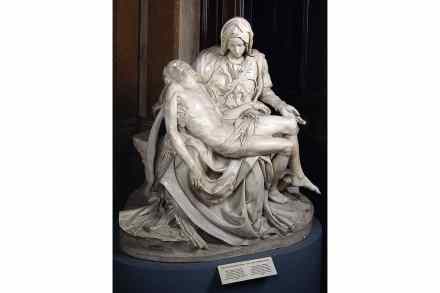
How much does a Michelangelo cost? It is, as they say, a good question, meaning: nobody really knows. The reason for this odd state of affairs is that almost none of them have ever been bought and sold on the open market, which is how the prices of most things are established. It’s hard to think of many examples of his sculptures being traded in that way over the past 500 years. Strangely, the main exception is the ‘Taddei Tondo’, otherwise known as ‘Virgin and Child with the Infant St John’, which, reportedly, some members of the Royal Academy are suggesting the RA should sell. If that were to happen, which I very much hope it does not, we might learn the answer to the conundrum. Probably it would be a very large sum indeed.

Spectacular and mind-expanding: Tantra at the British Museum reviewed

A great temple of the goddess Tara can be found at Tarapith in West Bengal. But her true abode, in the view of many devotees, is not this sacred structure itself but the adjacent, eerily smoking cremation ground. There she can be glimpsed in the shadows at midnight, it is believed, drinking the blood of the goats sacrificed to her during the day. Many holy men and women live in that grisly spot too, adorned with dreadlocks, smeared with ash, and dwelling in huts decorated with lines of skulls painted crimson. As a domestic setting this wouldn’t suit everybody. But the varieties of religious experience (to borrow the title of a celebrated work by William James) are many and extremely diverse.

I wish John Chamberlain was still around to crush this hideous toothpaste-blue Ferrari

For three months art lovers have had nothing but screens to look at. As one New York dealer complained to the Art Newspaper in May, ‘Everything is so flat — except for the curve,’ referring to the infection rate. Flatness isn’t such a problem for paintings, which are flat anyway, or for digital media obviously. The art form that has suffered most from the lockdown is sculpture, since no 360˚navigation technology yet invented can replicate the experience of walking around a 3-D object. So it’s fortuitous that Gagosian is unlocking its three London spaces to a trio of new exhibitions of 3-D works, under wraps since March.

How to succeed in sculpture (without being a man)

Whee-ooh-whee ya-ya-yang skrittle-skrittle skreeeek… Is it a space pod bearing aliens from Mars? No, it’s a podcast featuring aliens from Venus: women sculptors. If the intro music to Sculpting Lives: Women & Sculpture sounds like Dr Who, its two jolly presenters — Jo Baring, director of the Ingram Collection of Modern British & Contemporary Art, and Sarah Turner, deputy director for research at the Paul Mellon Centre for British Art — come across as younger, slimmer, artier versions of the Two Fat Ladies. ‘Jo can talk about Liz Frink’s work until the cows come home,’ Sarah informs us at one point before warning Jo: ‘You’re going to have to convince me a little bit.

Mother nature is finally getting the art she deserves

I guess that few would currently dispute that the world is in crisis. I’m not talking about Covid-19. Nor am I primarily addressing the issues arising from the 36 billion tonnes of carbon that the human project sends into our atmosphere every year. Climate chaos is a part of the issue, but I’m thinking principally of those things that most impact upon the biosphere as an ongoing live enterprise.