Schools

Letters | 8 August 2019

From our UK edition

We don’t cut God Sir: The Revd Dr Peter Mullen suggests (Letters, 3 August) that Boris Johnson told him my BBC Great Lives programme had cut from our broadcast treatment of Samuel Johnson an extended discussion of Christianity’s role in Dr Johnson’s life. Boris J championed Samuel J for our programme, and your correspondent has been persuaded that Mr J argued at length the centrality of religion to the great lexicographer. I am fascinated by religion. My producers would not relegate a person’s faith where it was claimed as central to their greatness.

How not to make TV

From our UK edition

BBC2’s How the Middle Classes Ruined Britain (Tuesday) began rather promisingly. ‘I’m a working-class comedian who voted Leave,’ announced presenter Geoff Norcott, ‘and I think it’s about time you lot heard some home truths.’ But then came the programme itself — which turned out to be the TV equivalent of a footballer who, faced with an open goal, dribbles about aimlessly before falling over. The first bit of aimless dribbling followed the shock news that middle-class parents often try to get their children into the best local schools, sometimes by claiming to live nearer to them than they do.

The disastrous decline of Scottish and Welsh education

From our UK edition

I’ve contributed a chapter to an education book published this week by the Institute of Economic Affairs. I was asked by the editors, Pauline Dixon and Steve Humble, to assess the impact of Britain’s education reforms, beginning with the introduction of the National Curriculum in 1988, extending through the creation of league tables in 1992 and culminating with the opening of academies and free schools from 2002. The first challenge was finding a reliable way to measure the effect of these initiatives. The introduction of the National Curriculum coincided with the replacement of O-levels and CSEs with GCSEs, making it difficult to compare before and after.

The in-tray of horrors

From our UK edition

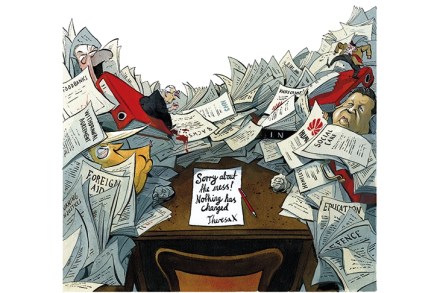
‘Dear Chief Secretary, I’m afraid there is no money. Kind regards — and good luck!’ Liam Byrne will forever be haunted by the note he left on his desk for his successor in 2010. Both coalition parties made much of what was supposed to be a joke about the difficulties of keeping Whitehall spending in check. David Cameron waved the note around in his victorious 2015 election campaign. Byrne later said he was so embarrassed by his mistake that he considered throwing himself off a cliff. There’s nothing funny about what Theresa May leaves on her desk for the next prime minister. Rather than just one pithy note, there’s a teetering, disorganised in-tray of decisions the Tory leader has been putting off.

Barometer | 30 May 2019

From our UK edition

Tears for fears Theresa May welled up while announcing her resignation in Downing Street. How often do leaders cry? — Lady Thatcher was seen to have tears in her eyes while being driven away from Downing Street for the last time. — Tony Blair nearly broke down in public, but not while in office — while responding to the publication of the Chilcot Report in 2016. — Several US presidents have been witnessed crying — and at a time when it was rare for men to be seen showing emotion in public. Dwight Eisenhower had to cover his face with a napkin to hide his tears in 1952, when recalling wartime experiences. — In the same year Richard Nixon was seen crying after surviving a funding scandal and being retained as vice-presidential candidate.

The fanatical thinking that’s on its way to Britain

From our UK edition

For anyone who isn’t following the long march of racial self-flagellation through America’s institutions, last week’s revelations about the excesses of New York City’s education tsar will come as a shock. Schools chancellor Richard Carranza has introduced mandatory ‘anti-bias and equity training’ for the city’s 75,000 teachers at a cost of $23 million a year. During these ‘workshops’ the teachers are told that ‘worship of the written word’, ‘individualism’ and ‘objectivity’ are all hallmarks of ‘white supremacy culture’ and that it is better to focus on middle class black students than poor white ones.

A class act | 2 May 2019

From our UK edition

Kate Clanchy is an extraordinary person. She is a veteran of 30 years’ teaching in difficult state schools, as well as an acclaimed poet (awarded an MBE in 2018 for services to literature) who has nurtured a generation of successful young migrant writers. In 2006 she was one of the judges for the Foyle young poets of the year award. Seven years later, seeing how the winners were scything through Oxbridge and networking ‘like an artsy version of the Bullingdon Club’, she wanted the same opportunities for her own pupils, ‘not just the poetry, but the sense of entitlement’.  She was teaching at a comprehensive in east Oxford, a generally unloved institution, ‘record-breakingly under-subscribed’, where more than 50 languages were spoken.

Moving on | 14 March 2019

From our UK edition

Will independent schools ever be sensibly discussed in the media, in politics or over the supper tables of the nation? It is a long-standing national habit to view all independent schools as aloof, expensive, exclusive and barred to almost everyone in the land. The impression is now gaining ground that the cost has become so great (the figure £40,000 a year crops up regularly) that soon only Russian oligarchs and other members of the world’s super-rich elite will be able to afford them. This takes to extreme lengths a misapprehension that all independent schools, of which there are 2,500, have been created in the image of a handful of famous public schools. Discussion revolves around the famous few as if they were typical representatives of the sector as a whole.

School portraits | 14 March 2019

From our UK edition

  Merchant Taylors’ School One of the country’s ‘great nine’ schools, Merchant Taylors’ School, near Rickmansworth, was founded in 1561 by the Merchant Taylors’ Company. Catering for boys from the ages of three to 18, it is highly academic but also well known for its extracurricular provision and pastoral care. Activities range from Combined Cadet Force and the Duke of Edinburgh Award to Greek and Mythology Club. It has a tutorial system, with each boy assigned a tutor who looks after him throughout his time at the school. Merchant Taylors’ also has a campus of 285 acres of parkland, and there is easy access from the Metropolitan line. More recently the school has excelled in sport, becoming under-17s national cricket champions in 2017.

A class of their own

From our UK edition

I never meant to conduct a social experiment. I never intended to undermine anyone’s confidence in their judgement. And I certainly never meant to arouse so much hostility. Yet by choosing to home-school my six-year-old this is precisely what I seemed to be doing. Like many other desperate parents, I hadn’t got our first choice of primary state school (this year, just 68 per cent of parents in our Local Education Authority, Kensington and Chelsea, did). In fact, the only place for Izzy was at a primary across the river, which would take over an hour of travelling to get to. So I decided to teach Izzy at home. To be more precise, I decided that my mother, then 72, would teach her.

Unconditionally yours

From our UK edition

I know what it is like to receive an unconditional offer for university. In 1984, when I took the Cambridge entrance exam, if you passed, you then only had to meet the matriculation requirements of the university, which were two Es at A-level. For someone predicted straight As (virtually all Oxbridge candidates), that wasn’t asking a lot. It was hard not to slacken off a little, to take a mental gap year, or six months at any rate, for the last two terms of the sixth form. I slipped to a B in further maths, which seemed an embarrassment at the time, though I know others who took a bigger plunge. What with a real gap year, too, I never really did get back into numbers.

Open access

From our UK edition

Rugby was immortalised in Tom Brown’s School Days, but its headmaster, Peter Green, is brandishing another book — a Christie’s catalogue with the school’s name on it. During an attic clear-out items were discovered in an archive room and were put up for sale. They had been given to the school in around 1880 by the Old Rugbeian Matthew Holbeche Bloxam, and included Chinese ceramics and British watercolours. The highlight was a rare drawing by Dutch Old Master Lucas van Leyden, which sold for £10 million. If the decision to sell that seems crass, it isn’t, says Green. ‘Why would we keep it? It has no intrinsic value to Rugby School. If we were able to build a massive museum, then perhaps.

School report | 14 March 2019

From our UK edition

Should we scrap GCSEs? A senior MP has suggested getting rid of GCSEs and reshaping A-levels altogether; but not everyone agrees. Robert Halfon, chairman of the Education Select Committee, wants to rewrite the exam system so that A-levels include a mixture of vocational, academic and arts subjects, arguing that ‘all the concentration should be on the final exam before you leave’. ‘All young people should have access to the technical and creative subjects that will give them the skills that employers are looking for,’ says Halfon. ‘We must move from knowledge-rich to knowledge-engaged.

Editor’s Letter | 14 March 2019

From our UK edition

What should we do with difficult students? The ones who distract everyone else in the class, and don’t care how they are punished? Some schools exclude struggling pupils because they are worried that their exams performance might drag down the class’s grades. But children have a right to an education, says Sophia Waugh, so we need to find a solution. Former teacher Hannah Glickstein agrees, but argues that new Ofsted rules have been put in place by bureaucrats with no experience of teaching. It might not be the sexiest of subjects, but it’s certainly an important one. Talking of exams, Ross Clark takes a look at the rise in unconditional offers to university. As someone who was offered one himself, he thinks that they are a terrible idea.

Testing teachers’ limits

From our UK edition

Next year the London Interdisciplinary School (LIS) will offer one degree, in design, technology and the humanities, to teach students to solve ‘complex problems’ like (they suggest) knife crime. Really? The key to problem solving is the development of two essential faculties — the imaginative and the critical. Can LIS really teach for those — or just how to pass exams? The philosopher Seneca insisted that the search for what really counted (his example was virtue) ‘cannot be delegated to someone else’. He illustrated it by telling the story of Calvisius Sabinus, who had the brains and bank account of the Roman equivalent of Sir Philip Green.

Save your children – take them out of school

From our UK edition

A good decade or so ago I wrote a fairly vituperative article in response to a piece by the writer James Bartholomew in this magazine, who had announced that he intended to home-school his daughter Alex, aged nine. James had explained in great detail how he would inculcate his charge in the liberal arts: ‘I don’t want to give the impression that I will be a Gradgrind. We will have some fun, too. Alex loves to paint. We will go to the major Cézanne exhibition in Aix and see his paintings of Mont Sainte-Victoire. Then we will see the mountain itself from the same viewpoint that he used. I hope we will settle down to paint it ourselves — perhaps copying Cézanne’s technique.’ Ever the class warrior, I was annoyed by this paragraph in particular.

Letters | 21 February 2019

From our UK edition

The breakaway seven Sir: ‘In both parties there are fools at one end and crackpots at the other, but the great body in the middle is sound and wise.’ One of the magnificent seven speaking this week? Well, the sentiment is surely present day, but rather they are the words of Churchill in 1913 trying to engineer a centrist national movement from ‘a fusion of the two parties’. In those days, it was the Conservative and the Liberal parties, but the history of the middle ground since then augurs poorly not just for the breakaway seven, but for those of us who feel disenfranchised by politics. We can argue who currently represents the devil and who the deep blue sea, but right now neither seems an attractive or palatable home.

Letters | 7 February 2019

From our UK edition

Fawning over China Sir: In reading your recent leading article on Huawei (‘Red-handed’, 2 February), I feel I should point out that it is not solely the British government who have been wrong-footed by the rise of China. Here in Canada, Prime Minister Trudeau has long desired to open up Canadian markets to Chinese companies, going so far as to express admiration for the country’s ‘basic dictatorship’. The Chinese press even bequeathed him with a charming nickname: the Little Potato. Now, in the face of the Huawei charges, Mr Potato has been forced to change course and has fired his ambassador, John McCallum, after he defended Huawei’s Chinese executives rather than supporting Canadians who have recently been imprisoned in China.

The problem with measuring progress

From our UK edition

The Department for Education (DfE) published its finalised data on the 2018 GCSE results last week, revealing that, for the second year running, white pupils are doing worse in English secondary schools than any other ethnic group. According to the new Progress 8 measure, which assigns a score to GCSE entrants based on how much progress they’ve made between the ages of 11 and 16 relative to children of similar abilities, Chinese pupils do the best, with a score of 1.08, Asians are second (0.45), then blacks (0.12), mixed race (-0.02) and, bringing up the rear, whites (-0.10). What that score means is that on average white children are behind by a tenth of a grade in each of their best eight GCSEs compared to all English schoolchildren with the same grades at the age of 11.