Schools

Sex education now means whatever schools want it to mean

From our UK edition

I’ve never shied away from discussing sex with my children and they’ve always been precocious enough to ask probing questions, usually in public. So when the letter came home from school announcing sex education classes for my then ten-year-old, I was relaxed. And when I later asked him, ‘Did you learn anything you didn’t already know?’, I expected a bored ‘no’. In fact, he said, ‘Yes. Oral sex and masturbation.’ Clearly sex education has moved on since I was at school. Schools have traditionally covered reproduction in science lessons and, since the 1960s, sex education as a discrete subject has dealt with contraception, sexually transmitted infections and unwanted pregnancy.

Minding the gender gap

From our UK edition

Boys are behind girls: at primary school, secondary school and at university. In the UK, white working-class boys have long been at the bottom of the heap in terms of attainment, but these days boys of all backgrounds are underperforming relative to girls. Last year, girls got two-thirds of the new top grade 9 scores at GCSE, while just 32 per cent of boys applied for university, compared with 44 per cent of girls. It’s not just in Britain either. Across the OECD countries, a study has found that 15-year-old boys are 50 per cent more likely than girls to fail to meet the baseline standards in reading, maths and science. So the question is why? How do boys and girls differ in their approach to learning? And what are schools doing to help boys learn effectively?

School report | 15 March 2018

From our UK edition

TRUE GRIT Education secretary Damian Hinds gave his first big speech at the Education World Forum in January, about the vital importance of learning from other countries and ensuring young people are able to thrive in a global economy. He also spoke of the benefits that come from sharing Britain’s educational excellence and know-how with the rest of the world. But he made it clear that he doesn’t believe education is all about exams and A grades. ‘There is much outside the relevant qualifications which matters a great deal as well,’ he said.

Editor’s Letter | 15 March 2018

From our UK edition

Is it the responsibility of schools to teach children about relationships and sexual consent? Or is that something parents ought to be teaching at home? This is the question Joanna Williams addresses in our opening feature. She takes a look at the changing face of sex education, and talks to some of its more evangelical exponents, as well as to a mother who has chosen to remove her daughters from sex education classes. It’s something of a controversial topic — but an undeniably interesting one. Gender neutrality is a fashionable subject these days, but Katherine Forster suggests that it’s quite harmful for boys if we pretend they learn in the same way as girls.

Church school critics ought to be consistent on selective education

From our UK edition

This week my daughter, 11, got the equivalent of a whopping scratch card win in the lottery of life; she got into the secondary school of her choice, an outcome partly determined by her being a Catholic, partly by dint of her entirely fortuitous proximity to the school in question. Some of her classmates are also going around punching the air, others, also baptised, aren’t, presumably on the basis that they didn’t live close enough. They’re a bit subdued right now, poor mites; at the age of eleven, they’ve got the sense that things haven’t really worked out for them, unless quite a few of the lucky ones turn down their place. Or in my case, fail to take it up because I’m a bit rubbish dealing with the cross-borough e-admissions site.

It’s World Book Day again. God help us

From our UK edition

For parents of primary school children, the first Thursday in March has got to be the worst day of the year. Even an attendance Nazi like me, who won’t countenance any excuse for keeping a child home from school, would accept that on this occasion a ‘tummy ache’ is a perfectly legitimate reason. Why do I say this? Because the first Thursday of March is World Book Day. Now, for those of you without children, or whose children went to school before this annual ritual was invented by Unesco in 1995, I should explain that the reason it’s such a colossal bore is because parents are expected to mark the occasion by sending their offspring to school dressed as their favourite fictional character.

The independent schools where fee assistance goes unused

From our UK edition

This piece was first published in Spectator Schools. In 2007, many of today’s young parents were either graduates or school-leavers testing their skills in their first jobs. They were saving for a mortgage or just enjoying the freedom of being young with few responsibilities. Back then, UK average annual earnings were around £23,765. Now, they are £27,271 — a rise of just under 15 per cent. The average house price in 2007 was £181,383. Today, it’s £215,847 — a rise of more than 19 per cent. Tough on today’s young families, you may think. But the rise in house prices relative to income is nothing compared with the increase in fees for independent schools.

Faith schools are more diverse than their critics make out

From our UK edition

Ever willing to exploit my children, I asked them yesterday just how many actual English children there were in their class at school – one’s at primary, the other, secondary. What, English-English, they said reasonably? You mean, both parents, plus born here? Yes, I said, which meant they couldn’t count themselves – they were born in Dublin. They thought about it for a bit. The elder said, counting on his fingers, that five out of 27 were English-English, with another three more half and half. My daughter counted 10 out of 27, if you include pupils from Guernsey and Northern Ireland, which I unwillingly conceded might count as British from some perspectives; a child whose granny is from Sierra Leone counts as English. The rest were a ragbag.

Look down on me at your peril: I’ll eat you alive

From our UK edition

Angela Rayner is perhaps the only Labour MP who works with a picture of Theresa May hanging above her desk. It’s there for inspiration, she says, a daily reminder of the general incompetence of the Conservative government and the need for its removal. ‘That picture motivates me, in a strange way,’ she says when we meet. ‘They are doing such a bad job of Brexit, and a lot of people will be let down. Again. The people who already think that politicians are lower than a snake’s belly.’ The anger is with politicians in general. ‘It just feels that this generation is not doing a very good job.’ Ms Rayner, 37, has been a politician for not even three years and her rise has been nothing short of extraordinary.

Sadly, true grit can’t be taught

From our UK edition

I am currently wrestling with a dilemma. I have agreed to contribute to a panel discussion on character education at University College London, and while I generally applaud schools that try to inculcate qualities like perseverance, resilience, the ability to defer gratification, etc, I am not entirely convinced that these virtues can be taught. Should I swallow my scepticism, or gently point out that it’s naive to expect schools to achieve much in this area? The panel will be discussing an essay in a periodical called Impact in which philosophers write about education policy. This essay by Randall Curren, a professor of philosophy at the University of Rochester, New York, strikes some pleasingly conservative notes.

Letters | 14 September 2017

From our UK edition

Fat responsibility Sir: Prue Leith is right to note that the state picks up the bill for our national obesity problem (‘Our big fat problem’, 9 September). But the kind of large and expensive scheme she proposes only deepens the mindset that the government is responsible for our choices. Manufacturers should be forced to display hard-hitting facts about obesity on the labels of the unhealthiest food, in the vein of cigarette packets. This would leave people in no doubt about the consequences to their health, while avoiding extra cost to the state or punitive taxes which also hit those who exercise moderation.

Follow the money

From our UK edition

In 2007, many of today’s young parents were either graduates or school-leavers testing their skills in their first jobs. They were saving for a mortgage or just enjoying the freedom of being young with few responsibilities. Back then, UK average annual earnings were around £23,765. Now, they are £27,271 — a rise of just under 15 per cent. The average house price in 2007 was £181,383. Today, it’s £215,847 — a rise of more than 19 per cent. Tough on today’s young families, you may think. But the rise in house prices relative to income is nothing compared with the increase in fees for independent schools. As with incomes and house prices, there are vast differences between north and south, rural and urban.

A sorry state of play

From our UK edition

The link between a healthy mind and a healthy body was understood by Juvenal — but he didn’t have to raise two kids in our brave new world of social media and fast food. We’ve all seen the stats, so there’s no need to repeat them. But as snacks replace square meals and the virtual world replaces the real one, our children are becoming increasingly sedentary and unhealthy. For parents of school-age children, sport has never been more important. But making sure kids get a good sporting education is no easy matter — and I should know. In my experience as a parent (and briefly as a teacher), sport in the state sector is usually pretty patchy.

Eat, pray, learn

From our UK edition

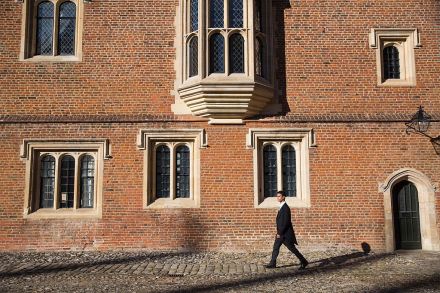
My greatest spiritual moment this year came in Eton College Chapel. I was there for Evensong with a friend who’s an English master at the school. Suddenly, unexpectedly, the congregation belted out Verdi’s ‘Chorus of the Hebrew Slaves’ — in English. Part of the pleasure came from the shock of hearing 1,300 upper-middle-class schoolboys imitating Hebrew slaves singing a lament about their Babylonian captivity in 500 BC. But it was also the sheer joy of the music in Henry VI’s chapel, a triumph of the Perpendicular Gothic. In quieter moments during the service, I examined the 15th century wall paintings, which are splendid, Flemish-style pictures of miracles of the Virgin Mary.

Editor’s Letter | 7 September 2017

From our UK edition

We live in an age where technology surrounds us almost all of the time. In the Western world, smartphones are omnipresent, and information is available at the press of a button. But how is this affecting schoolchildren — and how can schools deal with both the problems and the benefits that modern technology brings? In our cover piece, Rhiannon Williams takes a look at how various schools are handling technology, and reports that a ban on smartphones may not always be the answer. While technology is playing an increasingly large part in pupils’ lives, sport is still important. William Cook says that it shouldn’t all be about elite athletes. But neither is a ‘prizes for all’ culture the right way to encourage children to enjoy PE.

Hard lessons

From our UK edition

George Tomlinson, the post-war education secretary, declared that politicians should leave exams to the teachers because ‘the minister knows nowt about curriculum’. Today, however, the curriculum seems to be in a state of permanent revolution. The new GCSEs, for example, are marked on a nine-point scale: a grade of 7 or above indicates what used to be an ‘A’. For every five students who hit the 7 threshold, only one will get 9, the top mark. How employers are meant to understand this is another question. The GCSE overhaul is the latest of a series of reforms, started by Michael Gove seven years ago, which are intended to ‘restore confidence’ after years of grade inflation. During the Labour years, ministers denied that exams were getting easier.

Letters | 17 August 2017

From our UK edition

The education gap Sir: It is disappointing that Toby Young (‘Parents, not schools, are key to the knowledge gap’, 5 August) conforms to the ‘Close the gap’ mentality that obsesses Ofsted and leftish thinking in state schools. Young deplores ‘the attainment gap between disadvantaged and non-disadvantaged 16-year-olds in England’. I prefer to get away from the tendentious terms ‘disadvantaged’ and ‘non-disadvantaged’ pupils and stick to the idea of high- and low-attaining pupils. Left-inclined schools have various ways of closing this gap in attainment. One is to impose limits on how abler pupils can be challenged.

Parents, not schools, are key to the knowledge gap

From our UK edition

The Education Policy Institute (EPI) has just published a report looking at the attainment gap between disadvantaged and non-disadvantaged 16-year-olds in England — and the news is not good. While the gap has narrowed by three months since 2007, it is still 19.3 months. That is to say, it is as if disadvantaged pupils have received 19.3 months less schooling than their peers by the time they take their GCSEs. For the persistently disadvantaged, i.e. those who have been eligible for free school meals for at least 80 per cent of their school lives, the gap is 24.3 months. Most people’s instinctive reaction to this news will be frustration and anger.

The knives are out for Christian faith schools

From our UK edition

Today's Holy Smoke podcast responds to rumours that the Government is planning to betray parents who want to send their children to faith schools. As The Sunday Times reported: Ministers are expected to drop plans to allow Christian, Jewish and Muslim state schools to admit all their pupils from one faith after warnings that the move could heighten community divisions in Britain. A U-turn would jeopardise dozens of new free schools planned by faith groups, some to cope with the influx of Catholic families from Poland and other east European countries. Catholics said this weekend they would not open new state schools if they had to reserve half their places for children of other faiths, raising new school funding problems for the government.