Reform

The red reshuffle overshadows Reform

14 min listen

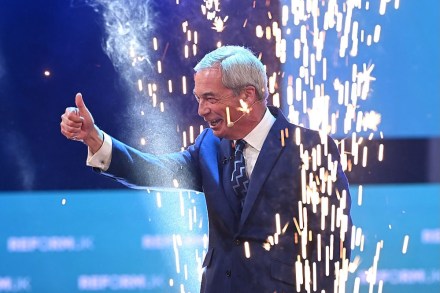
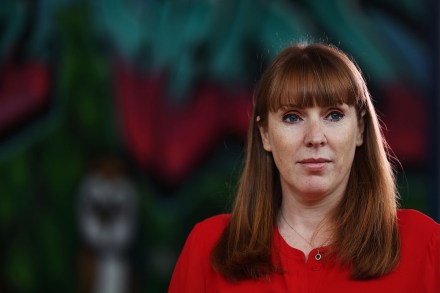
Lucy Dunn catches up with Tim Shipman at Reform's party conference, taking place in Birmingham, to get his reaction to Labour's reshuffle. The reshuffle took place following Angela Rayner's resignation from government. Tim argues that it's clear the reshuffle centred around getting Shabana Mahmood into the Home Office, where she can tackle some of the biggest issues for Labour – small boats and asylum hotels. They also round up the goings on at Reform including leader Nigel Farage's speech, who claimed Labour's reshuffle proved an election could be sooner than we think... Produced by Patrick Gibbons and Megan McElroy.

Reaction from Reform as Rayner resigns

17 min listen

Angela Rayner has resigned following the ethics probe into her tax affairs. What impact will this have on Starmer's government? And does this hinder her chances of succeeding Starmer one day? The Coffee House Shots team react live from day one of the Reform party conference, which is taking place in Birmingham. What's the mood in the conference hall? And, after Nadine Dorries joined Reform last night, could more former Conservatives follow? Produced by Patrick Gibbons and Megan McElroy.

Reform’s camp following, masculine rage & why do people make up languages?

51 min listen

First: Reform is naff – and that’s why people like it Gareth Roberts warns this week that ‘the Overton window is shifting’ but in a very unexpected way. Nigel Farage is ahead in the polls – not only because his party is ‘bracingly right-wing’, but ‘because Reform is camp’. Farage offers what Britain wants: ‘a cheeky, up-yours, never-mind-the-knockers revolt against our agonisingly earnest political masters’. ‘From Farage on down,’ Roberts argues, ‘there is a glorious kind of naffness’ to Reform: daytime-TV aesthetics, ‘bargain-basement’ celebrities and big-breasted local councillors. ‘The progressive activists thought they could win the culture war simply by saying they had won it’, but ‘the John Bulls and Greasy Joans are stirring again’.

Farage finally unveils his deportation plan

13 min listen

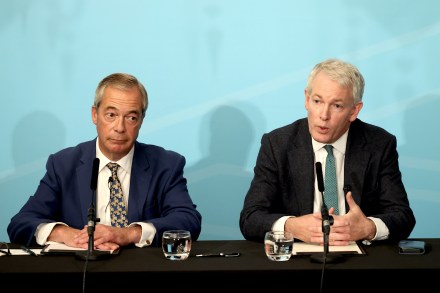
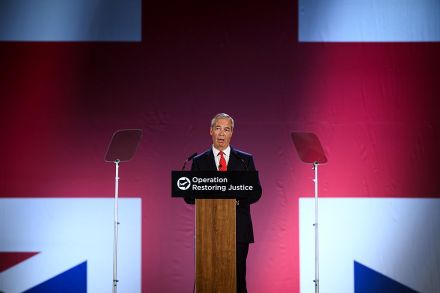
Today James Heale has been on quite the magical mystery tour. Bundled into a bus at 7.45 a.m. along with a group of other hacks, he was sent off to an aircraft hangar in Oxfordshire where Nigel Farage finally unveiled his party’s long-awaited deportations strategy. The unveiling of ‘Operation Restoring Justice’ was accompanied by some impressive production value, including a Heathrow-style departure board and an enormous union flag.

Farage, flags and the forgotten English

The flag-raisings in towns and cities across the country are an inevitable consequence of elites’ seeming preference for every flag but England’s. High-status flags: Ukraine, Palestine, Pride. Low-status flags: Union Jack, St George’s Cross. It is possible, of course, to favour multiple flags. Although a Scot, I am quite partial to St George’s Cross, a simple emblem that stirs up a thousand years of English history – of blood and bravery, trial and triumph – in a crisp, snapping flutter of its folds. The Ukraine flag is the banner of a people who, rather than surrender their homeland, have chosen to fight to the death for it. However you feel about your compatriots flying another country’s flag, Kyiv’s is at least an honourable one to fly. Honour.

Can the Lib Dems emulate Reform’s Scottish surge?

19 min listen

Jamie Greene, an MSP for the West of Scotland region, defected earlier this year from the Conservatives to the Liberal Democrats. Most defections in Scotland – indeed across the UK – seem to be from the Tories to Reform, so what is behind Jamie's motivations to go in a different direction? What are his reflections on the splintering of politics, particularly in Scotland, as we look ahead to next year's Holyrood elections? And does he agree that this is shaping up to be the most consequential Scottish Parliament election of modern times? In Jamie's view, Reform have shown to struggle with power in the areas they've been successful in, but admits that the Liberal Democrats could learn from Reform in some ways. Can the Lib Dems emulate Reform's Scottish surge?

Farage goes for the Lords

15 min listen

The big news today is of course the bilateral between Donald Trump and Vladimir Putin in Alaska. We should know by around 8 p.m. whether they have successfully negotiated an end to the war in Ukraine – and at what cost – but in the meantime Westminster is abuzz with the news that Nigel Farage is going for the Lords. This morning the Times splashes on a letter from Nigel Farage to the Prime Minister, Keir Starmer, in which he demands that Starmer allow him to nominate Reform peers to the House of Lords. It is not a totally unreasonable request either, with the Greens and the DUP represented in the chamber and Farage has gone after Starmer for ‘democratic disparity’.

Does European solidarity over Ukraine matter?

14 min listen

Ukraine's President Zelensky has spent today with Keir Starmer at Number 10. This is in anticipation of tomorrow's Alaska summit between Presidents Trump and Putin – where European leaders will be notably absent. Zelensky's visit to the UK is designed to project an image of solidarity with Starmer, and European leaders in general – but does it really matter? And is Putin really closer to accepting a ceasefire? Tim Shipman and James Heale join Lucy Dunn to discuss Plus – Tim talks about his article in the magazine this week, for which he spoke to George Finch, the 19 year old Reform councillor who is leader of Warwickshire County Council.

Can Reform beat the blob?

Shortly after he was elected as Britain’s youngest council leader last month, 19-year-old George Finch of Reform UK had a conversation with Monica Fogarty, the chief executive of Warwickshire county council, about which of them was really running the show. In Finch’s telling, this was a watershed moment: he offered a ‘professional working relationship’ but the relationship quickly soured. ‘I know you’re trying to get rid of me,’ Fogarty said, according to Finch. ‘Well, you can’t get rid of me. The way it works around here is: your councillors play ball.’ Finch allegedly replied: ‘Are you joking? You have to work with us. It’s not the other way around. We’ve been put here by the electorate. You haven’t.

Motherland: how Reform is winning over women

17 min listen

Does – or did – Nigel Farage have a woman problem? ‘Around me there’s always been a perception of a laddish culture,’ he tells political editor Tim Shipman, for the cover piece of the Spectator this week. In last year’s election, 58 per cent of Reform voters were men. But, Shipman argues, ‘that has begun to change’. According to More in Common, Reform has gained 14% among women, while Labour has lost 12%. ‘Women are ‘more likely than men… to worry that the country is broken.’ Many of Reform’s most recent victories have been by women: Andrea Jenkyns in the mayoral elections, Sarah Pochin to Parliament; plus, their most recent high profile defections include a former Tory Welsh Assembly member and a former Labour London councillor.

Vance & Farage’s budding bromance

16 min listen

Nigel Farage hosted a press conference today as part of Reform's summer crime campaign 'Britain is lawless'. He unveiled the latest Tory defector: Leicestershire's Police & Crime Commissioner Rupert Matthews. Amidst all the noise of whether crime in the UK is falling or not, plus the impact of migration on crime, is Reform's messaging cutting through? Would US Vice President agree with Farage's message that Britain is lawless? Vance is in the UK, staying in the Cotswolds, as part of his summer holiday. Tim Shipman and Lucy Dunn are joined by James Orr, associate professor at Cambridge University, and a friend of Vance's to talk us through the dynamics between Trump, Vance, Starmer, Lammy and Farage. Does Farage have Vance's ear?

Could Reform’s Scottish surge provoke indyref2?

20 min listen

Scotland's First Minister John Swinney unveiled his strategy for pursuing a second independence referendum this week, arguing that an SNP majority at next year's Holyrood elections is the only way to guarantee it. This is seen as an attempt to put Scottish independence back on the table as well as combat the rising popularity of Reform. Pollster Mark Diffley of Diffley Partnership joins Lucy Dunn to unpack the SNP's independence strategy. Mark points out that while Reform are consistently outperforming expectations, their support still primarily comes from ex-Conservatives. This, plus the unpopularity of the current UK Labour government, could provide the SNP with an opening to exploit and shore up nationalist support.

The unstoppable Angela Rayner

14 min listen

There is the small matter of the Macron–Starmer press conference today, at which the Prime Minister will hope to announce a new migration deal with France. But we thought we would dedicate today’s podcast to Angela Rayner, with some MPs thinking that the answer to Labour’s woes could be to ‘give it Ange until the end of the season’. As Tim Shipman reports in the magazine, she has undergone quite the political transformation – keeping her head down and away from incoming fire. Downing Street is taking her increasingly seriously. Is she the new John Prescott – or even the next Labour leader? Also on the podcast today: Jake Berry, former Conservative party chairman, defected to Reform last night. But how much of a coup is that really for Nigel’s gang?

Keir can’t catch a break

13 min listen

Keir Starmer will have been hoping for a more relaxed week – but he certainly won’t be getting one. He is facing a fresh rebellion over support for children with special educational needs (SEND), which threatens to become welfare 2.0. The plan involves overhauling the SEND system and it’s another case of Labour MPs exclaiming that they didn’t stand on a Labour ticket just to target the most vulnerable in society. The main concern among backbenchers is whether it should be legally enforceable for parents to ensure their children receive bespoke support. Elsewhere, all roads lead to the Treasury, as Neil Kinnock has a solution for increasing Rachel Reeves’s headroom: a wealth tax.

In Essex, the only way is Reform

The country is slipping away. The whole place, slowly, but London suddenly, blinding glass slabs becoming East End blocks, ‘SPLENDID NEW APARTMENTS!’ turning to marshland, to golf clubs, to small towns and a train station, Laindon, Essex, which has a nice 4x4 Porsche parked outside. Decline is the mood of Britain, and I was going to Essex to talk to people about it. Any political energy left in this country is behind Reform, and lately Nigel Farage has been using a new label for his people. ‘We are the party of workers, but also the party of entrepreneurs,’ he said recently. Did he mean the two simultaneously? The appeal to rich and poor and the people done good... Something in that mix sounded like an evocation of Essex.

Rupert Lowe on Reform turmoil, Chagos ‘treason’ and taking the Tory whip

50 min listen

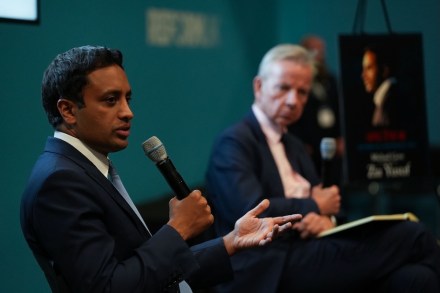
The Spectator’s editor, Michael Gove, and assistant editor, Madeline Grant, interview Rupert Lowe, MP for Great Yarmouth and notorious Westminster provocateur. Earlier this year, Lowe was suspended from the Reform party amid claims of threats towards the party's chairman, Zia Yusuf and a souring relationship with Nigel Farage. Following his political ‘assassination’, he now sits as an independent MP and continues to be one of the most energetic parliamentarians in challenging the Westminster orthodoxy.

Zia Yusuf resigns from Reform

10 min listen

Zia Yusuf resigned this evening from his position as chairman of Reform UK, saying: ‘I no longer believe working to get a Reform government elected is a good use of my time.’ This comes after he tweeted yesterday that it was ‘dumb’ for Sarah Pochin, Reform’s newest MP, to urge the Prime Minister to ban the burka during PMQs. Did he jump before he was pushed? And can Reform UK really claim to have ‘professionalised’ when this is the second high profile departure this year?  Oscar Edmondson speaks to James Heale.

Kemi’s one chance at recovery? Trussonomics

You may have noticed that for some while the BBC News people have stopped referring to Reform UK as ‘far right’ or ‘hard right’. That’s not because Nigel Farage has tacked to the left a little on such policies as nationalisation; one characteristic of the left is that if they consider you ‘far right’, they will not commend anything you say, even if they fervently agree with it. You will never gain their favour, even if you join Greta Thunberg on her stupid and narcissistic boat expedition to Gaza and then pronounce your solidarity with all trans folk. This is one of the mistakes often made by people who are right of centre and have said or done something that has aroused the fury of the left-wing mob.

Inside the Conservative clubs that are turning Reform

My first job was working behind the bar of the Richmond Conservative Club in North Yorkshire. The place was as you might expect: dark blue doors, no women in the bar – other than on Fridays – and a ban on red ties. There were portraits on the walls of Margaret Thatcher and Winston Churchill. The local MP, William Hague, sometimes held his surgeries there. The Richmond club is still open, but many others have closed since the 1950s, when more than a thousand clubs offered cheap beer, snooker and bingo to almost three million Tory members. The party’s membership is now a fraction of what it once was; only 95,000 people voted in last year’s leadership election. Last month, in the run-up to the local elections, Nigel Farage visited the recently closed Frodsham club in Cheshire.

The death of public discourse

It is said that since Donald Trump returned to the Oval Office, it is once again possible to use the word ‘retarded’. Or at least to use it without being cancelled by a group of demonic online third parties pretending to be woefully offended by the use of an often-useful term. I don’t know how long this window of opportunity will remain open, so let me note while I can that it is hard to think of a country in the world that has a more retarded public discourse than Britain. Almost everyone in public life aims to stop any discussion of the issues via obfuscation and misrepresentation The journalist Andrew Norfolk died this month at the age of 60. For once the term ‘brave’ deserves to be used of a journalist.