Pop

I would be surprised if his next tour included arenas: Louis Tomlinson at Wembley reviewed

From our UK edition

You don’t need to be a historian of pop to realise that having been part of a huge manufactured group is no guarantee of subsequent success. Most boy and girl band stars, after a brief flurry of passion, are forced to descend into the netherworld of panto, reality TV, and ever-diminishing returns from the actual music. The problem seems to be that the wider world doesn’t have the mental space to accept three, four or five people competing for attention. In almost every case, the wider world can only be bothered to embrace one person after the split, and it’s not always the one you expect. Gary Barlow – the talent! – was meant to be the solo star from Take That; it turned out to be Robbie Williams.

‘I came, I saw, I scribbled’: Shane MacGowan on Bob Dylan, angels and his lifelong love of art

From our UK edition

We join Shane MacGowan, much like a character from one of his songs, in a world where prosaic, often harsh realities vie with feverish flights of fancy. The former Pogue conducts this interview remotely, ‘sitting on a vastly uncomfortable lime green leather chair, within reach of a grey bucket, in a small but surprisingly unspeakable room. In a corner, Jimi Hendrix is repairing some broken guitar strings, while in the kitchen behind me, Bono is loading the dishwasher and a leprechaun with a gold earring is rolling what he says is a cigarette. On the walls are a selection of my wife’s multidimensional angel paintings and one or two of my drawings. Clint Eastwood is on the telly and Maggie Barry is on the record player.

He is now a family entertainer: Stormzy at the O2 Arena reviewed

From our UK edition

Stormzy occupies a curious place in British pop culture right now. He’s the darling of liberals for all his good deeds – setting up an imprint for black writers within Penguin, and a charity to put black kids through Cambridge. He’s also the figurehead of UK hip hop, which at times has made him a lightning rod for the particular worldview of certain people. ‘Is it asking too much that he show a scintilla of gratitude to the country that offered his mother and him so much? Instead of trashing it,’ wrote, inevitably, Amanda Platell in, inevitably, the Daily Mail, after Stormzy had attacked Theresa May’s government over the Grenfell fire. You don’t see so much of that sort of coverage these days, and a glance around the O2 showed why.

No one should be doing indie rock at 43: Band of Horses’s Things Are Great reviewed

From our UK edition

Grade: B That thing, ‘indie rock’, is so well played and produced these days, so pristine and flawless, that it has become almost the antithesis of what it was back at the end of the 1970s, when the term was invented. Then it referred to bands who released stuff on small independent labels because the big labels wouldn’t take them on. Shouty, angsty and angular, or just weird and beloved by the befringed dolorous yoof, in their anoraks or donkey jackets, the whole thing had a pleasing DIY feel to it, even if it sometimes grated. These days ‘indie’ just tends to mean anodyne power pop played by whining blokes who haven’t had a shag for ages. So it is, I think, for Seattle’s Band of Horses.

Felt like being caught on the moors in a storm: Keeley Forsyth, at the Barbican, reviewed

From our UK edition

It took a moment to realise Keeley Forsyth was there. There were already three musicians, faint figures on a dark stage, wreathed in dry ice. And then, to their side, one became aware of a patch of darkness that was a little darker than the rest, and which seemed to be moving. Even when she moved into the slightly less gloomy part of the stage, Forsyth remained hidden: this was a show of startling unease and intensity. ‘Well, she’s spectacular,’ one chap ahead of me said to his friend as they filed down the stairs at the end. ‘Not sure I could manage more than an hour of it, though.

Fabulously boring: Weather Station’s How Is It That I Should Look at the Stars reviewed

From our UK edition

Grade: C– Anyone remember that TV advert for Canada from the 1980s – a succession of colourful images, including a delicious pink donut, downtown T.O. and soaring mountain peaks, displaying the beauty, vitality and vibrancy of the country? It made me want to visit. Wild horses wouldn’t drag me there now – that glorious, vast expanse now the sine qua non of smugness and condescension. It has become a terminally precious country and we should withdraw our ambassador, or invade (that being the fashion). Weather Station, led by the fabulously irritating Tamara Lindeman, were once okayish indie folkies who have now become pretentious, half-assed purveyors of somnambulant fake jazz, like the very worst of Joni Mitchell without the melodies or ability.

Too neat but it has hooks aplenty: Avril Lavigne’s Love Sux reviewed

From our UK edition

Grade: B Yay, life just gets better and better. World War Three and now this. More petulant popcorn pre-school punk in which Avril spells words stupidly and tells ‘bois’ how much she weally, weally hates them but acksherly weally loves them. This was momentarily captivating on the magnificently catty glam-rock thrash of ‘Girlfriend’ 15 years ago. Trouble is, Avril is now 37, older than the Prime Minister of Finland – and there’s something a little unbecoming in a mature woman still hanging around the school bike sheds and shrieking at those bois: ‘When I think of you I wanna throw up!’ Shouldn’t she be writing about pre-nups, the onset of the menopause and the spiralling cost of divorce lawyers?

Pop music isn’t getting better — and that’s okay

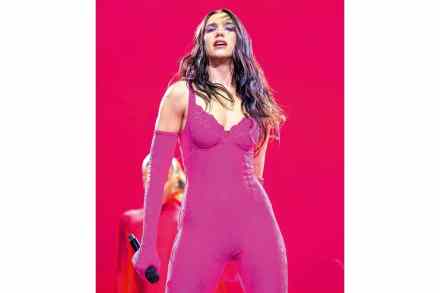
In last weekend’s Wall Street Journal, James R. Hagerty and Anne Steele argue that pop artists are using more imperfect — that is, half or slant — rhymes than before because of the pressure to be original in the age of Spotify. This, plus the influence of rap, which “requires verbal virtuosity,” they argue, “has upped the ante on originality in rhyming.” Color me unconvinced. Olivia Rodrigo rhymes “smart” with “car” in “Brutal.” Dua Lipa’s “Don’t Start Now” rhymes “full 180” with “crazy.” For Hagerty and Steele, these are examples of stunning creativity. But lyricists have been using slant rhymes for a long time. Why? Mainly because they are easier than perfect rhymes, at least in English.

olivia rodrigo pop music

The buzz band of 2022 sound like they’re from 1982: Yard Act, at Village Underground reviewed

From our UK edition

One of the curiosities of modern pop’s landscape is that no one knows any longer how to measure success. An artist can be a huge live draw, but make no impact on the charts; they can be consistent chart-toppers but minnows among the streamers; they can stream by the bazillion, but have no live following to speak of. The metrics of success are so unrelated to each other that anyone can prove anything these days: any band can be the biggest young band in Britain right now. Yard Act are one of those biggest young bands in Britain. Their debut album was a No. 2 hit at the start of this month. Properly big, right? Well, no, perhaps not. For one, it stayed in the chart for only two weeks.

Expectations were met and then exceeded: Arooj Aftab, at Celtic Connections, reviewed

From our UK edition

We gathered on a freezing Sunday night, inside a barrel-vaulted church designed in the 1890s by Charles Rennie Mackintosh, to witness a cresting wave. Vulture Prince, the third album by the Brooklyn-based Pakistani singer, composer and producer Arooj Aftab, was one of the most accomplished and interesting records of last year. A keening song of loss, dedicated to her late brother, Vulture Prince is almost impossible to pin down. It’s a flood plain of merging musical streams, a genre-phobic blend of jazz, minimalism, Sufi devotional music, acoustic textures and torch song. Sung almost entirely in Urdu, its beauty and import are immediate, its emotional pull universal. Following two Grammy nominations and a fat wodge of critical acclaim, Aftab’s stock is in the ascendant.

Pretty astonishing: Black Country, New Road’s Ants From Up There reviewed

From our UK edition

Grade: A+ It is not true, fellow boomers, that there is nothing new under the sun nor no good new music being made. Just almost nothing new and almost nothing good. The majority is indeed toxic landfill, rehashes of that least appealing of decades, the 1980s, and performed by pasty-faced, limp-wristed, deluded woke idiots whose chief concern is to tell you their gender. But there are yet pockets of brilliance, just as there were in 1975 and 1995 — and this youngish Cambridge band (the only other place they could have come from is Oxford) inhabit one of those pockets. Upon completion of this, their second album, the lead singer Isaac Wood left the band because, so far as I could tell from his confused message on the band’s website, he was going round the bend.

One of the most exciting hours I’ve spent in ages: Turnstile at O2 Forum Kentish Town

From our UK edition

Even leaving aside its origins as prison slang, punk has always meant different things on either side of the Atlantic. Forty-five years ago, in New York, no punk band sounded like the next one: the only thing that linked Ramones, Talking Heads, Patti Smith, Suicide, Blondie and Television was that they played the same club, CBGB. Over here, by contrast, punk was rapidly codified into people shouting angrily over buzzsaw guitars. These days, it can seem as though the opposite applies. It’s the American punks who stick to a formula, while in the British Isles, the punk label seems to apply to any band with a guitar and a modicum of attitude. Both Turnstile (from Baltimore) and Fontaines D.C. (Dublin) have been called punk.

Triumphant: Idles at the O2 Academy Brixton reviewed

From our UK edition

The single thing you don’t want when you are beginning a run of four shows in a prestige venue, with reviewers out in force, is for it all to go tits up at the start. Which is precisely what happened to Idles as they opened their Brixton run. On came the band, up started the throb of the opening song, ‘MTT 420 RR’, and off stalked singer Joe Talbot. Back he came. Off he went. Back he came. Off he went, clearly dealing with some technical issue. The rest of the band carried on, but given that until Talbot starts singing, ‘MTT 420 RR’ is nothing but a monotone drone, this was not the dramatic start one might have hoped for. Next to me, Idles’ booking agent started laughing, a little despairingly.

A story of reflection and self-discovery: Anaïs Mitchell’s new album reviewed

From our UK edition

Any artist who has habitually written or performed in character — from David Bowie to Lady Gaga — eventually arrives at their Mike Yarwood moment: ‘And this is me!’ With the release of her sixth solo record, Anaïs Mitchell has reached the point of personal revelation. ‘I’ve spent a lot of time trying to write in the voice of other characters,’ she says. ‘It felt like after so many years of working on telling other stories — now here are some of mine.’ In 2020 Mitchell was named one of Time magazine’s 100 most influential people. Nevertheless, she requires an introduction.

Lovely and wistful: Neil Young and Crazy Horse’s Barn reviewed

From our UK edition

 Grade: A I have persisted in buying everything Neil Young releases since I first heard On the Beach as a callow but pretentious 13-year-old. To tell you the truth, the past 27 years have somewhat tested this commitment. There has been a fatal laziness in the songwriting, lyrically and melodically, since 1994’s Sleeps with Angels and the preaching has become ever more tiresome. But I continued forking out in the increasingly forlorn hope that he’d turn out something if not wonderful, then at least reminiscent of wonderful things past. And for lo, the grizzled old troubadour has done exactly that. This is a subtler incarnation of Crazy Horse, helped incalculably by the presence of Nils Lofgren on flowery bar-room piano and sweet guitar.

Truly godawful: Ed Sheeran’s =

From our UK edition

 Grade: C= My wife’s ill with Covid and demanding inexhaustible libations and difficult meals, which she will leave uneaten. The dog thinks it deserves a walk in the filthy sleet. The kitchen is a tip and the bins need emptying. I have a headache, a runny nose and the ghost of a ticklish cough. Can things get worse? Yes, yes they can. It’s The Spectator on the phone. Can you please review Ed Sheeran’s new album? As in: look, you’re feeling rough and put upon at the moment. So can we come round and smash your spectacles and rub human excrement in your hair? And all this a few weeks after they foisted on me the woke caterwauling exoskeleton that is Adele. Oh, he seems a nice enough bloke, Ed.

In praise of seasonal chart fodder

From our UK edition

Christmas: the most vulnerable time of the year. I heard ‘A Winter’s Tale’ by David Essex on the radio the other day and, oh boy. It was Noël Coward who wrote, in Private Lives, that smart little line about the strange potency of cheap music. It is a truism never more apparent than at Christmas, when we allow the gaudy and sentimental access to our hearts with only the most cursory of security checks. Songs that would never make it past the bouncers in May are whisked directly into the VIP area come December. A quick google confirms that ‘A Winter’s Tale’ was released in the run-up to Christmas 1982, which means I was nine years old when it was first released.

More mesmerising than it should be – Disney+’s The Beatles: Get Back reviewed

From our UK edition

My late friend Alexander Nekrassov loathed the Beatles, which I used to think was a wantonly contrary position akin to hating kittens or blue skies or Christmas carols. What could there possibly be not to like, love and admire about the band that gave us ‘Eleanor Rigby’, ‘A Day In the Life’ and ‘Strawberry Fields Forever’? Since then I’ve encountered so many Beatles sceptics that it has given me pause for thought.

A soulful man with a blistering voice: Sipho, at Studio 9294, reviewed

From our UK edition

When I were a lad — back when you could buy the entire back catalogue of the Fall for thruppence and still have change to get into a New Order show on the way home — record labels mattered. Well, a cohort of independent labels mattered, because their imprints stood for something. There was Creation, with its dedication to a twin axis of 1977 and 1967 as the only years that counted; 4AD, with its arty sleeves and its wafty, diaphanous music; there was Factory, somewhere between an elaborate practical joke and home to the most forward-thinking musicians in the country. You don’t get many labels like that any longer. The new economics of the music industry militate against the model of the record label as an aesthetic statement, rather than purveyor of vulgar commerce.

The quiet radicalism of the Chieftains

From our UK edition

Pop quiz time: which act was named Melody Maker Group of the Year in 1975? The answer is not, as you might expect, some testosterone-fuelled blues-rock outfit or a hip gang of proto-punk gunslingers, but a gaggle of semi-professional Irish musicians who performed trad tunes sitting down, dressed for church in cardigans, sensible shoes, shirts and ties. The Chieftains were so far from rock and roll they met it coming back the other way. On the cover of Irish Heartbeat, a later collaboration with Van Morrison, they could be mistaken for a loose affiliation of farmers, minor office clerks and earnest ornithologists waiting for a bus outside the town hall. It was a brilliant disguise. The Chieftains wore their radicalism lightly, but radical they were.