Painting

Constable changed the course of painting, not Turner

From our UK edition

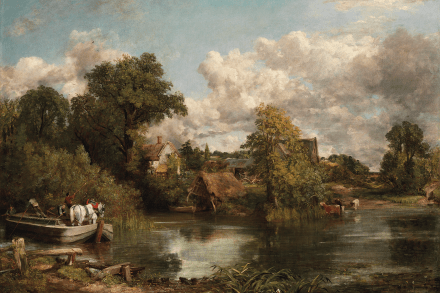
Flanders and Swann; Tom and Jerry. Some things come in pairs. Like Turner and Constable, even though our two most famous painters were more like chalk and cheese than cheese and pickle. They were close contemporaries: Turner was born in 1775, Constable a year later. Both painted landscapes. But that’s almost all they had in common. In every other way that matters, personal and artistic, they could hardly have been more different. Turner was a prodigy, a student at the Royal Academy Schools from the age of 14 and an associate (ARA) at 24. That same year, Constable had only just enrolled in the Schools, and was not elected ARA until he was 33. Constable did not become a full RA until the age of 52, while Turner had been one since he was 27.

The thrill of Stanley Spencer

From our UK edition

‘Places in Cookham seem to me possessed by a sacred presence of which the inhabitants are unaware,’ wrote Stanley Spencer. Mystically devoted to the Berkshire village near the Thames where he grew up, Spencer was synonymous with Cookham as early as 1912, when he was at the Slade; ‘Cookham’ was his nickname. His greatest work is probably ‘The Resurrection, Cookham’ (1924-7), and he lived out his life there. He became known for pushing an old pram full of paints around town. The former Wesleyan Chapel, where he worshipped as a boy, is now the Stanley Spencer Gallery. So it was intriguing to come across this new show connecting him with Suffolk.

Why is divorce so seldom addressed in art?

From our UK edition

Two years ago I was flown to Reykjavik to interview the Icelandic performance artist Ragnar Kjartansson. It was a weird old trip, booked in at 48 hours’ notice, but Ragnar was consistently charming and generous. Indeed, the only slightly touchy moment came when I asked him about his 2012 video installation The Visitors, a berserk undertaking split across nine screens, in which the artist and an entourage of musician friends spend 52 minutes chanting the baleful refrain from a song written by his then recent ex-wife. The artist tensed up as he considered the question. ‘Shit, I gotta go,’ he said. He probably did, but his reticence might also have had something to do with the fact that the work was possibly conceived as a cathartic means of putting his first marriage behind him.

The genius of William Nicholson

From our UK edition

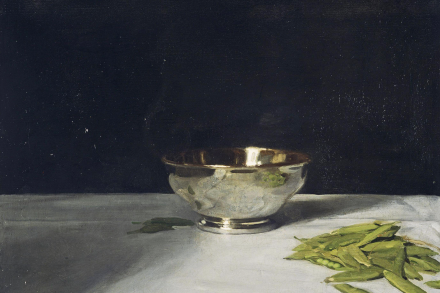
Even if you think you don’t know William Nicholson, it’s a fair bet that you’ve come across his work. If you’ve read those excellent children’s books, The Velveteen Rabbit or Clever Bill, you’ll have taken in his drawings – never wholly sentimental, even the rabbit – into your mental world. And if you’ve seen his woodcuts (they’re everywhere) – say, of Queen Victoria looking stout and dour – you’ll have noticed their economy, their clever use of space and their humour. This exhibition has the familiar elements of his work, but also the grander stuff: the still lifes, the landscapes, the portraits. Then there are the unexpected aspects – who knew he designed costumes for the stage production of J.M. Barrie’s Peter Pan?

The Two Roberts drank, danced, fought – but how good was their art?

From our UK edition

The Two Roberts, Robert MacBryde (1913-66) and Robert Colquhoun (1914-62), are figures of a lost British bohemia. Both born in Ayrshire, they met on their first day at the Glasgow School of Art, becoming lifelong partners and painters. Well-connected in louche literary London, their conversational barbs were recorded by Julian Maclaren-Ross, their jig-dancing antics noted by Joan Wyndham, their drunken fights observed by Anthony Cronin – so that one sometimes forgets what sort of art they made. This show, staged in a former municipal building in Lewes, is a reminder. The work is haunted, unbeautiful British neo-romanticism, second cousin to Piper and Sutherland. They established this angsty, angular modernist style in the 1940s.

The melancholy genius of Joseph Wright of Derby

From our UK edition

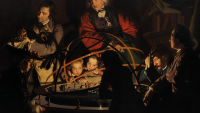
If you lived in the 1760s and were affluent enough – and curious enough – science could be a family affair. The instrument maker Benjamin Martin actually marketed scientific equipment for amateurs, complete with an instruction manual listing simple, edifying experiments for home enjoyment. And so in 1768, in ‘An Experiment on a Bird in the Air Pump’, Joseph Wright (1734-97) painted a group of family and friends attempting Experiment 42 in Martin’s manual. You’re sure to have seen it: a darkened room with a white bird wilting in a glass bulb while the faces of the participants – a magus-like scientist, a fashionable couple, a frightened little girl burying her face in her dad’s coat – are half-illumined in a pure, almost supernatural light.

sixties surreal

Sixties Surreal at the Whitney is a bad trip

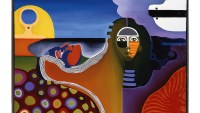
The Whitney’s Sixties Surreal is not about Surrealism. I spent about a week trying to figure out what it might actually be about, before I gave up. The show claims to seek to answer a simple question: what if Surrealism, rather than Cubism, had been the dominant thread in modern American art? This is funny to me, as Dalí’s melting clocks are far better known in America than any Cubist painting. Regardless, the museum never provides an answer. Instead, the Whitney jumps right to its agenda: reviving what it deems an overlooked thread of countercultural art. Ah, yes, the woefully neglected subject of… counterculture in the 1960s.

met kinky

Why is the Met making medieval art perverse?

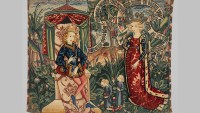
Unwitting historians often reveal just as much – if not more – about their own time and place than the time and place they claim to describe. The curators of Spectrum of Desire: Love, Sex, and Gender in the Middle Ages, a new exhibition at the Met Cloisters, are prime examples. Gathering manuscript illustrations, paintings, sculptures, jewelry and more from the 13th to 16th centuries, the exhibition promises to uncover “the hidden sexuality and sensuality of medieval art.” The intent is “queering the past,” and the objects were chosen to show expressions of “desire” in as many forms as possible – a saucy premise that appeals to contemporary trends. But many of the new interpretations range from the woolly to the laughable.

Are Vermeer’s paintings really coded religious messages?

From our UK edition

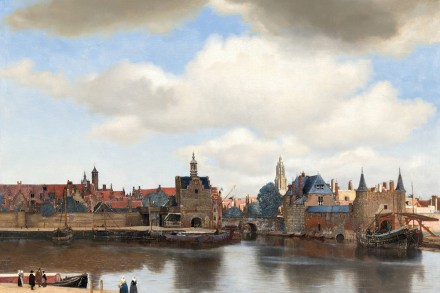
The Delft painter Johannes Vermeer, now probably the most beloved artist of the Dutch Golden Age, had an unusual career. His reputation in his lifetime was small. For some reason he painted almost exclusively for the van Ruijvens, so only those who knew the family would have been able to view much of the work. One foreign observer who did see a painting owned by a baker (probably handed over in security for a large overdue account) was incredulous at what the owner claimed was the value of a small picture by an unknown artist. After Vermeer’s death, and the sale of the collection for very little on the death of his patrons’ son-in-law, his name disappeared. He is hardly ever mentioned in any of the exhaustive and insightful 18th-century histories of Dutch painting.

The best artist alive? Probably

From our UK edition

Taking place every October in Regent’s Park, the Frieze fair is probably the biggest event in London’s art calendar. It is also, as a spectacle, by far the least enjoyable. With works crammed into cubicle-sized booths, and punters battling a crossfire of air kisses and the palpable stress ricocheting around the flimsy partitions, I struggle to think of a worse context in which to look at art of any stripe. Still, it always used to be an occasion to take the pulse of the contemporary art world, to pick out the visual signatures of the reigning avant-garde tendency and clock what Jeremy Deller was doing with his facial hair at any given moment. This year’s iteration proposed no such insights.

The staggering beauty of Fra Angelico

From our UK edition

In 1982, Pope John Paul II surprised a few people by beatifying Fra Angelico, the 15th-century Dominican friar from near Fiesole. It’s not clear why he put Beato Angelico on the road to sainthood, given that the artist didn’t perform any miracles. And yet, after spending a few hours immersed in his works, which are both profoundly sacred but also staggeringly beautiful, you begin to understand the decision. He was certainly a hit with popes.

Condoms in 18th-century painting

From our UK edition

Waldemar Januszczak and Bendor Grosvenor’s art podcast has returned after nearly five years. It is, says Januszczak, ‘the podcast they could not stop – but they did have a jolly good try’. What happened? It isn’t clear; there are teases that it revealed too much, which is anyway a good ploy for attracting listeners. ‘Subversive’ is not the first word that springs to mind when tuning in to the two unlikely chums. Their regular feature, ‘Shocking News from the Artworld’, is more Apollo than Nigel Dempster. For example: Christie’s has closed the digital art department that dealt in NFTs, the crypto tokens going the way of the dodo.

This museum is a lesson for all curators

From our UK edition

The National Railway Museum is 50 years old, and it’s come over all literary. A quote from Howards End stands at the entrance to the newly refurbished Station Hall: railway termini, proclaims Forster, ‘are our gates to the glorious and the unknown’. T.S. Eliot salutes you on the way out: ‘You are not the same people who left that station.’ Big claims, but as it turns out, largely to the point. The changes to the Station Hall are subtle but numerous, making the argument that as well as being the foundational technology of modern civilisation, railways are a culture in their own right. The aim, say the curators, is to reintroduce the human dimension to a museum that (fairly, and unfairly) is more generally associated with huge, gleaming machines.

The best Turner Prize in years

From our UK edition

So, the Turner Prize: where do we start? It’s Britain’s most prestigious art award, one that used to mean something and now attracts little more than indifference. Taking place every year, it grants £25,000 to a winner chosen from four shortlisted artists, all of whom are obliged to display work together either at Tate Britain, or at a regional gallery. The latest iteration, at Bradford’s Cartwright Hall, is the best in a while – but before we get to that, some context. The Turner was established in 1984, but only really grabbed anyone’s attention when Channel 4 began televising the prize-giving ceremony in the 1990s.

Was Serbia the real birthplace of the Renaissance?

From our UK edition

Where did the Renaissance begin? There has been an official answer to that question since 1550, the date that Giorgio Vasari’s Lives of the Artists was first published. According to this version, it all began in Florence and the first painter in the long line that ended with Leonardo, Raphael and Michelangelo was named Cimabue. But here’s another suggestion: you could just as well try looking in the rolling hills of Serbia. My wife and I went travelling there earlier this year. For a couple of nights we stayed in the town of Novi Pazar in the south-east of the country. From the religious point of view this town is a remnant of the Ottoman Empire; according to the census of 2022, nearly 80 per cent of the population is Muslim (with just 71 atheists).

I’ve had it with Anselm Kiefer

From our UK edition

August is always a crap month for exhibitions in London. The collectors are elsewhere, the dealers are presumably hot on their heels, and the galleries are filled with makeweight group shows staged to hold the fort until the end of the holidays. This year, however, even events of that kind are thin on the ground: many establishments have simply shuttered for the month – and given the dire state of the art market, I’m inclined to wonder how many will reopen come September. The doom-auguring sunflower paintings here would look great on the cover of a Metallica record Still, I caught the two Anselm Kiefer shows running concurrently.

Modest, interesting – no masterpieces: Millet at the National Gallery reviewed

From our UK edition

Jean-François Millet (1814-75). One Room. 14 items. Eight paintings. Six drawings and sketches. Modest, interesting. No masterpieces. The show appeals to the contemporary English preference for the unassuming, the humble, the unpretentious. Take ‘The Wood Sawyers’ (oil on canvas, 1850-2). Two figures are sawing a tree trunk with a long two-man bucking saw. Two thick sections have already been cut and the sawyers are busy with a third. The simplified trunk is like a salami, the bark corresponding to the floury skin. The main foreground figure with his blue rump has his foot braced against the trunk and commands our immediate attention. You can see the folds of flesh gathered at the back of his neck as he looks up from the task towards his fellow worker.

On holiday with Goya

When I’m first invited to a sojourn in Madrid to learn about the life and work of Francisco Goya and the conservation work of Factum Arte, I’m thrilled but also a little apprehensive. While art-themed travel is right up my street and I live a mere train trip from the Spanish capital, Goya’s work is known for being a little, well, dark – particularly during his later years. As a fan of the Botticellis of this world, spending a few days with the artist famous for his "black paintings" was not something I was sure I’d enjoy.  And yet, three days later, as I stand in front of Goya’s grave in La Ermita de San Antonio de la Florida, I find myself moved in a way I never could’ve anticipated.

Goya