
One of the miracles of art history is how painting, so often written off, keeps on coming back. Right now we are in the middle of just such a resurgence, and one sign of the current vitality of the medium is the emergence of painters such as Hurvin Anderson. Admittedly, Anderson – who was born in 1965 – has been emerging for a long time now. But, with the opening of a big retrospective at Tate Britain, his status as a major figure in modern British art is clear.
Anderson is completely individual yet visibly connected to the tradition – indeed, to several traditions – and capable of creating huge, wall-filling canvases into which you can sink and float away, but which also make you think and feel. He can do things with paint that no one has done before, which is quite something given that human beings have been playing around with pigment on walls for around 60,000 years. The medium remains a good test of a painter’s stature.
Anderson can do thing swith paint that no one has done before
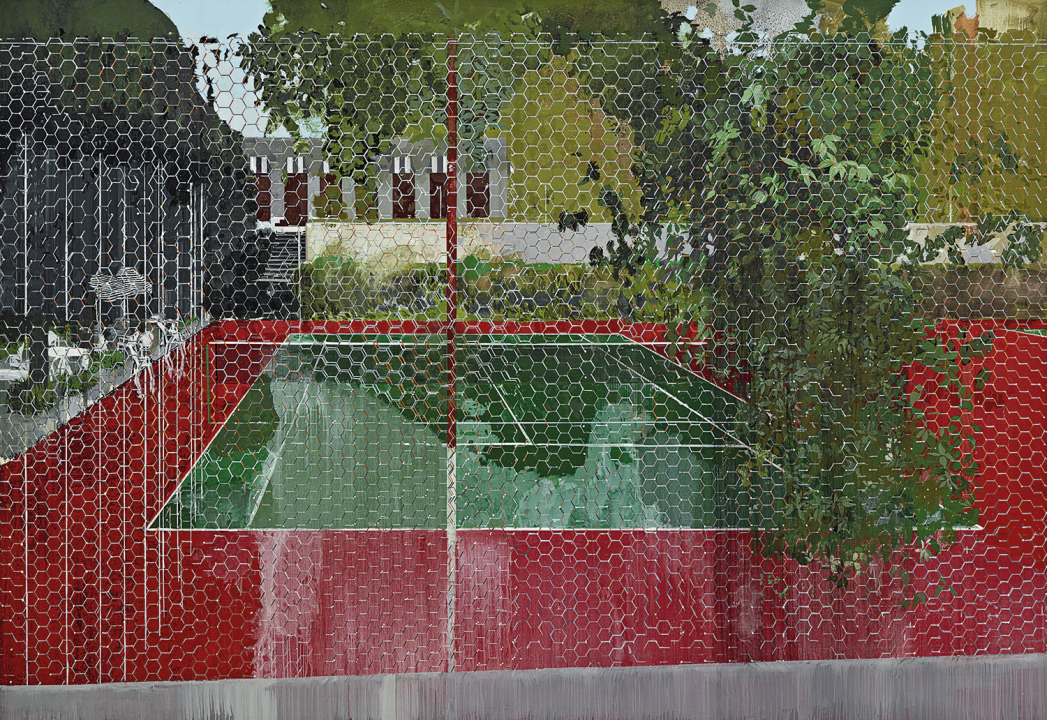
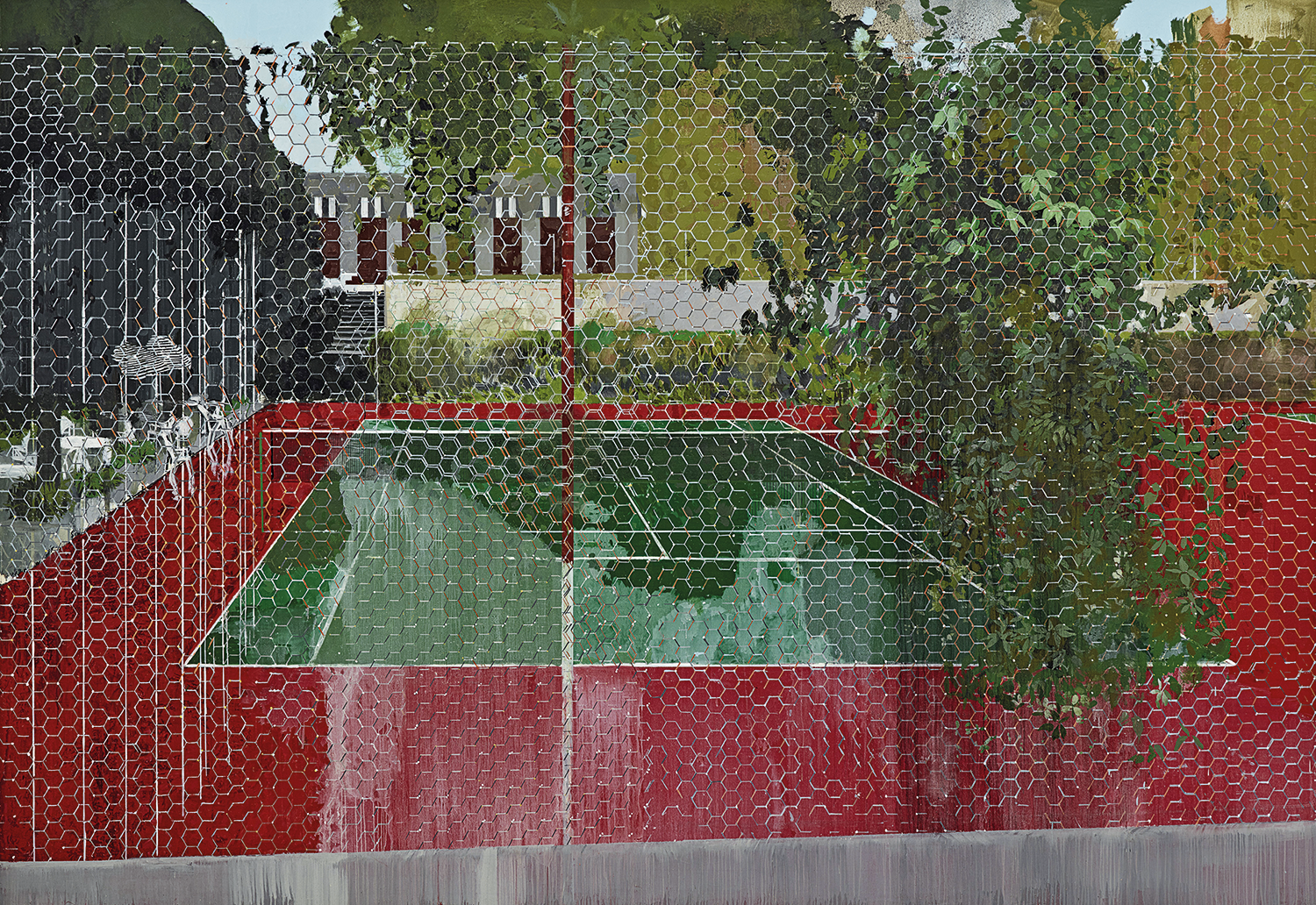
“Country Club: Chicken Wire” (2008) demonstrates the point. It is on a grand scale, and the surface is covered by a depiction of wire fencing so brilliant that when you first see it from a distance you think the picture is wrapped in an actual fence. As trompe l’oeil it’s perfect, but the hexagonal pattern of the chain links also plays a part in the yin-yang of the whole picture. Behind it is a domesticated landscape comprising a tennis court in neat, Renaissance perspective, tables under sunshades, luxuriant vegetation and dilute paint that trickles down to the bottom of the canvas. Formally speaking, this work is an interplay between geometry – tight and sharp, close to op art in the chicken wire – and brushwork that is loose and free.
Anderson often combines those opposites. His barbershop interiors, such as “Kasumba” (2023), are built around an array of rectangles, large and small. These represent the mirrors and posters on the walls of the salon but look like an abstract composition from the 1950s – except, that is, for the sense of airy space and the squiggly shapes of bottles and jars that tell you that you’re looking at a picture of a room.
Another large subsection of Anderson’s work is concerned with landscapes – often of the Caribbean, whence his parents originally hailed, sometimes the West Midlands where he was born and grew up. Occasionally the two blend together, as in “Ball Watching I” (1997), based on a photograph of the artist’s youthful friends hanging out in a park in Handsworth, but with tropical trees substituted for the species that grow in Birmingham.
Some of Anderson’s landscapes are explicitly homages to John Constable, one of his heroes. Of course, he is not alone in that. Artists who love the brushy fluidity of paint – among them Frank Auerbach, Frank Bowling and Lucian Freud – tend to be Constable fans. But Anderson has more than one painterly lodestar. Turner is another, just behind Constable, and also – among others – Patrick Caulfield, David Hockney, Leon Kossoff, Peter Doig (who taught him at the Royal College of Art), and above all Michael Andrews.
Artists have a way of retrospectively rearranging the tradition they come from. Anderson’s evident connection with Andrews alters the way you think about both of them. Instead of seeming an isolated individual, Andrews suddenly seems part of a lineage – and so does Anderson. One connection between them is the way they both use photographs as a starting point but transmute those snaps into something utterly different: poetic and full of painterly life.
The ambiance and environment of the Caribbean is a frequent subject of Anderson’s. But it’s not as presented on Instagram or by the tourist board. In his beach scenes, the bathers on the sands are tiny, the mass of vegetation behind huge and forbiddingly dense. In paintings such as the marvelous “Grace Jones” (2020) there is a sense of humanity infiltrating an environment that is luxuriant, wild, not exactly hostile but definitely unknowable.
Artists who love the brushy fluidity of paint tend to be Constable fans
In this picture a young woman walks down a steep staircase (Anderson named it after the actor and model because he thought the figure looked like her). All around are tree trunks, foliage, huge leaves. So the architectural geometry of a concrete villa or hotel is set against verdant chaos. Quite often, as here, Anderson’s work gives you a feeling that you can also get from Edward Hopper’s: of isolation in the immensity of nature.
You might say that the fundamental theme in western landscape painting is paradise lost (whereas in Chinese art, for example, it’s the mystical energy of nature). In Anderson’s case the sense of loss is specific. He is connected with the Caribbean – it’s where his parents came from – but he has said it is “a place I don’t know but have learned about through conversation.” Perhaps that is what gives these paintings such a powerful mood: dreamy and elusive.



Comments