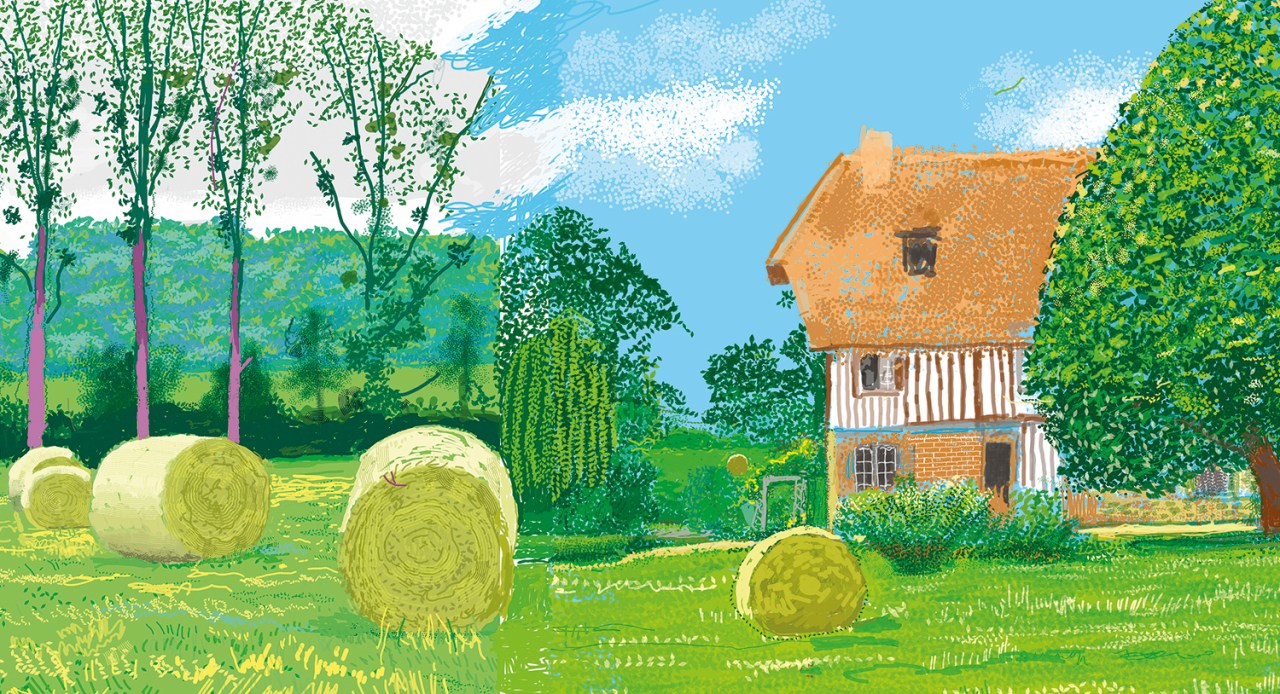
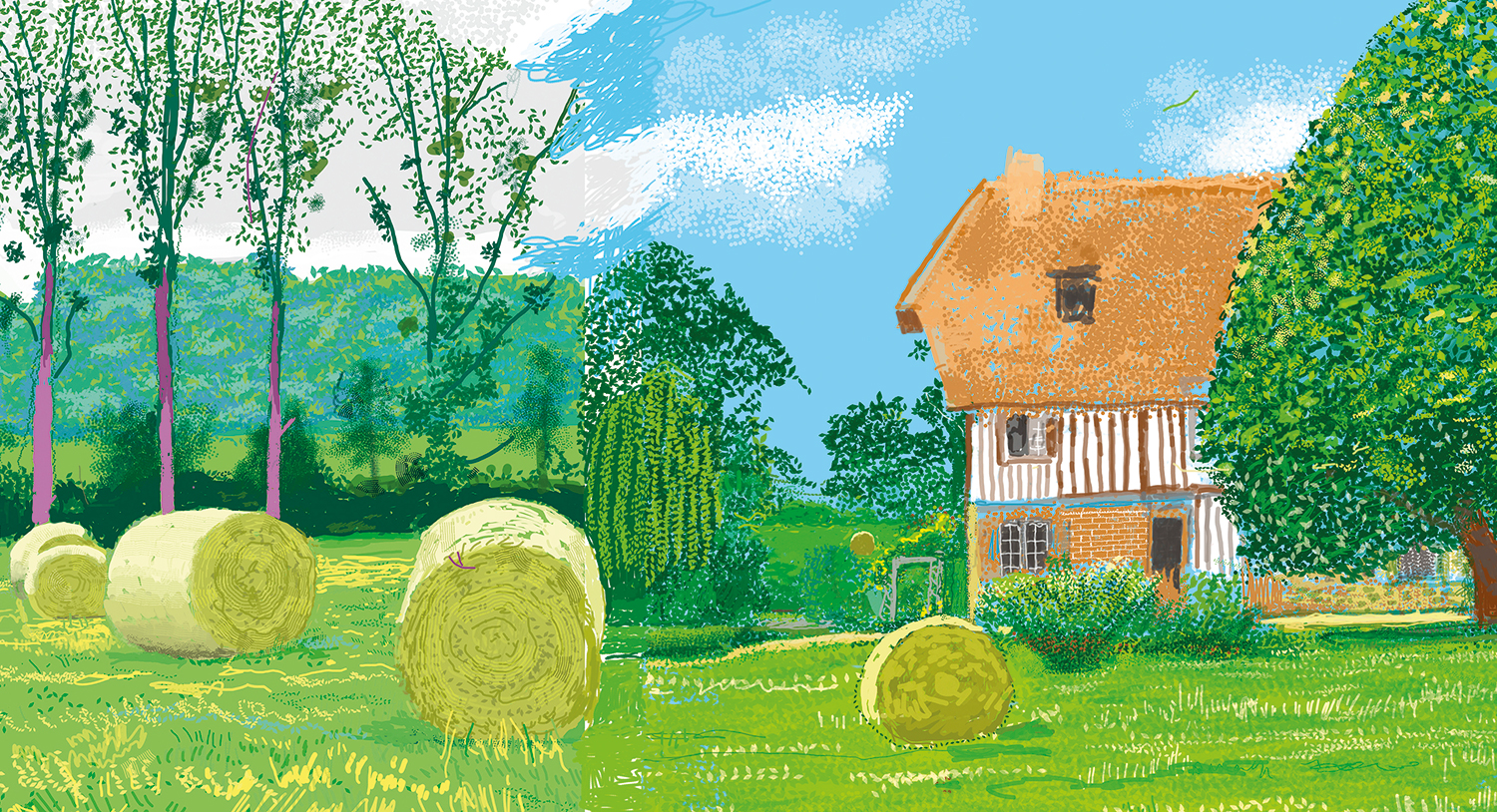
When so much contemporary art is riven with obscurity and angst, it is disorienting, at first, to encounter something as straightforwardly enjoyable as Hockney’s latest exhibition. Aged 88, the artist went out into his garden in Normandy with his iPad to make a visual diary of the year 2020. A hundred or so of the iPad sketches he made have been put together here, blended into a frieze, a walk-through panorama of the seasons rendered with Vivaldi-like virtuosity.
As we move along the curve of this 90-meter frieze, we see nature through Hockney’s bright yellow spectacles. He distills the garden to its dramatic essences. The chill mist of winter is numinous, the dormant trees skeletal, the spring blossom riotously delicate, the blue sky bluer than blue. It is as if he is holding all he sees close, impelled to capture it once and for all.
This show is a marvelous indicator of what can and will be achieved by artists working on screens
“Late style” is the critical term used to try to characterize work by composers and artists of advanced years – Verdi’s Falstaff and so on. Of course, barely any generalizations can be made apart from that these works often show a disregard for superficial polish or convention. One can see here that this printed-out frieze has been tacked to the wall with gold pins, as if the fuss of invisible mounting was deemed beside the point. Likewise there are some crude joins between the distinct iPad pictures where we can see the digital spray can at work, blending and blurring.
Be quick, these maker’s marks seem to say, nature will not wait: the trees are coming into leaf.
The year 2020 being what it was, the decision to spend it closely observing nature was something of a radical act, and that is perhaps why the work sings so intensely, charged with denial, a deliberate turning away from the drama of the news. Hockney has referenced his interest in the Bayeux Tapestry, but the only death here is the death of a leaf, the only butchery the formation of a log pile.
Hockney has always had sprezzatura – reveling in displaying his own speed and facility. Here he condenses a garden chair into a few inspired squiggles, makes perfect late summer shadow out of a purple streak. Lightness of touch is his genius. The art references feel casually instinctive too, with irises and cherry blossoms that are a bit like Van Gogh’s – because why wouldn’t they be? – as well as April rain that falls as briefly and decisively as Hiroshige’s “Sudden Shower Over Shin-Ohashi Bridge and Atake.”
There is one mistaken inclusion: a hastily dashed off red house, standing on computer-standard issue grass, against a cyan sky with white scudding clouds. It ought to have been edited out. Otherwise, this show is a marvelous indicator of what can and will be achieved by artists working on screens, a rebuke to all those that scoffed at Hockney’s early adoption as showcased at the Royal Academy in 2012. He has become more adept since those large-scale works and it is a joy to see here new technology applied to the pastoral tradition.
There is a playful interaction, too, with the Serpentine North’s bucolic setting: a large replica of his blossom and sky painting outdoors. The day I visited, this made the actual sky look like a pale imitation of his sky, the blossom less convincing than his ebullient buds.
At the heart of the gallery, a former gunpowder store, are ten new oil paintings. Half of them are witty quotations of famous styles of abstraction, served up on a tablecloth, as if to be feasted upon. The rest are portraits of people important to Hockney: his nephew, his partner, and his carer, wearing blue scrubs and a badge saying: “End Bossiness Now.” They are touching, but should be considered as a counterpoint to juvenilia. There is rather too much emphasis on a bright checked tablecloth as an optical statement. Not all the master’s works need to be shown. But in general this is a wonderful show – and free to visit, too.


Comments