The first thing you see on entering this major new Viennese exhibition is not one of Canaletto and his nephew Bernardo Bellotto’s majestic paintings of London, Venice or Vienna, but a camera obscura. The magical art of both artists depended upon this simple but effective device, which exploits pin-hole projection – an optical phenomenon that had been known since antiquity.
The decision to open the show at the Kunsthistorisches Museum with a deceptively boring little wooden box amounts to a curatorial throwing down of the gauntlet. Because – although I find it hard to fathom – there are still art historians and critics out there who refuse to countenance the fact that great artists used optical aids. The show follows hot on the heels of the publication last year of Philip Steadman’s Canaletto’s Camera (UCL Press) in which he demonstrated precisely how the Venetian master employed drawings made with a camera obscura to create his paintings. (Canaletto’s own – stamped ‘A. Canal’ – is on display at the Museo Correr, Venice.)
Was Hockney suggesting that artists cheated? If that’s how you want to look at it, of course they did
A pin-hole image appears upside-down and back to front, but both these aspects can be adjusted in a purpose-built device through the incorporation of one or more mirrors (you can try out a sophisticated 1828 camera obscura at Bristol’s Clifton Tower). Canaletto’s own little box showed images the right way up although still back to front. The scene before him was projected on to a ground-glass screen – shaded from the light by a wooden hood – where it could readily be traced on to transparent paper, which was then simply reversed.
After the second world war a sketchbook was presented to the Accademia in Venice that contained no fewer than 140 pages of sketches by Canaletto of Venetian buildings, all of them related to finished paintings. The pages are tiny, 17x23cm, limited by the size of the camera obscura. A few are very rough initial outlines, but the rest are highly detailed, many of them worked over in ink and even annotated with shop names. Owing to the petiteness of the device, Canaletto had to take a number of sketches of any particular view, which he then stitched together into paintings. Using modern-day photographs taken on site, Steadman related these groups of sketches to the relevant paintings. He revealed that Canaletto liked to tweak reality here and there in the interests of composition and effect but that, overall, the verisimilitude was astonishing.
Steadman had performed a similar trick in his equally radical treatise Vermeer’s Camera (OUP, 2001), in which he demonstrated that the artist did not just employ a camera obscura: he had an entire room fitted out for the purpose. Just one month after that book came out, another explosive disquisition arrived, David Hockney’s Secret Knowledge: Rediscovering the Lost Techniques of the Old Masters (Viking). Through a minute study of a host of paintings, Hockney argued that artists must have started to use optical aids in the 15th century because of the many abrupt advances in the realistic depiction of the world that had occurred. Hockney reckoned it was not only the camera obscura that they were using but mirrors – especially concave mirrors with which images could be projected on to panel or canvas.
Well, the ructions! I lost count of the handbags and insults that were hurled about by people who ought to have known better. Was Hockney suggesting that artists cheated? If that’s how you want to look at it, of course they did, but that objection is all upside-down and arsy-versy – just like a pin-hole image. Where was the evidence, the critics demanded. Frankly, it was before their very eyes, as Hockney had realised: not just in the paintings themselves, but in drawings by everyone from Leonardo and Dürer to the modern day.
Hockney’s detractors missed a fundamental point: no camera or mirror can ever do the actual painting for you. Devices offered a beginning, never the finished product. Both Canaletto and Bellotto were, above all things, masters of the brush, as the Kunsthistorisches Museum demonstrates.
The display is so cleverly curated that Canaletto’s precision of brushwork emerges in a new and more dazzling way than ever. As does the often luscious richness of his paint and his delight in colour. Bellotto is in contrast a master of tone rather than colour: his pictures immediately strike the viewer with their dramatic and darker tonality. But for all his command of composition and paint, and his chiaroscuro effects, Bellotto falls short of the perfection of Canaletto.
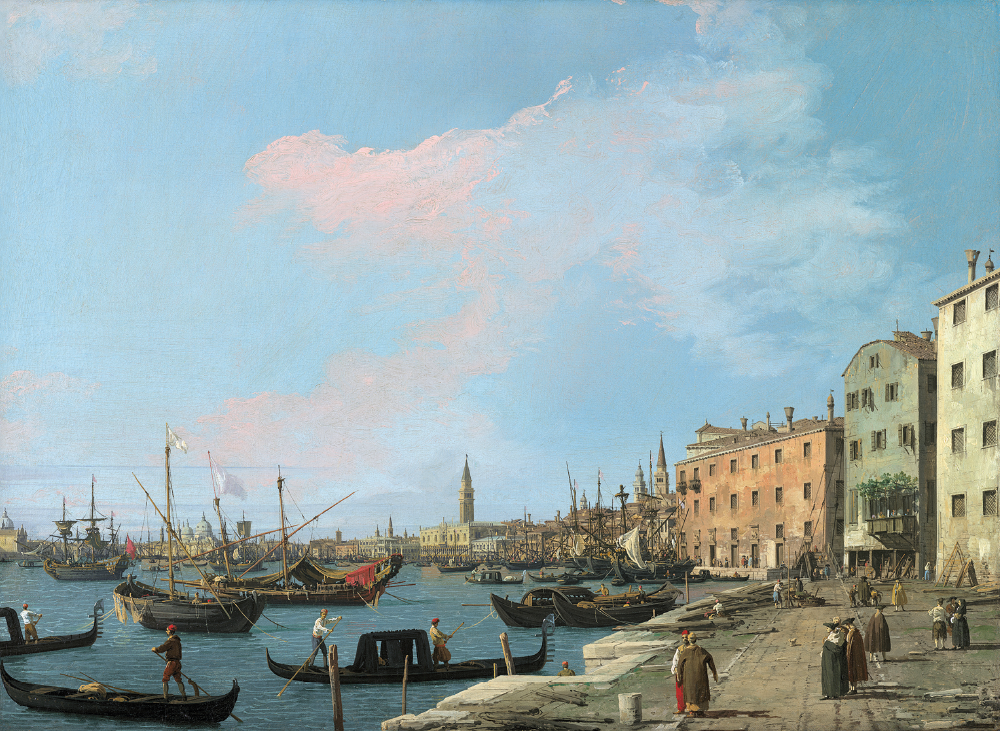
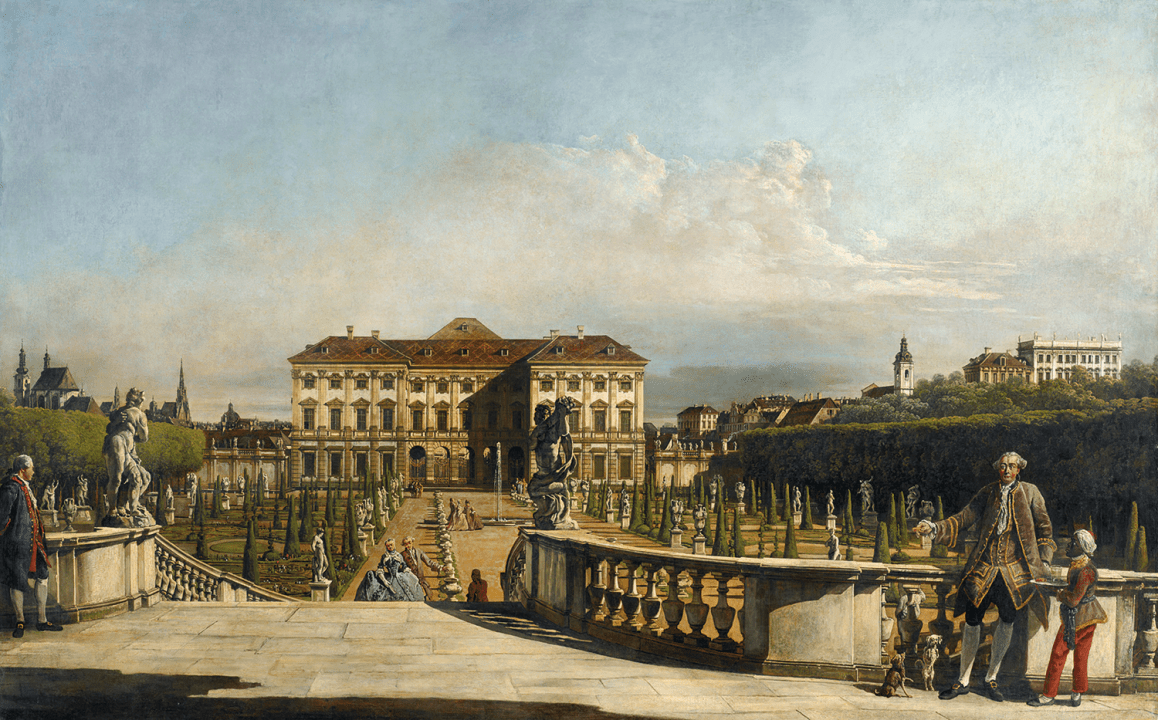
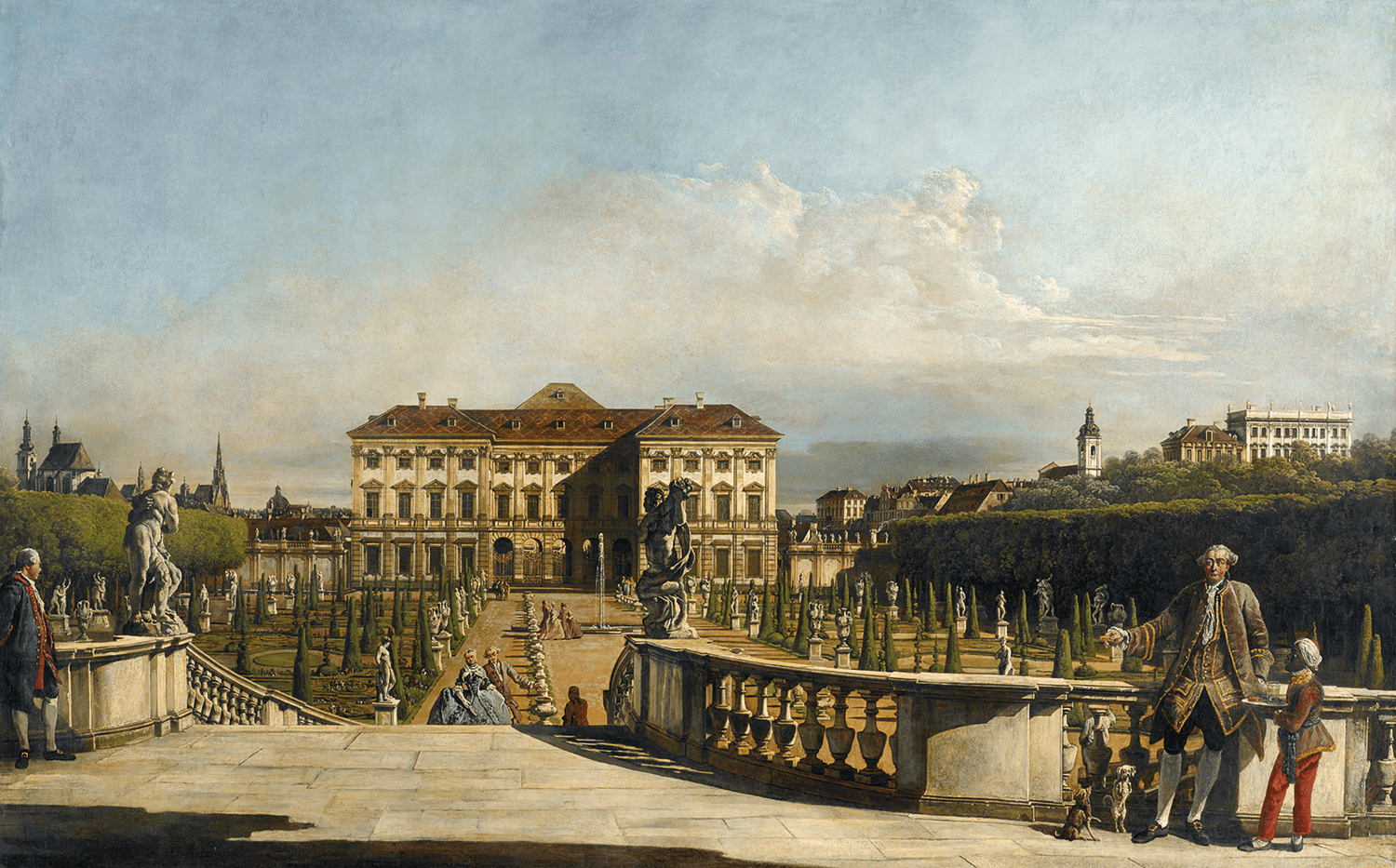
We are talking of two artists of the very highest quality, and so this is a bit of nit-picking, but one of Bellotto’s deficiencies is more than just a niggle. In fact it interestingly demonstrates his use of the camera obscura – and his lack of total command of it. Canaletto always adjusts the peculiar optical effects the device can produce, but Bellotto can be more uncertain. Notably, he fails on several occasions to adjust the distortions of the lens towards the sides – think of the all-too familiar look of the modern-day selfie. The human eye naturally adjusts to these things, but a tracing in a camera obscura does not.
In ‘The Liechtenstein Garden Palace in Vienna, seen from the Belvedere’ (1759-60) Bellotto evidently set up the camera to the right of centre of the symmetrical view in front of him. As a result, when he traced the camera image, the terrace in the foreground fell uncomfortably away to the left-hand side, dragging the figure standing there along with it. This individual was intended to match another on the right, who, alas, takes on the dimensions of Frankenstein’s monster. The effect is so alarming that I had to check whether Bellotto was offering a portrait of one of those Teutonic giants that German and Austrian courts found so amusing to have around (he wasn’t). Optical aids, then, were not without pitfalls, and the artist needed considerable skill to make the most of them.
I found out much about the devices and desires of painters while researching my book The Portrait in Britain and America (1987). On one occasion I visited the Science Museum to examine the camera obscura that had belonged to Sir Joshua Reynolds. He had it disguised as a very large book and, upon lifting the cover – in effect the lid – it must have appeared as if he were pretending to consult a text, while actually sketching the outlines of the sitter before him.
Reynolds was frustrated when a new and improved camera obscura, William Storer’s Accurate Delineator, proved too complicated to use. Fortunately for portraitists, another gadget, the camera lucida, appeared in 1806, patented by Sir William Hyde Wollaston. This prismatic device allowed you to see a mirrored image of what you were looking at directly on the page, which you could then trace with ease. Hockney’s book was, in fact, the result of his having visited the great Jean-Auguste-Dominique Ingres exhibition in London in 1999, where he realised that the artist simply had to have been using some such device as the camera lucida for his preliminary portrait drawings.
On my visit to the Science Museum, I also wanted to see a ‘Claude glass’: a concave mirror contained in a little metal case. The concavity shaped the landscape into something resembling a composition by the great 17th-century painter Claude Lorrain. In order to use it, you turned your back on the landscape that you wanted to enjoy. It seems bizarre to us today but it was then thought almost impossible to enjoy nature in its raw form. I asked to examine one. ‘Which do you want to see?’, the curator asked me. ‘We have 2,500.’ Ample evidence that optical aids were widespread.
Sir Joshua Reynolds had his camera obscura disguised as a very large book
Countless gadgets and tricks have come and gone over the centuries, from the early perspective grid to the physiognotrace to the graphic telescope. And then, of course, around 1840 came the camera itself. Far from being the enemy of painting, perceptive artists swiftly recognised that the image created by a photographic camera was no more ‘real’ than a painting itself and was never going to replace the medium. Rather, it opened up new and exciting ways of seeing. Take Degas and Toulouse-Lautrec: both began to compose work that could be understood by the newly photo-literate public. Figures or horses, for example, would advance out of the canvas, or be abruptly cut off at the edge of a picture in the most dramatic way.
Among these enlightened artists was the glamour-boy of the Edwardian age, John Singer Sargent. In his group portraits he often shows his subjects seated, viewed slightly from above, in the then-novel manner of a photograph. And that great masterpiece, ‘The Daughters of Edward Darley Boit’ (1882), is even more profoundly indebted to Sargent’s exploitation of the effects that appear in a photo. Taking inspiration from the distorting effects of depth of field to which viewers were now accustomed, Sargent moves our eye about the painting by bringing different parts into sharp focus while blithely making sure that other areas are blurred.
The picture was designed as one in the eye for the photographers. Sargent makes that obvious by using a square format, never before used in a portrait painting. It was a shape that had become familiar from early plate cameras but, at 7x7ft, it was on a scale no photographer could dream of. Sargent was saying, ‘Anything you can do, I can do better.’ He was right.
Canaletto & Bellotto is at the Kunsthistorisches Museum, Vienna, until 6 September.


Comments