Nigel farage

Inside Bannon and Burra’s post-CPAC blowout

From our US edition

National Harbor, Maryland “CPAC 2024 was a HUGE success!,” the conference’s account tweeted this morning. Cockburn isn’t sure how they’re measuring that: the gathering was decidedly muted when compared with previous Trump-era affairs. After the former president spoke on Saturday and Argentinian president Javier Milei offered attendees an economics lecture, Steve Bannon closed out proceedings. He led the CPAC crowd in chants of “Trump won, Trump won, Trump won” and branding Joe Biden “a usurper in 1600 Pennsylvania Avenue.” Bannon has never feared courting controversy.

bannon burra

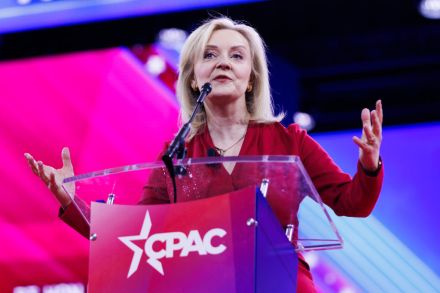
Liz Truss works the crowd at CPAC

From our US edition

National Harbor, Maryland “Oh, that’s Liz Truss,” a young attendee says as the former British PM passes us in the corridor at the Conservative Political Action Conference. “She sucks. What’s she doing here?” Trying to sell books, apparently. Truss is one of two Brits — alongside mainstay Nigel Farage — addressing CPAC. Her visit forms part of the promotional tour for the US release of her book Ten Years to Save the West: Lessons From the Only Conservative in the Room, which has been handily retitled for US audiences: “Leading the Revolution Against Globalism, Socialism and the Liberal Establishment.

liz truss

Why the story of the Holocaust still needs telling

In Chekhov’s The Seagull Dr Dorn is asked which is his favourite foreign city. Genoa, he replies: in the evening the streets are full of strolling people and you became part of the crowd, body and soul. ‘You start to think there really might be a universal spirit,’ he says. I remembered Dr Dorn when I was discovering Genoa in October. Then it suddenly came to me that I had been to the city before. Genoa was where my family embarked for the Far East, when I was 18 months old, fleeing the Nazis. I don’t know about the universal spirit, though. I’m reading Enemies and Neighbours: Arabs and Jews in Palestine and Israel, 1917-2017 by Ian Black. I had reached 1953 when at midnight a text pinged in from an old friend: ‘Who will cross the street when we pass?

The hypocrisy of Nigel Farage’s supporters

Much heartened by the barrage of criticism I’ve been receiving from both Spectator and Times readers, I’m returning to the subject of Coutts’s customer selection. I’ve learned over the years how to spot the emergence of a herd opinion, not just by the volume of shouts but also by how members of the herd begin copying and repeating – often word for word – each others’ phrases; and what we now call ‘memes’ take shape. My experience is that when public sentiment begins to attract these characteristics, it is almost always wrong. I never forget the advice of my late grandfather, Squadron Leader Leonard Littler: ‘Whenever I hear of a great wave of public indignation, I am filled with a massive calm.

Is Nigel Farage really a grifter?

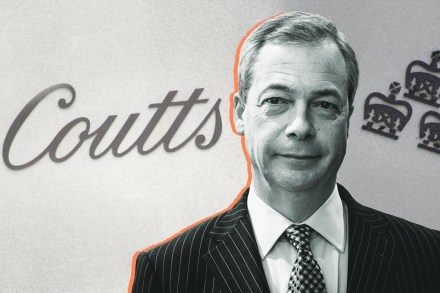
That Coutts dossier on Nigel Farage said in passing: ‘He is considered by many to be a disingenuous grifter.’ I didn’t quite know what grifter here meant. According to the Telegraph, a podcast host at Spotify called the Duke and Duchess of Sussex ‘grifters’. That does not limit the semantic field. It feels to me like a synonym for chancer, which in an 1889 dictionary of slang was defined as ‘one who attempts anything and is incompetent’.  Stephen Frears’s film The Grifters (1990), not to be recommended to anyone of a nervous disposition, deals with fixing racecourse odds, running confidence tricks, and even faking one’s own death.

Coutts has forgotten what the job of a bank is

We now have a reluctant apology from Dame Alison Rose, followed by her even more reluctant resignation. Her departure is a major achievement, but the reluctance is a symptom of the problem. How could she possibly have thought she could stay after she was caught breaking a client’s confidentiality and spreading untruths about him (untruths which the BBC checked with her before publishing)? How could her chairman, Sir Howard Davies, have possibly thought that she could? And still we have nothing from Coutts, the bank that tried to trash Nigel Farage in the first place. Coutts is a B Corp, meaning a corporation which signs up to the commandments of current virtues, such as sustainability and inclusion.

The horror of being branded a PEP

When I asked my husband if he knew what PEP meant he said: ‘It’s an emergency combination of HIV drugs that can stop the virus if you’ve been putting your todger where you shouldn’t.’ Trust him to get hold of the wrong end of the stick. To him as a doctor, PEP meant Post-Exposure Prophylaxis. But I was talking about Politically Exposed Persons – a concept abused by banks to deny people accounts, as happened to Nigel Farage. Dominic Lawson, once editor of The Spectator, wrote in the Daily Mail about his wife being refused a bank account because her brother is a Viscount – but one without a seat in the Lords. The PEP has seeped into financial regulations, acquiring the status of the Black Spot.

In defence of Coutts

Dame Alison Rose should not have resigned as head of NatWest over the Nigel Farage affair – and ministers who forced this by flinching in the face of a silly media storm should be ashamed of themselves. In the great Coutts debate this columnist finds himself in a minority. I express no opinion on the wisdom or otherwise of the private bank’s decision to drop Farage as a client, believing this to be a private matter between himself and Coutts. I’ll pose a number of questions, but first there’s something we must get out of the way. Whether or not Coutts was wise to exclude Farage, a bank like this has, as the law stands, a right to discriminate in its choice of customers.

Dame Alison’s ousting lifts the lid on banking’s wider moral pickle

When Dame Alison Rose was a frontrunner for chief executive of NatWest in 2019, I described her as ‘sensible’ and ‘unspun’ and said I hoped she’d get the job. That view was based partly on personal impression and partly on a prejudice of mine, expressed consistently since the 2008 crisis, that women often make better senior bankers than men, being less prone to macho risk-taking. Rose has now yielded to political pressure and resigned over her role in the false reporting of the decision to ‘exit’ Nigel Farage as a customer of NatWest’s subsidiary, Coutts. But this column has never been in the business of following the baying crowd in hounding corporate chiefs from office.

The liberal case for Nigel Farage

After ‘it’s not happening’, ‘it may be happening, but for different reasons’, and ‘would it be such a bad thing if it was happening?’, we have finally arrived at the ‘it’s happening and it’s a good thing’ stage of the Nigel Farage banking story. This now-familiar pattern of motivated reasoning was first identified by conservative writer Rod Dreher in his law of merited impossibility, which described how progressives could simultaneously hold the views that gay marriage wouldn’t diminish religious liberty and that the religious liberty of opponents of gay marriage ought to be diminished. As Dreher put it: ‘It will never happen, and when it does, you bigots will deserve it.

How my brother-in-law Boris got me cancelled

Nigel Farage and I don’t have too much in common beyond liking a pint and a cigar. Yet I now discover a link: we are both PEPs, or ‘politically exposed persons’. Such a handle may not be a total surprise to Nigel. (He may not have been surprised, either, when Coutts said that it had closed his bank account simply because he didn’t have enough funds.) But it certainly was to me – especially as I found out from an official at the bureau de change in the baggage hall of Mexico City airport. As I proffered a couple of grubby $100 bills to change to pesos, I filled in a short form – name, address etc – then noticed the cashier looking quizzically at my passport. He called over a supervisor. My passport was analysed by a machine.

Cockburn does Dallas

From our US edition

Dallas, Texas Howdy from the Lone Star State, where Cockburn is braving 100-degree heat, overpriced IPAs and America First applause lines to bring you coverage of CPAC Texas. The conservative conference has come to the Hilton Anatole in Dallas for the second year — and is once again headlined by former president Donald Trump, set to speak this evening. Appropriately, the hotel’s two bars are called “Media” and “Gossip,” as if they’d been purpose-built for your intrepid correspondent. Cockburn managed to finagle his way into the $375-a-head Cattleman’s Ball for free on Friday night, where he sat at a table with a cadre of fellow hacks, chief among them John Fredericks, the “Godzilla of Truth.

sean hannity cpac texas dallas

Why we’ll all miss Boris

From our US edition

I think that Thomas Babington Macaulay had the last word about Boris Johnson’s forced resignation as prime minister of the UK: “We know no spectacle so ridiculous,” Macaulay wrote, “as the British public in one of its periodical fits of morality.” Macaulay’s line needs to be slightly adjusted, it is true, because, ridiculous though public displays of puritanical moralism are, in this case it was mostly Boris’s colleagues in Parliament, not the public at large, that suffered that unbecoming fit of morality. Indeed, throughout it all, Boris — a politician with more élan than any prime minister since Margaret Thatcher — remained popular with the public. He was especially popular, I think, with the American public. And why not?

boris johnson trade

Richard Tice is a rebel without a cause

The vaccines make you magnetic, didn’t you know? And Covid is a form of biological warfare, released by the Chinese to weaken the West. New 5G technology is melting people’s brains and the Bank of England is owned by the Rothschilds. I am listening to three delegates from Reform UK’s first party conference, held in parallel to the Tories' much larger jamboree just down the road. They are outside chaining cigarettes and they’re fired up. At last, they feel they can talk about this stuff without being shut down. I nod along. I’m not a scientist, I explain, and I don’t really know how central banks work. But why, I ask, aren’t these things being discussed on the Reform conference stage?

From Neil to Nigel: the descent of GB News

I can’t claim to know any behind-the-scenes rivalries or boardroom brouhaha motivating Andrew Neil’s departure from GB News but I am glad to see him go. Neil is out at the still ill-defined channel which can’t decide whether it’s a populist classical-liberal network, standing up to authoritarian cancel culture, or a British version of Fox News. It excels at neither. Given wobbly ratings, staff departures and one instance of very off-brand knee-taking, it's not entirely surprising that Neil has finally had his fill and walked away. He was not only chairman but the underwriter of the promise — issued in his opening monologue — that the channel would dissent from the broadcasting mainstream with quality, rigour, open-mindedness and intelligence.

France’s provocateur is coming to London

Five years ago, London’s affluent French poured their dosh into the campaign of Emmanuel Macron. This time around, supporters of France’s rising provocateur are trying a similar tactic. Eric Zemmour is the Tucker Carlson of French media. A potential rival to Marine Le Pen, he is planning a visit to London in October. His undeclared but badly concealed French presidential campaign has the backing of 'Generation Z', a shadowy group of French political consultants and fundraisers, who are looking at the monied expatriates of South Kensington and seeing potential campaign money. If Macron’s people aren’t spooked by Zemmour, they aren’t acting like it I profiled Zemmour in the magazine in March.

Why is Vince Cable so liberal towards Chinese illiberalism?

On Monday, Vince Cable appeared on Nigel Farage’s 'talking pints' segment on GB News. This, if you haven’t seen it, is where Farage places a guest in front of a pint of beer while having his own and the two figures talk politics for a quarter of an hour. Really, it’s like any other political segment on a British news channel, only with Farage and alcohol involved. It started off well for Vince. Farage asked him about the coalition, and unlike most Lib Dem politicians who would have unveiled a litany of apologies for that government having ever come into existence, Cable staunchly defended it. ‘As a government, it worked well. We didn’t necessarily like each other politically, but we were grown-ups and we worked well together.

When will there be another right-wing insurgency?

Almost the whole of the British political class failed to understand that the rise of Ukip after the 2010 general election was not some fringe irrelevance but was in fact likely to have major consequences. Academics Robert Ford and Matthew Goodwin were two of a select band of political futurologists who were onto the Ukip advance early. By the time their insightful book Revolt on the Right was published, Ukip had already forced an EU referendum pledge out of David Cameron and the book was therefore read by many dumbfounded Westminster insiders as if it were a crammer for a module that had unaccountably not been covered in the standard curriculum.

Nigel Farage’s foray into ‘eco-friendly’ blockchain

Is Nigel Farage about to rebrand as a tech entrepreneur? Since quitting UK politics, the former Ukip leader has had a varied portfolio when it comes to new work. He has tried out broadcast journalism, Cameo (£75 a pop) and climate activism – as a spokesman for the green finance firm the Dutch Business Group (DGB), which invests in forests in a bid to reduce carbon emissions. Now Mr S understands Farage's post-Brexit reinvention is about to step up a gear – by entering the world of crypto. Last week, his company DGB acquired a controlling stake in a software development outfit called Statix Artificial Intelligence, with the aim of using its artificial intelligence, blockchain, big data and drone technology to validate the carbon offsets that they sell.

Nigel Farage is destroying his own legacy

How's this for a terrible confession? There has always been a small part of me that admires Nigel Farage. As a Remainer liberal, it's hard to admit. I disagree with Farage on many things. And my (partial) admiration doesn't mean I forgive him for some of the low points of his political career, not least the disgraceful ‘Breaking Point’ poster unveiled in the lead-up to the EU referendum, nor his earlier comments about migrants with HIV. Yet I have a soft spot for outsiders, particularly ones like Farage who beat the odds.  What Farage achieved, all from outside a two-party system pitted against him, is unprecedented in the history of British politics.