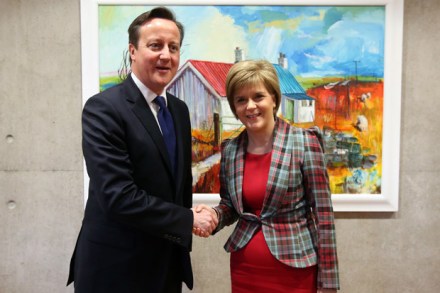
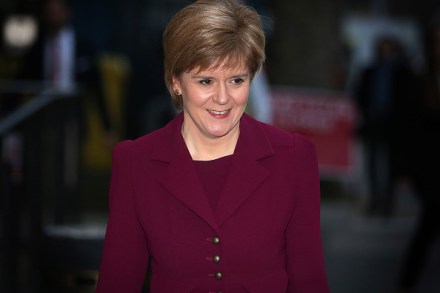
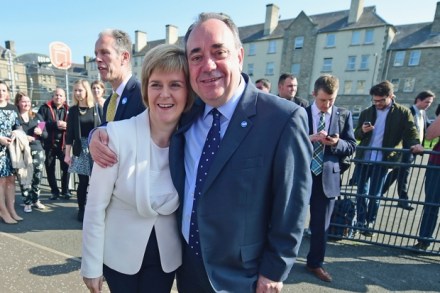
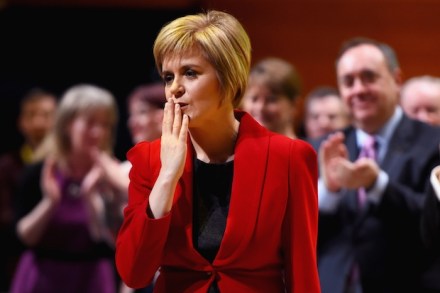
Nicola sturgeon

Stakes raised ahead of Thursday night’s debate

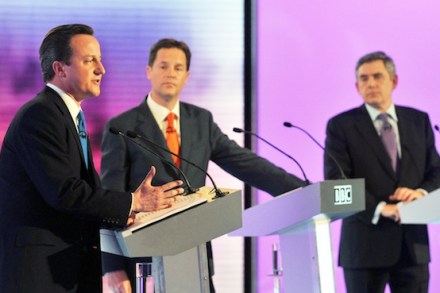
The stakes have been raised, at least psychologically, for Thursday night’s debate. Today’s YouGov poll has Labour four points ahead, in contrast to a two point Tory lead in their last survey. This is being seen in Westminster as a Paxman bounce for Miliband. If this Labour leads is still in place at the end of the Easter weekend, Tory nerves will begin to fray. Thursday’s debate will be a crowded affair with seven leaders on stage. Despite it being a two hour debate, there’ll only be time for four questions. As I say in the Mail On Sunday, the debate will almost certainly turn into Cameron versus the rest as they all try and go after the sitting Prime Minister.

Nicola Sturgeon’s speech in Glasgow highlights the similarities between the SNP and Ukip

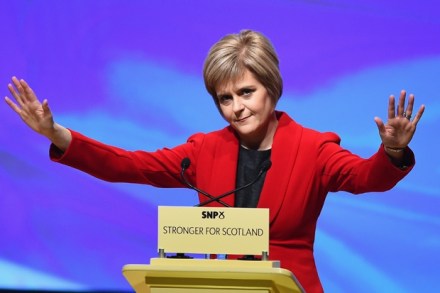
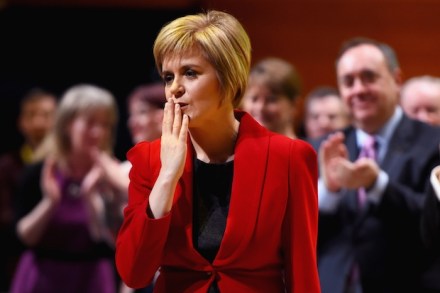
Is Nicola Sturgeon trying to channel Nigel Farage? Scotland’s First Minister regaled the 3,000-strong crowd at the SNP’s spring conference today with some nuggets of policy, more demands for Ed Miliband and even a swipe at Margaret Thatcher. But she also positioned herself as part of a UK-wide movement seeking to 'shake up' Westminster in the name of 'ordinary people'. You might add: the Ukip of the north. SNP folk loathe being compared to Ukip. In fact, when I was writing this piece in a bar at the conference centre, I was berated by a group of Nats who spotted the headline and took me to task. But let’s face it: both are populist-nationalists who love to rail against the Westminster elite.

Debate deal finally reached

After months of negotiations, a final deal on debates has now been reached. There will be no head to head debate between Cameron and Miliband. Instead, there will be one seven way debate on April 2nd broadcast on ITV. There will also be an opposition leaders’ debate on the 16th of April on the BBC featuring Labour, the SNP, UKIP, the Greens and Plaid Cymru. On top of these debates, David Cameron and Ed Miliband will both do separate interviews, taking questions from a studio audience on Thursday for a Channel 4 / Sky programme. Then, on 3oth of April, Cameron, Miliband and Nick Clegg will appear separately on a special edition of Question Time.

Keith O’Brien stripped of the rank of cardinal – an extraordinary disgrace for the Scottish Church

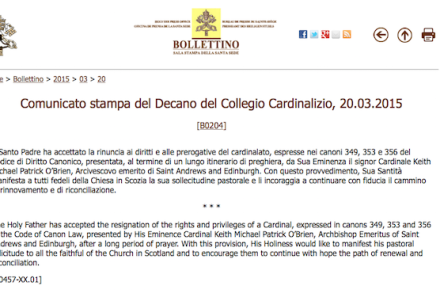
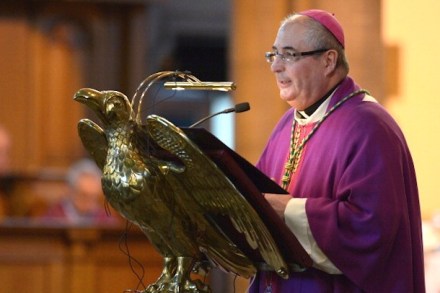
Keith O'Brien, former Cardinal Archbishop of St Andrews and Edinburgh, was today stripped of the rank of cardinal by Pope Francis. Technically he has resigned. But the statement above leaves us in little doubt that O'Brien has had the red hat forcibly removed from him. He's the first cardinal to lose his title since Louis Billot, a French Jesuit who resigned as cardinal in 1927 in protest at the Church's condemnation of the far-Right anti-Semitic Action Française movement. Billot was the only cardinal to resign in the 20th century. [Update: see discussion in the thread over O'Brien's title. This he has not lost, de jure, but de facto he is no longer a cardinal and I suspect Rome will come down on him like a ton of bricks if he clings on to it.

The real threat to Britain (and it’s not the SNP)

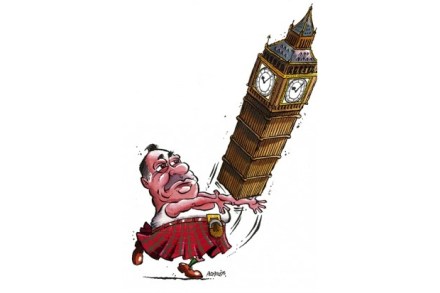
What a load of mendacious balls everybody talks about Scotland. It’s like a disease. It’s like, you know how they say Ebola probably started in some festering bat cave in Guinea? Well, the referendum campaign was that cave. We had secret oilfields and fantasies about the NHS and endless guff about austerity being done for evil Tory fun, and the VOW the VOW and, dear God, the relief when it ended. Only it didn’t end. Instead it spread. And it set the tone. People talk now, for example, about an SNP/Labour coalition. As though this would make sense, when they must know it wouldn’t at all. As though Ed Miliband would even fit in Alex Salmond’s pocket, and Salmond (or Nicola Sturgeon, but only Scottish people talk about her) would want him there.

The latest economic statistics are a disaster for the SNP (not that it matters)

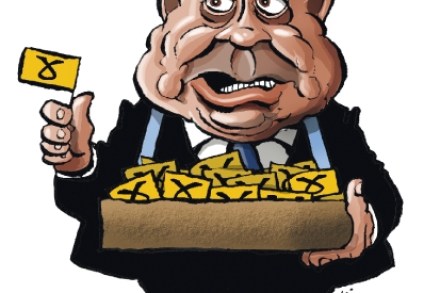
That, pictured above, is what the Scottish government wants you to remember about the latest GERS (Government Expenditure and Revenue Scotland) figures released today. It's not, at least according to these calculations, an untruth. Per capita revenues from Scotland are indeed higher than per capita revenues for the UK as a whole once - importantly - a geographical share of North Sea revenues are assigned to Scotland. Hurrah! Winning! Except, of course, these are Revenue and Expenditure figures. And the latter confirm that, once again, per capita spending in Scotland is significantly higher than in the UK as a whole. Some £1,200 per head higher. 1200 is a larger number than 400.

Why an SNP surge at Westminster could mean the end of Britain

[audioplayer src="http://rss.acast.com/viewfrom22/the-snp-threat-to-westminster/media.mp3" title="Alex Massie and Sebastian Payne discuss what an SNP victory will mean for the union" startat=42] Listen [/audioplayer]Anyone seeking to understand the strength of the SNP should look to those parts of Scotland where the party is supposed to be weakest. At the last election, the nationalists took just under 10 per cent of the vote in the Scottish Borders. This year, Tory canvass returns suggest the SNP may treble its share of the vote in one of the most staunchly unionist seats in Scotland. For months, opinion polls have made unremittingly gloomy reading for unionists. The nationalists are heading for a victory on a scale still not fully comprehended in England.

Will Labour rule out a deal with the SNP?

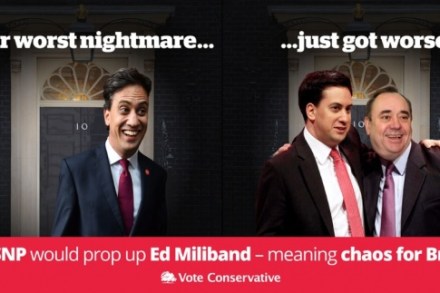
Who ends up governing Britain after the election may well be determined by what happens in the Scottish seats. If the SNP take a slew of seats from Labour, it becomes far more likely that the Tories will be the largest party nationally. Add to that the fact that Cameron is the incumbent Prime Minister and he would, in these circumstances, probably be able to put together a deal that sees him carry on as Prime Minister. Labour is acutely aware of this and is busy warning Scots ‘Vote SNP, Get Tory.’ But in this anti-politics era, these squeeze messages don’t work as well as they used to—as the Tories are finding out with their ‘Vote Ukip, Get Miliband’ warnings.

Immigration, not money, will improve Scotland’s most deprived schools

I suppose we should be thankful that Nicola Sturgeon has acknowledged there’s a problem with Scotland’s public education system, even if she’s hit upon the wrong solution. Earlier this week, the First Minister announced that the Scottish -government would be trying out its version of ‘the London challenge’, a programme carried out by the last government, to address the chronic underachievement of Scotland’s most deprived children. In the past, the SNP has deflected criticisms of its education record by pointing out that Scottish 15-year-olds did marginally better than their English counterparts in the 2012 Pisa tests. But the difference between the two groups is minuscule and both have declined dramatically since Pisa first started testing in 2000.

David Cameron is lucky he faces Ed Miliband, not Nicola Sturgeon

In some respects David Cameron has been a lucky politician. Lucky that his predecessors had failed so completely that his initial brand of so-called modernisation seemed a punt worth taking. Lucky that he faced Gordon Brown, not Tony Blair. Lucky that he could pivot from 'sharing the proceeds of growth' to 'we're all in it together' without too many people noticing (or caring too much). Lucky, above all, that he now faces Ed Miliband. Because however you dress it up, this has not been a happy government. In economic terms - the defining issue of the age - his party has missed many of its most important targets. Functionally-speaking, George Osborne's record in office has followed Alistair Darling's 2010 plans more than it resembles Osborne's own projections from five years ago.

Ed Miliband is being pushed to the left by the SNP

At last, the picture is becoming clearer. We now have a better idea of what the SNP will demand in return for its support to put Ed Miliband in Downing Street. Nicola Sturgeon didn’t use the term ‘red line issue’ but this was the clear message underlying both the broadcast interviews she made this morning and her keynote speech at UCL. We have known for some time that the SNP leadership does not favour a formal coalition with Labour. Rather, it would look for a ‘confidence and supply’ deal, backing Labour’s Budgets and opposing no confidence motions and expecting concessions in return. And now there appear to be two ‘red lines’ - concessions which the SNP would expect from Labour.

Scottish electoral geography is working to the SNP’s advantage

The dramatic rout of Scottish Labour continues. Polls suggest the SNP will take 55 out of 59 seats and of the 14 constituencies surveyed by Lord Ashcroft, only Glasgow North East is set to remain in Labour hands. Such political collapses are rare in UK politics - so what's going on? Prior to 2011, the dividing line of Scottish politics was ‘to be or not to be’ Labour. This was a huge advantage to a party which, faced with split opposition, managed to win 69% of Scottish seats in 2010 with just 42% of the vote.

Unless something changes soon, Scottish Labour is doomed

The headline figures in today's YouGov poll for The Times are brutal for Scottish Labour. Labour (27 percent) are still 20 points behind the SNP (48%). But that's the good news. Because everything else is even worse. Consider this: 95 percent of SNP supporters think Nicola Sturgeon is doing a good job. That's impressive or, if you prefer, slightly terrifying. But, hark at this: 39 percent of Labour supporters think Nicola is performing admirably. Her net approval rating amongst Labour voters is just -4. Jim Murphy's net approval rating amongst SNP supporters, meanwhile, is -54. Or this: 67 percent of SNP voters say there is no chance they will change their minds before the election but only 50 percent of Labour supporters are so certain.

Scottish sisterhood unite for Andy Murray

While the behaviour of the Westminster mob at PMQs is often reminiscent of playground bickering, the women of Scotland are taking a more civilised approach as they prepare for First Minister's Questions. Far from any hostilities between their opposing parties, Nicola Sturgeon has been joshing on Twitter with Ruth Davidson, Leader of the Scottish Conservative and Unionist Party, and Kezia Dugdale, Deputy Leader of Scottish Labour. The trio put their politics aside to support Andy Murray in his match at the Australian Open. @RuthDavidsonMSP I'm sure we could come to some arrangement - @kdugdalemsp?

UK and Scottish governments already at each other’s throats over extra devolution

It didn’t take long. In fact, the tweet from Nicola Sturgeon appeared soon after Alistair Carmichael had started speaking this morning. Smith clauses publication welcome - but doesn't include a general power to create new benefits in devolved areas as was promised 1/2... — Nicola Sturgeon (@NicolaSturgeon) January 22, 2015 2/2...and gives UKG effective veto over changes to universal credit, including bedroom tax. @scotgov will work to secure improvements — Nicola Sturgeon (@NicolaSturgeon) January 22, 2015 The Scottish Secretary was in Edinburgh with fellow Scot Danny Alexander to launch the UK government’s blueprint for more devolution for Scotland.

Memo to the Scottish Catholic bishops: stop sucking up to the SNP

The Most Rev Philip Tartaglia, Catholic Archbishop of Glasgow, is at it again: There is a feeling around that we are in a special moment when we can shape a new Scotland. Our new First Minister, who is happily with us here this afternoon, has proposed a more consensual form of government, less partisan, less party-political, and less adversarial. I think everyone would welcome that … We are all equal in Scotland … all free to express our views and follow our consciences. The Archbishop was speaking earlier this month at an ecumenical service attended by Nicola Sturgeon. By all accounts she was pink with pleasure at his lavish tribute. But I doubt that she was surprised.

Interview: Alex Salmond’s game plan for the Commons

Alex Salmond is losing his voice but that’s not going to stop him from talking — I doubt that anything would, or could. I meet him in the Savoy, after The Spectator’s Parliamentarian of the Year Awards (he won top gong) and he orders a hot toddy — setting out the ingredients just in case the Savoy Hotel is too English to know how to make one. No one talking to Scotland’s former first minister today would have any idea that his political dream was clearly rejected by Scottish voters just three months ago. He is relishing the SNP surge and the likelihood of his party holding the balance of power at Westminster next year, which he gleefully describes as ‘the favourite’s bet just now’.

Nicola Sturgeon’s plans for the Crown Estate — my response to the Scottish government

My article about Nicola Sturgeon’s plans for the Crown Estate caused some excitement within her administration. All untrue, they say. They have written a response (below). So what could have happened? It’s worth look at in some detail, as it gives an insight into how government works. The Crown Estate is in the news because Lord Smith’s Commission into extra powers for the Scottish Parliament recommended that Crown Estate assets in Scotland – and their profits – be handed over to the Scottish Parliament. And, in his report, Lord Smith added: 'Responsibility for financing the Sovereign Grant will need to reflect this revised settlement for the Crown Estate.

Nicola Sturgeon shows how she means to go on by picking a fight with the Queen

Downing Street, we are told, wants to 're-set' the relationship between Westminster and Holyrood after the referendum. UK ministers apparently want an atmosphere of 'co-operation; to exist between the two governments. Well, that’s great but it only seems to be going one way. Just take a look at what Nicola Sturgeon has decided to do over the funding over the Royal Family. Under the Smith Commission proposals, Scotland is going to get control over all Crown Estate assets north of the border. At the moment, the Crown Estates profits are used to fund the Royal Family. So, if the Crown Estate loses a chunk of its assets, it will lose a chunk of its profits and the Queen will lose out.

The National shows just how much danger the Union – and Scotland – is still in

Nearly 20 years ago, during one of the many impasses on the road to ‘peace’ in Northern Ireland, Gerry Adams reminded his opponents that the republican movement would set the terms of any agreement. The IRA reserved a power of veto. ‘They haven’t gone away, you know,’ he said. Scotland is not Ulster, of course, but the Scottish nationalists haven’t gone away either. Anyone who thinks the referendum settled this country’s constitutional future hasn’t been paying attention. The long war continues, albeit — and mercifully — in figurative terms. If anything, defeat has encouraged the nationalists to redouble their efforts. The SNP is the only political party in Scotland that can credibly claim to be a mass organisation.