New yorker

High life | 2 February 2017

When I saw an email from Lucy, the lady who has the unenviable task of editing my copy each week, I knew something was wrong. And sure enough it was. The bad news was that my first editor at my beloved Spectator had died. Forty years, gone in a jiffy. It was back in 1977, and I had gone to Turin to pick up a new car on my way to Paris. Back then one had to drive the first thousand miles slowly, while breaking in the engine. (Yes, I know: a bit like wearing spats and a monocle, but that’s how it was in those prehistoric days.) Driving a fast car slowly is like lying next to a beautiful girl but not being allowed to touch her: very frustrating. So to pass the time I thought up a story and memorised every word; it took about eight hours. I then typed it up and flew to London.

Long life | 26 January 2017

I keep finding myself singing ‘Nellie the elephant’ who, packing her trunk and saying goodbye to the circus, went off ‘with a trumpety-trump, trump, trump, trump’. I’m hoping against hope that Donald Trumpety-Trump will also say goodbye to the circus in Washington and return to the jungle whence he came; for irrespective of whatever he does in government, even if some of it proves to be beneficial, he is unworthy to be president. The president is not only the country’s chief executive and commander-in-chief; he is the symbol of national unity and the protector of the American constitution, and he has already failed in both these last two roles.

Distant voices

One of the weirdest responses when someone close to you dies is the gradual realisation that now at last you know them fully. They become to you complete, rounded, fully themselves, in a way that just does not seem possible while they are still alive. It’s so frustrating. Just when you’re at last ready and able to talk to them in the way you’ve always wanted, in full knowledge of who they are, seeing clearly every aspect of their person, they are no longer present. Radio 4 has come up with a partial antidote to this aspect of death, loss, grief, and so too of life and living, with its unsettling new lunchtime series, Unforgettable (produced by Adam Fowler), the title inspired by Natalie Cole’s 1991 single, where she duets with her long-dead father.

A touch of class | 31 December 2015

The New Yorker, not far off its centenary now, has moved beyond rivalry to a position of supremacy among American magazines. It has attained this not by taking a particular political position, although it certainly has one — it represents, obviously, a metro-politan, liberal, outward-facing attitude to the world. Rather, its pre-eminence is down to its valuing, above all, the quality of writing. Of course, aspects of the New Yorker have always irritated people. It possesses a somewhat supercilious quality — the one-page comic sketch, ‘Shouts and Murmurs’, invariably leaves me straight-faced, and sometimes even a bit depressed. I can never decide whether the restaurant reviews are meant to be a joke, so absurd do they make their subjects sound.

Long life | 29 October 2015

The Metropolitan Club in Washington is so close to the White House that President Obama chose to walk there for lunch on Tuesday through Lafayette Park while his motorcade followed behind. The lunch was described in the media as ‘secret’, and American reporters were frustrated by the refusal of the White House and the club’s staff to divulge anything whatsoever about it. But nothing the President does is really secret, and his visit was certainly not secret to me, since I was staying in the club at the time under a reciprocal arrangement between the Metropolitan and the Garrick in London, of which I’m a member.

Long life | 10 September 2015

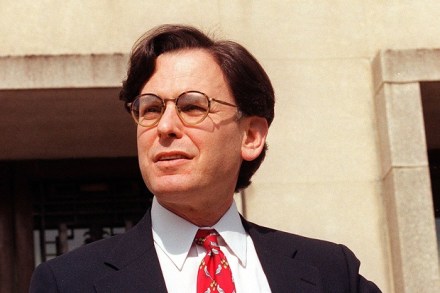
I remember Sidney Blumenthal from my time in Washington in the late 1980s when I was there as the first American editor of the Independent. He was a smartly dressed, agreeable political journalist, handsome in a donnish kind of way, who had a gracious, dignified manner that seemed to put him a cut above most of his fellow hacks. He was also a liberal of strong political conviction, whose purpose was to help rebuild American liberalism so that it could take on and beat the New Right after its long ascendancy under Ronald Reagan and restore the Democrats to power. It was at around this time, in 1987, that Blumenthal first met Bill Clinton whom he came to regard — rightly, as it turned out — as the Democrats’ best hope for achieving this aim.

Long life | 30 July 2015

I was wondering what to write about this week when I suddenly realised that exactly 40 years ago this Saturday I became editor of this magazine. Despite eventually getting the sack, I hung onto the job for nine years, from 1975 to 1984, which is still the longest that anyone has had it since Wilson Harris ended his 21-year tenure in 1953. The Spectator has had 15 editors since him, but none apart from myself has lasted for much more than six years. Fraser Nelson, however, looks set to outlast us all. I am surprised how little I can remember of those years (or perhaps I shouldn’t be surprised, given my drinking habits at the time), but I will never forget how they started.

Sharpen your pencil

‘I had had a fantasy for years about owning a dairy farm,’ says Mary Norris, as she considers her career options in the first section of this odd but charming cross between a memoir and a usage guide. ‘I liked cows: they led a placid yet productive life.’ Instead, she found a productive life — if not always as placid as she might have liked — as a copy editor on the New Yorker magazine. In Between You and Me, she presents the accumulated wisdom and winsome anecdotes of several decades of proof-reading, editorial queries and office arguments, ‘for all of you who want to feel better about your grammar’.

Long life | 30 April 2015

I remember the first time that someone stood up and offered me a seat on the London Underground. It was in 2002, when I was 62 years old, and rather a pretty girl whom I had been quietly admiring through the crush on the Piccadilly Line suddenly rose to her feet and beckoned me to take her place. I was so shocked that I responded most ungraciously. I just shook my head in irritation and signalled to her to sit down again. For, notwithstanding the fact that my hair had long ago turned white, it was the first time I had realised that I actually looked old. From then on, offers of seats on crowded Tube trains started to come my way occasionally, and they came with gradually increasing frequency, until now, 13 years later, I have almost come to expect them.

An Episcopalian vicar made me warm to the principle of women joining gentlemen’s clubs

In 1993, when I was living in Manhattan working for the New Yorker magazine, I was chosen as ‘distinguished visitor’ to be a temporary member of the Century Club: there were two of us in this category, me and the Tanzanian ambassador to the United Nations. The Century, in midtown Manhattan on West 43rd Street, is one of the grandest clubs in New York, most of which were opened in the 19th century in imitation of the gentlemen’s clubs of London. The Century was founded in 1846, only 15 years later than the Garrick Club, of which I have long been a member. It was originally planned as ‘an association of artists, writers, musicians and amateurs of the arts and letters devoted to companionship and conversation’.

I’ve been sacked more times than I can exactly remember. It teaches you nothing

The Oldie magazine — of which, until otherwise advised, I appear to be the editor — runs an occasional article about someone’s experience of being sacked. When I was young, this used to carry something of a stigma: other people found it hard to believe that you could be sacked without having somehow deserved it. But since then so many admirable people have lost their jobs for no good reason that nobody thinks any the worse of them for it. And now we are told by Anna Wintour, the editor of American Vogue and queen of the fashion world for 27 years, that to be sacked is actually a good thing. ‘I think everyone should be sacked at least once,’ she told Alastair Campbell in an interview for his new book Winners: And How They Succeed.

The cruellest present you could give a hated old in-law

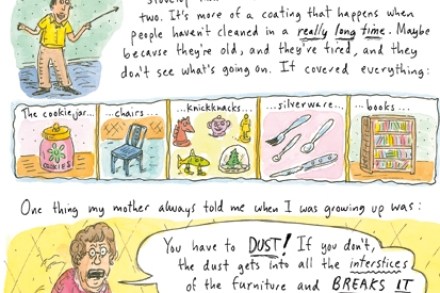
It takes a special sort of talent to be able to make drawings of your own 97-year-old mother on her deathbed funny. The person with that gift is Roz Chast. Subscribers to the New Yorker will already be familiar with her marvellous cartoons, which often feature elderly and over-neurotic parents shouting dire imprecations to their rather dazed and mild-looking adult offspring. Their warnings tend to concern such mortal perils as crossing the road, running to answer the telephone or touching the handrail on public transport (the germs!). The subjects are from Brooklyn, but the appeal is universal: visiting a friend in Athens the other day, I saw a Chast cartoon stuck to the fridge door. Can’t We Talk About Something More Pleasant? is a graphic memoir of Chast’s own parents.

Lessons from Tina Brown on the art of failing upwards

Shortly after I started working at Vanity Fair in the mid-1990s, I suggested to my boss Graydon Carter that I write an article about the number of New York society types who were bankrupt. Not morally bankrupt, but up to their eyeballs in debt. ‘Let’s get a team of researchers to go through the financials of everyone on the guest list of the annual costume ball at the Met,’ I suggested. ‘We could publish a list, like the Forbes 400, but the exact opposite: America’s most indebted billionaires.’ Graydon didn’t go for it, and not just because he was worried about its impact on his social life. ‘Like who?’ he said. I rattled off a list of names, but he pooh-poohed every one. ‘This is just wishful thinking, Toby,’ he said.