Nasa

Space travel, ancient Greek style

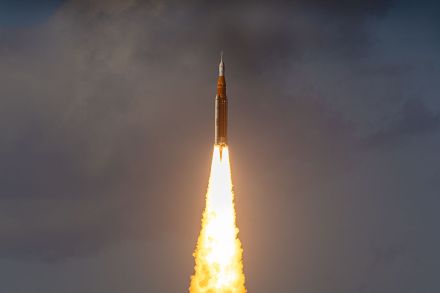
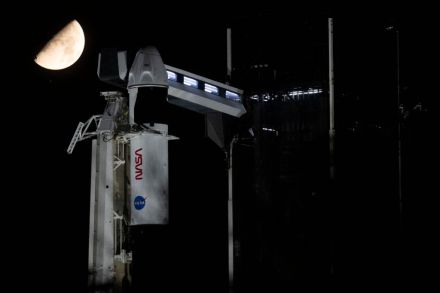
Apollo, Artemis and Orion have not been named at random. The first two are brother and sister, and all three are known in myth as hunters – which is what the astronauts are. Ancient Greeks would have been very envious of them. The satirist Lucian (c. AD 125-180) had great fun with space travel. In his True History, he describes how he sets off with his companions to sail the Atlantic when suddenly a typhoon whirls them up to the Moon, but after many adventures he is able to return and describe what he saw. There are no women, but men act as wives. They produce children in the calf of the leg. The children are born dead but brought to life by breathing in the wind. Men then become husbands. Their noses run with honey and when they exercise, they sweat milk.

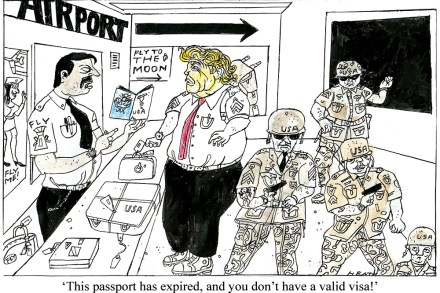
Portrait of the week: Trump threatens Iran, Kanye is banned and Artemis II heads to the Moon 

Home The government withdrew an offer to create 1,000 more training posts for doctors in England after the British Medical Association refused to call off a six-day strike by resident doctors. In a speech at a White House Easter lunch, President Donald Trump of America mocked Sir Keir Starmer, the Prime Minister, for having to consult his team about sending ‘two, old broken-down aircraft carriers’ to the Middle East. Seven people protesting at Lakenheath RAF base were arrested on suspicion of supporting the proscribed group Palestine Action. Chris Rokos, the billionaire hedge fund owner, is to donate £190 million to the University of Cambridge to found a school of government.

Why space is the perfect subject for podcasts

The podcasts I’m recommending to everyone at the moment are Nasa’s Curious Universe and the Royal Astronomical Society’s The Supermassive Podcast. Both have me convinced there’s no topic better suited to the oral medium than space. Not even history. Unless you happen to be an astronaut, you’ll find much of what is described so alien, that your imagination will go into overdrive. What does a Brown dwarf look like? What is the ‘tadpole’ orbit of a quasi-moon? The icy surface of Europa has red furrows which make it look like ‘a giant dragged its fingernails’ across it. How did those furrows get there? You will probably find the images summoned in your head offset the urge to reach for Google.

Acceptable for a hangover day: Fly Me to the Moon reviewed

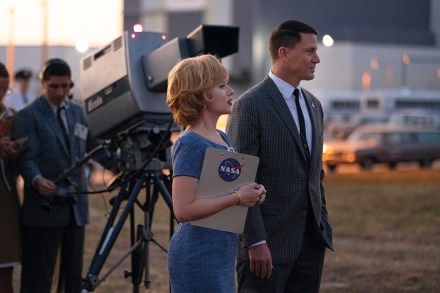
Fly Me to the Moon is a romantic comedy starring Scarlett Johansson and Channing Tatum set during the 1960s space race but, unlike Apollo 11, this isn’t going anywhere we haven’t been before. The extent to which the film does take flight is largely thanks to Johansson’s charisma, even though I couldn’t help shake the feeling they’d fired up a Maserati for a job that basically required a pootle to the shops and back. Tatum, meanwhile, doesn’t have to do much but stand around and look beefy – but he does excel at beefiness. (The shoulders on this fella!) Tatum is 82 per cent shoulders,18 per cent neck. (This is aguess; don’t hold me to it) The film opens in 1969 with Johansson as Kelly Jones, a Madison Avenue marketing genius.

The moon matters to China

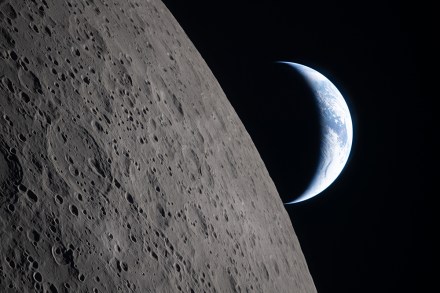
China’s Chang’e-6 moon mission was launched on 3 May. It reached lunar orbit a few days later and began waiting for sunrise over its landing site on the moon’s far side. Chang’e-6 is named after the Chinese goddess of the moon and it will land on Sunday in a crater called Apollo – an ancient double-ringed walled plain caused by an asteroid smashing into the young moon. Apollo has been heavily damaged by subsequent impacts and in many places covered with lava flows and sprinkled with particles from newer impacts. It is as Buzz Aldrin said, a magnificent desolation. It is a region of great geological significance, since it contains rocks from the moon’s lower crust and the deeper mantle – a treasure trove of planetary history.

Fools rush in: Mania, by Lionel Shriver, reviewed

Pearson Converse teaches literature at Verlaine University, Pennsylvania. She exists in an alternative universe to our own in which the Mental Parity Movement holds sway.  There is intellectual levelling, and no ‘cognitive discrimination’. This is high satire, exaggerated, crude, inviting ridicule of the social system portrayed, close to the great satirists of the 18th century in tone if not in style.   Yet Lionel Shriver’s Mania is more than just a satire. It is a study of Pearson’s family life and her ‘unbalanced’ relationship with her best friend from childhood, Emory. Pearson has three children: an intellectually gifted girl and boy by a high-IQ sperm donor, and an averagely intelligent girl conceived with her tree-surgeon partner, Wade.

Farewell, Voyager 1

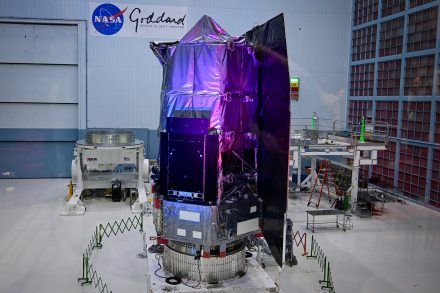
Some time soon we will have to say farewell to our most distant emissary – the Voyager 1 spacecraft. After almost 50 years in space, it’s 15 billion miles away and showing signs of wear and could soon stop transmitting. Late last year, Voyager 1 began to decline, sending back spools of gibberish to its handlers on this planet. A few days ago, Nasa engineers finally traced the problem back to a single chip but it’s clear that Voyager 1 will shortly have to cut contact and make its way out across the universe on its own. It’s strange to think that it will be exploring on out into deep space long after its makers – humans – have become extinct.

What would life on Mars actually look like?

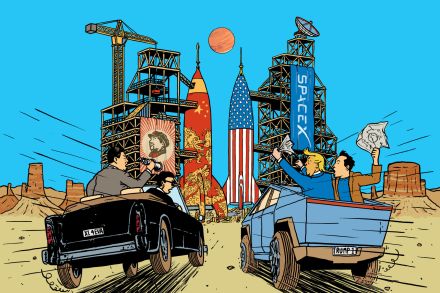
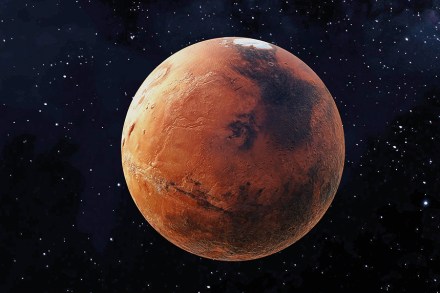
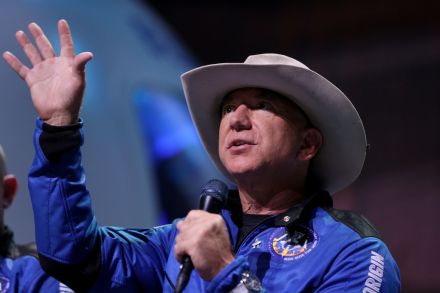
Just as extreme altitudes have notable effects on the human body and mind, so too does extreme wealth seem to have a particular effect on psychology. Or at least that’s how it appears when you look at the shared ambition of two of the world’s most prominent billionaires, Elon Musk and Jeff Bezos. Both men are fixated on the idea that humanity’s future lies beyond Earth and are funnelling fortunes into the vision that we will soon have significant human settlements off-planet, whether on the moon, Mars or elsewhere. It’s an argument grounded not just in exploration and discovery, but in survival. If humanity’s future on Earth looks to be in doubt, is living off-world not the ultimate insurance policy for our species?