Lockdown

Beware the hobby bobby

From our UK edition

‘Anything you say may be given in evidence. Do you have anything to say?’ I looked at the baby-faced police officer and tried to think of an appropriate response. I had been driving to Guildford station to meet a friend who every now and then comes from his nearby home on the train. I park in the station car park and together we walk to a kebab shop, order some food, eat it where we can perch, and cheer ourselves up. Running low on diesel, I pulled into a filling station on the way. After pulling back out, I noticed a police car close behind. I turned into the railway station and its lights flashed. Readying myself to explain the Covid-compliant kebab, I wound down my window.
Can Boris Johnson help struggling students?

From our UK edition

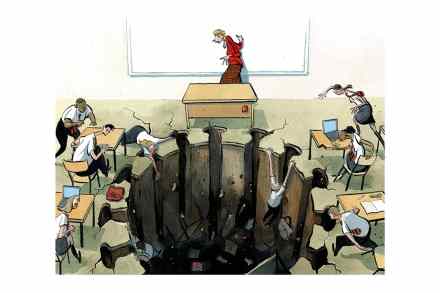
Helping children catch up on the best part of a year out of the classroom is one of the biggest tasks facing the government. On Wednesday, Gavin Williamson announced an extra £400 million in funding which schools can use to run summer programmes and other catch-up projects. That's on top of £300 million allocated last month and £1 billion announced last year. Ministers hope that their Recovery Premium will help schools support particularly disadvantaged pupils, who have fallen further behind than their peers as a result of having to do remote learning for so long. But they are also under pressure to show that they are thinking about the long-term, as even the best summer schools will not repair the damage to learning, confidence and other skills caused by the pandemic.

Tory MPs react to Boris Johnson’s roadmap

From our UK edition

Boris Johnson's roadmap out of lockdown moves at a much slower pace than many of his backbenchers would like. Despite, this, the Prime Minister has so far managed to avoid a large backlash from Tory MPs with his blueprint for ending lockdown. While leading figures of the Covid Recovery Group were quick to voice their objections in the Commons chamber over the fact restrictions will be in place until late June, the Prime Minister received a relatively warm reception when he addressed his party via Zoom on Monday evening. The Prime Minister was 20 minutes late for the call meaning questions were relatively limited. He began by assuring MPs that the government would not adopt a zero covid strategy. Instead, the country would need to manage it like flu.

The roadmap paints a grim picture for business

From our UK edition

As the Prime Minister announced the details of his government’s ‘roadmap’ out of lockdown in the Commons on Monday, no doubt some will have been cheering on the announcements, which will allow them to keep their pre-planned parties or holidays scheduled in their diaries. But the timeline has painted a grim picture for business in the months to come. According to the timetable, we are nearly two months away from outdoor dining being made legal again, and three months away from a return to indoor dining.

Boris’s lockdown speech was classic Blairite triangulation

From our UK edition

Several of Tony Blair’s ideas have found their way into the government’s Covid policy, most notably the policy of prioritising first doses. The end of Boris Johnson’s statement today owed a lot to Blair. Johnson cast himself as charting a middle course between those who think the government’s plan is too ambitious and those who want restrictions eased faster. It was classic Blairite triangulation. The road map is an interesting document. It is initially cautious and the decision to put five weeks between easing measures means that we won’t be able to sit inside a pub until 17 May, a long way from the idea that things would be heading back to normal by the Easter weekend. But at the end of the plan, the step up in freedoms is dramatic.

The lockdown roadmap explained

From our UK edition

Boris Johnson's roadmap for emerging from the pandemic shows us quite how bad his sense of direction has been at times over the past few months. The Prime Minister and his colleagues in government have repeatedly insisted that they won't be introducing vaccine passports — but today's document confirms that ministers are in fact establishing a programme of work on 'Covid status certification', which is a rose by another name. Johnson has also had to deal with a conflict between his advisers (and within his own mind) over whether or not it is — as he has repeatedly suggested — possible to vaccinate one's way out of this lockdown.

Will the vaccine reduce public support for lockdown?

From our UK edition

The vaccine news today is good, and better than would have been expected even a month ago. The Public Health Scotland data indicating that four weeks after the first dose of the Oxford / AstraZeneca vaccine there is a 94 per cent reduction in the risk of hospitalisation is phenomenal (the figure for Pfizer/BioNTech is 85 per cent). It suggests that the vaccines should deliver on the ‘protect the NHS’ part of the government’s strategy. This will lead to more Tory pressure on Boris Johnson for a faster easing of lockdown. The argument will go that given the data is better than expected, the pace of lockdown easing should be sped up.

Do we really want lockdown to end?

From our UK edition

Despite it being highly unfashionable to change your opinion, my lockdown stance has shown agility. For most of last year I was a ‘lockdown sceptic’. Not quite retweeting Piers Corbyn’s views on 5G, but equally not thrilled about spending every morning doing star jumps with Joe Wicks. I suspected lockdowns may ruin our children’s future forever, but was keen to not to be called a granny murderer. However, there was something about the words ‘deadly new strain’ which had an effect on me. Say what you want about epidemiologists, they know how to scare people. So I settled into being what I’d call a Covid ‘Centrist Dad’.

When will vaccines let us reopen society?

From our UK edition

With every passing day, more Covid immunity is being gained as hundreds of thousands receive the vaccine. Of course, vaccines take time to mature in the body and offer protection, but with roughly a quarter of the population having now received their first inoculation, our approach to dealing with the virus will inevitably need to shift. The big question is how vaccination has changed the equation for how quickly society can be reopened. Modelling from the PCCF project at Bristol University, on cautious assumptions, suggests that the pace of the vaccine rollout would allow significant reopening with herd immunity achieved in July. First, let’s say how much vaccine immunity has been induced by the vaccine.

Vaccines are working – so why isn’t society reopening?

From our UK edition

When the Prime Minister sets out his ‘roadmap’ for easing Covid restrictions on Monday, it will be against a backdrop that is both better and worse than could have been imagined six months ago. Worse because we have gone on to suffer a second wave of the disease that has seen almost as much excess death as the first wave. But better in the sense that we have vaccines that are in use and more effective than many hoped, with first doses given to 15 million people — almost a third of the adult population. On several occasions last year, Boris Johnson referred to vaccines as the cavalry coming over the hill. The cavalry is here, and most of those at serious risk of dying from Covid are being inoculated.

The need for speed: can we outpace Covid?

From our UK edition

The Spanish flu pandemic a century ago resulted in around 50 million deaths worldwide. Its second wave was over ten times more deadly than its first. History is repeating, with the global death toll from Covid-19 this second winter already three times that of the first. In the UK, the number of deaths in this second wave is close to double the number we suffered in the first wave. The death toll in the first wave, while tragic, is somewhat understandable. A deadly pandemic came out of the blue, and we had to work out the best way of responding. But we cannot use this excuse to explain the higher death toll in our second wave, as we have had months to prepare this time.

Will freedom always be just over the horizon?

From our UK edition

We should talk about horizons, and the setting of desirable ones. A newspaper gave it a go the other day with the front-page news that it is possible pubs may reopen in April rather than May. Given that we read elsewhere that when pubs do reopen, they may not be allowed to serve alcohol, the thrill from this news was limited. This cannot be our best hope: that if everybody behaves themselves and everything goes according to plan then we might be allowed to drink an orange juice in public sometime after Easter. This horizon is not sufficiently motivating. And societies, like the people within them, need motivation. There can’t be a person who hasn’t spent at least part of the past year feeling listless or even hopeless.

Kitchen techniques to perfect during lockdown

From our UK edition

No-one is born knowing how to poach an egg. Indeed, the technique is hardly intuitive: the addition of a little vinegar, whisking the water to create a swirling vortex. Just as golfing enthusiasts barred from hitting the links have resorted to putting practice in their living rooms, a lazy lockdown weekend feels like an ideal time to perfect classic cooking techniques. Here are six to try. Spinning sugar Spun sugar is a guaranteed way of achieving collective ‘oohs’ and ‘aahs’ from assembled guests at your next dinner party. Playing around with burning hot sugar is however the sort of thing that can tip you over the edge should you attempt it unpractised whilst trying to make polite conversation with the in-laws between courses.

Will the economy really rebound after lockdown?

From our UK edition

Bank of England chief economist Andy Haldane last week described the UK economy as a ‘coiled spring’ waiting to rebound just as soon as lockdown restrictions are eased. But is it a spring like the one on which Zebedee from the Magic Roundabout used to bounce around, or is it like a Slinky – the toy you place at the top of the stairs and watch, fixated, as it furls and unfurls itself right down to the bottom? Haldane, it is fair to say, sees it much like the former. He describes the economy as full of 'pent-up financial energy'. While the bank sees lockdown number three causing output to fall by 4.2 per cent in the first quarter of 2021, thereafter it sees a steady recovery.

Tory nerves are growing over Boris Johnson’s Covid strategy

From our UK edition

When the third lockdown was voted on in the House of Commons last month, there was a smaller Tory rebellion than the previous two votes. A combination of the arrival of an exit strategy through vaccines, the new Kent variant and the sharp increase in hospital admissions meant that many MPs previously critical of lockdown as a tool against coronavirus, supported the measures. However, with Boris Johnson due to set out a roadmap later this month on the path out of lockdown, the mood is now beginning to change. Tensions increased this week when Matt Hancock announced new border measures. Controversially, this included a potential ten year prison sentence for those who lied about where they had travelled to the UK from.

What a record GDP slump means for economic recovery

From our UK edition

It’s been no mystery that the UK economy took a severe beating in 2020: two lockdowns, a host of circuit-breakers and fire-breakers, Christmas cancelled for millions of people. The experience of an economy forced to hibernate for months on end last year is reflected in today’s GDP update from the Office for National Statistics, showing the economy contracted 9.9 per cent last year — the ‘largest yearly fall on record’ and biggest contraction in 300 years. The fall isn’t quite as stark as the Office for Budget Responsibility forecast alongside the Chancellor’s spending review last November (an estimated 11.3 per cent), but it still represents one of the largest economic hits among the big economies.

Universal Credit and the future of the welfare state

From our UK edition

Amid the many failures of public policy during the Covid crisis, one success has gone largely unnoticed. The Universal Credit system coped with a huge uplift in applications without breaking down. In February last year 2.6 million households were signed up; six months later that had swelled to 4.6 million. Some 554,000 people made new claims in the first week of lockdown, ten times the normal levels. For a benefit which not so long ago was being damned for the poor execution of its rollout, it is remarkable that the system coped. Its unexpected success offers plenty of lessons for the future of the welfare state. The digitisation of the system, controversial at the time, enabled the service to be delivered to those in urgent need of help.