Literature

The peculiar American attitude toward death

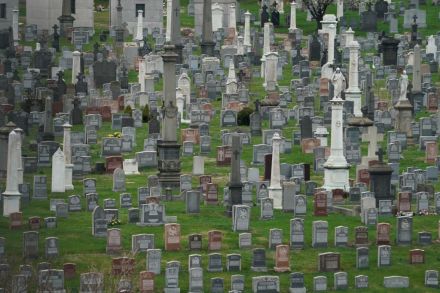
Dying sensibly has always eluded Americans — from Elvis to Houdini — and that’s before you even get to the funeral part. In fact, in America, something peculiar has occurred over the last century. Traditional obsequies have fallen out of favor as Americans increasingly opt for “anything but” the conventional when it comes to final resting places: that is, no more six feet under. According to the National Funeral Directors Association (NFDA), the majority of Americans now choose cremation, with the rate expected to surpass 80 percent by 2045. Ecofriendly departures — think hemp coffins or ashes strewn over a living coral reef — are also becoming more popular; 60 percent of respondents to one recent survey expressed an interest in “green funeral options.

death

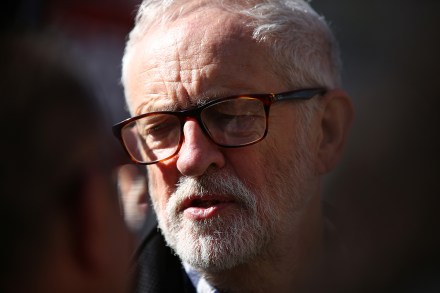
What convinces Jeremy Corbyn that ‘there is a poet in all of us’?

From our UK edition

Much like its editors, I have no idea who Poetry for the Many is for. However, the choir it preaches to is quickly identified. It opens with a dedication to Julian Assange, the free speech martyr in no way a narcissist patsy for a hostile state. A member of UB40 summarises the book’s aim on the jacket: to ‘encourage the working classes to embrace and enjoy culture’. Elsewhere, in the course of four separate introductions, I divine some plan to make poetry both politically relevant and accessible to the lower orders. This project apparently requires the literary advocacy of Len McCluskey and Jeremy Corbyn. They have written personal introductions to their favourite poems and invited ‘friends’ to do the same.

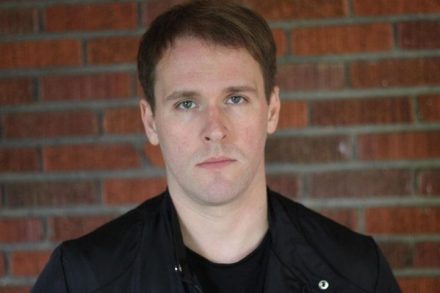
Blake Butler: ‘I don’t want this story to end as “Molly killed herself”’

A recent controversy rocked the literary world when coverage of author Blake Butler’s memoir, Molly, about his late wife, notable poet Molly Brodak, hit tabloids and spun for the worst. The coverage sparked debate over the ethics of writing about relationships, as online attackers made accusations that the widower weaponized Brodak’s private life and exploited her death for fame or revenge.   Claims gained ground that it was a “shameless cash grab,” “literary revenge porn,” or that it shouldn’t have been published due to privacy concerns, since the memoir reveals Butler’s discovery of his late wife’s affairs after her passing.

blake butler

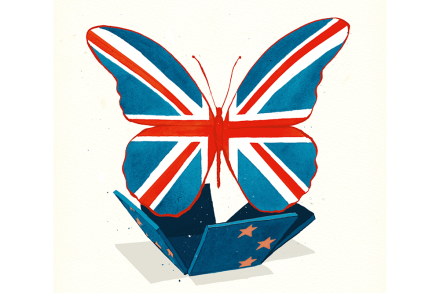
Why on earth did The Spectator support Brexit?

From our UK edition

The temperature has hit 40°C in Crete, where I am writing this, and although there have been no fires, nothing is quite how it ought to be. I can’t work out whether this is a great opportunity to get a tan or, effectively, the end of the world. My 60-year-old taxi driver tells me that unfeasibly hot summers were a regular occurrence when he was young and that there’s nothing to worry about. But, he adds, he’ll be dead soon anyway so why should he care? Right or wrong, this is the paradox at the heart of the climate change debate. Older people, who could be held responsible for the destruction of the planet, don’t need to worry. And young people, who have so much more to lose, don’t really have a say. We invented plastic. They live with it.

Literary festivals are no fun

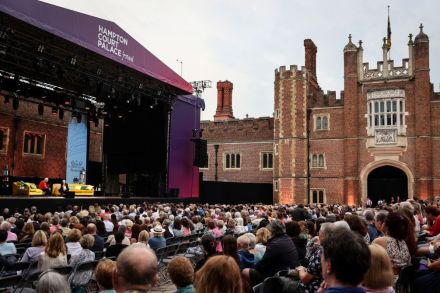
This is the season when literary festivals start to happen all over the UK. From the highlands of Scotland to the South London lowlands of Deptford, there are book festivals for every taste and tribe. Festivals devoted to crime fiction, women writers, LGBTQ writers and young novelists. Even old Marxists are having their own summer festival. I’m thinking of starting a literary festival for neglected and bitter writers like me who don’t get invited to literary festivals. I ask myself: why should I care? But I do. I spend long nights of self-torment scrolling through the lists of people appearing at various festivals and shouting at my laptop screen: who the fuck is he? What has she written? Why is Bono there and not me? For heaven’s sake, who invited Minnie Driver?!

Should we judge a work by the character of its creator?

From our UK edition

‘Most of my heroes are monsters, unfortunately,’ Joni Mitchell once said, ‘and they are men.’ The singer-songwriter was able to detach the maker from the made. Should we do the same? Is it ethical? Even possible? These are the questions Claire Dederer deftly considers in Monsters, which puzzles through the problem of what we ought to do about great art by bad men. Ideally, nothing. Early on in her quest, Dederer longs for someone to invent an online calculator: The user would enter the name of an artist, whereupon the calculator would assess the heinousness of the crime versus the greatness of the art and spit out a verdict: you could or could not consume the work of this artist. Alas, said calculator has yet to be programmed, so it’s down to her to do the maths.

The death of the Western literary tradition

A regular reader of Le Figaro for some years, I have been noting the frequency with which the editors print articles relating to the Académie française, founded by Cardinal Richelieu in 1634 for the purpose of acting as the protector and patron of the French language, fixing its usage and giving it exact rules to make it competent to deal clearly and elegantly with the arts and sciences. It was decreed that the academy should consist of precisely forty members, and that upon the death of any one of them the candidate to replace him should pay court to the remaining thirty-nine to be selected to fill his numbered seat. The sitting forty were known as “les Immortels.

literary

How America influenced George Orwell

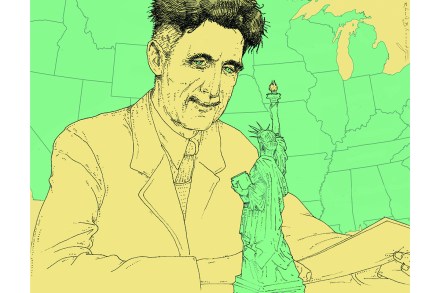
Some of the most tantalizing pieces of George Orwell’s journalism are the reviews written on the hoof, filed against deadlines, sent straight to the typewriter while World War Two raged above his head. One of them is a round-up of four reprinted dystopian novels supplied to the weekly magazine Time and Tide in July 1940, shortly after the fall of France. (Today, it’s rarely reissued and barely available outside the stout bindings of volume XII of Orwell: The Complete Works.) The four books are Jack London’s The Iron Heel (1908), H.G. Wells’s When the Sleeper Wakes (1910), Aldous Huxley’s Brave New World (1932) and Ernest Bramah’s The Secret of the League (1907).

orwell

A literary pilgrimage to Dublin

From the lilting normcore of Sally Rooney’s Normal People to the frenetic genius of poetic, post-(post?) punk band Fontaines D.C., I’m drawn to talented Irish voices of late. Martin McDonagh’s Oscar-nominated tragicomedy, The Banshees of Inisherin, won three Golden Globes, and my heart, to boot. And quite rightly. It’s news to no one that the Irish have always been exceptional storytellers; some stereotypes stick because they are true. Plenty of the finest words ever written hail from the town of the hurdled ford, Baile Átha Cliath, Dublin. This fact was recognized by UNESCO in 2010, when they named it a City of Literature.

dublin

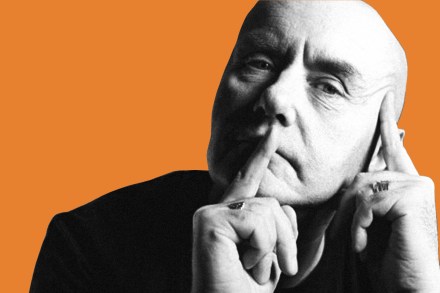
Trainspotting at thirty: an interview with Irvine Welsh

A lot of new books grow old fast. It isn’t even the fault of their material, necessarily, but their milieu. Hour by hour, the means of cultural production are accelerating at an evaporative rate. Today more than ever before, irrelevancy looms large over the shoulder of the novelist. It’s an environment within which thirty days of relevance is a feat, but thirty years? A fiction in and of itself. Yet, throughout three decades of cultural churn, the words of Irvine Welsh have remained steadfast; as culturally relevant and artistically avant-garde as the day they first hit the shelves.

Irvine Welsh

Literary journal in flames after interview with Spectator writer

All is not well at the literary journal Hobart Pulp, Cockburn has learned — and it's all down to one of our mischievous Spectator contributors. His words have caused violence, apparently, as nearly the entire staff of the journal have resigned in protest. Last month, Alex Perez sat down with Hobart Pulp's top editor, Elizabeth Ellen, to discuss the state of the literary and publishing scene — ranging from MFAs to woke writers to how he got his start in writing. Perez, a Latino writer who graduated from the prestigious Iowa Writers Workshop, had some choice words about the cowardice of writers and editors today. The interview, originally posted to the Hobart Pulp website last month, didn't make much of a stir until this week, when its editors and contributors began to take notice.

university alex perez hobart pulp

Forgotten books worth rediscovering

From our UK edition

Most readers have favourite books or authors they feel have been either forgotten or unjustly neglected. R.B. Russell, an assiduous book collector, did something practical about this when in 1990 he co-founded the Tartarus Press in order to bring the works of the once popular Arthur Machen back into print. Machen’s particular speciality was ‘weird fiction’, novels and stories that inhabit the borderland of this and other worlds, and Tartarus went on to reissue other authors in this genre, notably Robert Aickman and Sarban (otherwise the British diplomat John William Wall), as well as to publish new writers and a handful of classics.

Reading Flannery O’Connor under quarantine

I recently had a bout of Covid. The symptoms were pretty mild aside from persistent brain fog, which in my case has been a good cover for creeping senility. A much younger friend of mine confessed that she and her family celebrated their defeat of Covid with a summer beach holiday in Delaware. She and her husband still had a bit of Covid-brain — enough, apparently, that when they drove back, they came back in one car. They had driven up in two. It took them four days to figure this out. My own sense of disorientation, confusion, and fatigue has not been so dramatic. I might have fired off the odd, undiplomatic email. But I often do that. I might have wondered about where I left my reading glasses. But they are invariably suavely tilted back on my head.

Literature reminds us that indolence is underrated

I put off writing this article for ages. Initially, I decided I would write it from bed, but the temptation of simply giving up and falling asleep again was too great. A change of tactic proved no less helpful: out of bed, it took every ounce of effort I had to avoid getting straight back in again. Not a jot was left over for the exertion of writing and typing. This isn’t the status quo for my productivity, I promise; it is more a reflection of the subject matter. It is absolutely impossible to write about indolence while running around busily ticking off a to-do list. You have to relax into it. Call it method article-writing, if you will. Indolence gets something of a bad rap these days.

The Optimist’s Daughter at fifty

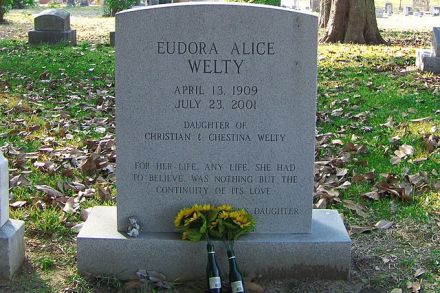
By her own account, Eudora Welty had an idyllic childhood. Born in 1909 on Congress Street, two blocks from the state capitol in Jackson, Mississippi, Welty spent her early years playing with friends from school, reading voraciously and riding her bicycle to the local store to pick up some flour or eggs for her mother and, of course, a treat for herself. Her father, who was devoted to his wife and children, advanced from a cashier to vice president at Lamar Life Insurance before his daughter had finished high school. He had, as Welty put it, a love for “all instruments that would instruct and fascinate,” including a toy train set, a telescope and a folding Kodak, with which he would teach the young Eudora the pleasures of photography.

eudora welty

Why Russian literature shouldn’t be cancelled

From our UK edition

Vladimir Putin makes no secret of his love for Russian culture, and Russian literature in particular – a body of work whose achievements, Dostoyevsky once claimed, justifies the existence of the entire Russian people. But if that same oeuvre now inspires a man instigating unprovoked war, doesn’t that raise urgent questions about its contemporary validity? For some, these concerns are best expressed via cancellation. In Wales, the Cardiff Philharmonic recently pulled the plug on performances of Tchaikovsky’s 1812 Overture, Marche Slave and Second Symphony, the ‘Little Russian’ (an old and patronising name for Ukraine).

Et in Arcadia ego

"Oxford I do not enjoy,” wrote T.S. Eliot to Conrad Aiken in February 1915. “The food and the climate are execrable, I suffer indigestion, constipation, and colds constantly.” The poet was clearly having one of his bad days. Since arriving at the university the previous October, he had found himself in and out of love with the place, which was hardly surprising, given the timing. Most of the undergraduates at Oxford had either left or were on the verge of leaving to fight for their country, meaning that the lecture and tutorial rooms were almost empty, the sports fields green through lack of use, and the centuries-old traditions stalling like motor cars on the long stretch of the High.

Oxford

Don’t read Ulysses; listen to it

From our UK edition

Dublin. 16 June 1904. A little after 8 a.m. Two men – both annoying, one stung with grief and ambition – are having an argument. One is pierced by thoughts of his late mother. ‘Pain, that was not yet the pain of love, fretted his heart.’ She has come to him in a dream smelling of wax and rosewood. ‘Dedalus,’ the other calls up to him. ‘Come down, like a good mosey. Breakfast is ready.’ Ireland. 16 June 1982. 6:30 a.m. Radios all over the country emit the words ‘Stately, plump Buck Mulligan’, and don’t stop broadcasting until they have read out every word of Ulysses, down to its last, heart-stopping syllable. There was no abridgement and no explanation: just the text, entire.

Cancel culture gets its comeuppance

Cancel culture has struck again, but this time its would-be victims aren’t apologizing. The Daily Mail — a publication notorious for being “free” with its own speech — is leading the anti-cancel culture charge this month with a series of stories that point to an encouraging trend. A handful of prominent creatives are standing up to woke bullies and noting the dangers (and impracticalities) of their demands, which essentially amount to writers and entertainers forsaking their imaginative talents by only addressing things they’ve personally experienced. Except they aren’t supposed to be candid about those things, either, as they might offend someone if they’re too honest.

Was Penelope really a ‘silenced’ woman?

Problems about the misuse of history, especially on subjects such as race and colonialism, have been running for a long time. But when it comes to the ancient world, there are also problems about the misuse of literature. Dame Mary Beard’s “manifesto” Women and Power (2018) contains an example of the problem. Her thesis is that women’s voices in the public sphere (my emphasis) have been “silenced” by men ever since the West’s first literature (Homer’s Iliad and Odyssey) gave us our first access to “Western” thoughts, deeds, beliefs, hopes and fears (c. 700 BC). The problem exists in the first example of her thesis, to which she returns four times — Penelope, the wife of Odysseus.

Penelope