Liberal democrats

Signs of nerves from the Lib Dems

Judging by today's reports, it's fear and self-loathing in Lib Dem Land. And it's not just that one of their Scottish candidates has quit the party in protest at its, ahem, "draconian policies" and "dictatorial style". No, according to this insightful article by Melissa Kite and Patrick Hennessy in the Sunday Telegraph, there are more manoeuvrings going on than that. Here are some passages from it, by way of a summary: 1) Chris Huhne, waiting in the wings. "Mr Huhne, who ran Mr Clegg close in the last Lib Dem leadership election, has told colleagues privately that he would be interested in leading his party in the future." 2) A rebrand (back to the SDP?).

Cleggballs

Amid allegations of Clegg being a Tory stooge, this Brown-esque mic-boob is likely to run. It'll also be reprised at the next election, whoever leads the Liberal Democrats. Hat-tip: Channel Four.

Osborne the Reformer is an unfinished work

One interesting aspect of today’s Budget is the government’s change of tack on personal allowances. Back in June 2010, when the Chancellor committed to raise allowances from £6,475 to £7,475, he chose to cancel out the gains for higher rate taxpayers by lowering the level at which the 40p tax rate kicks in. The idea was to focus the gains of the policy on basic rate taxpayers, making things a little more efficient. The 40p threshold will therefore be lowered from April this year from £43,875 to £42,475 with the result that 700,000 people will become higher rate taxpayers. Needless to say, that’s proved unpopular, and so this time around the higher rate threshold won’t be reduced.

Lib Dems bringing home the bacon

There are a few big Lib Dem policy wins in this Budget, most notably the rise in the personal allowance and the introduction of land auctions. But there are also a few bits of rather unseemly pork barrel politics. Nick Clegg’s Sheffield gets an enterprise zone, which is probably fair enough. But we are also told that ‘following a thorough review, the government is approving the revised Sheffield retail quarter regeneration scheme.’ The south west, which has a disproportionately large number of Lib Dem seats, gets help to keep water bills down.

PMQs live blog | 23 March 2011

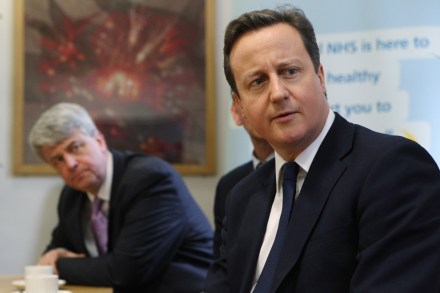
1232: And that's it. And here's my quick verdict: a solid performance from Cameron is what was, on the whole, a sedate session. The Main Event starts now, follow our live blog here. 1228: More fire from Cameron on the NHS. "Do you want to save ... lives," he quivers," or do you want to stick with the status quo." The PM's rhetorical confidence in this area is striking, particularly given that it is one of his most criticised policy areas. 1226: Matthew Hancock questions why the Labour government used PFI contracts to build hospitals, when there were better value alternatives. The Tories have spent the past few days emphasising Labour waste, as the blame game heats up ahead of the Budget.

Budget morning

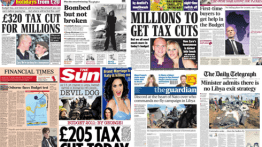
George Osborne couldn't really have expected a much better set of newspaper covers than the one before him this morning. Despite the dreary background picture – war, confusion, higher inflation, lower growth, the ruinous state of the public finances, etc – a handful of papers are leading on the goodies in his Budget, and specifically the £600 rise in the personal allowance that James mentioned last night. Judging by the movements of the grapevine, this will come into effect in April 2012, and will benefit more people than will the £1,000 rise already announced for this April.

PMQs live blog | 16 March 2011

VERDICT: A more evenly-matched PMQs that we have been used to, with both leaders parrying and thrusting to some effect. Miliband's chosen topic — the NHS — was a surprise, particularly given today's unemployment figures and the persistent flurry of bad news from abroad. Yet it did open up a clear divide between him and Cameron. On one side, the Labour leader claiming that the the coalition is taking undue risks with a beloved health system. On the other, the PM painting Miliband as Brown Mark II, a roadblock to reform and change. Neither side really won, or lost, the argument today, but you can expect them to return to it in future.

Another hurdle for Lansley’s health reforms

And so it came to pass. After sniping at Andrew Lansley's health reforms from the day they were announced — at one point describing them as a “slash and burn approach” — the British Medical Association has today voted to call on the Health Secretary to withdraw his Bill entirely. The speech that the BMA Council Chairman, Hamish Meldrum delivered this morning captures the tenor of their opposition: “…what we have is an often contradictory set of proposals, driven by ideology rather than evidence, enshrined in ill-thought-through legislation and implemented in a rush during a major economic downturn.” So what to make of it all?

Miliband: I won’t share a stage with Clegg

Ed Miliband has been on Sky, talking about the alternative vote and Nick Clegg. The normally consensual Miliband was in strident mood. He said: ‘I want to win the AV referendum because I think it is important to reform our politics and I think it will make for a more accountable democracy and one where more votes count. The problem is Nick Clegg is the last thing we need to win this referendum.’ Earlier this morning, Miliband also urged Clegg to ‘lie low for a bit', after the latter's office allegedly derailed a joint event on AV between Miliband and Charlie Kennedy. Miliband may be dabbling in the Leader of the Opposition’s stock-in-trade of curt throwaway lines, but this could signify a policy shift.

Another call for an in/out referendum

In or out? — that is the question that a new cross-party campaign would have put to the British people. And so they're launching their "People's Pledge" today. The idea is that voters would promise to support only those parliamentary candidates who back a referendum on our membership of the EU. The signatures will then be enumerated, presented on a website, and — it is hoped — shock Westminster into delivering the referendum itself. At the very least, it might persuade some candidates to face up to, and meet, the tide of public opinion on Europe. It seems we've been here, or somewhere like it, before now. Daniel Hannan, for instance, launched a campaign last year to collect signatures for an EU referendum.

Are the Liberal Democrats a Serious Political Party?

Obvious John Rentoul bait as this may be, the answer is still a definite No. Actually that's not quite fair. Nick Clegg and at least some of his parliamentary colleagues are serious; much of the party membership and, above all, the people who often vote Lib Dem are not. That's one thing to take from the revealing exchange James reports: The most political part of the Lib Dem electorate is, I suspect, the lefties scunnered by Tony Blair who thought they were buying into a more radical, truly left-wing, party when they hitched their colours to the Lib Dem mast. For all his occasional sanctimony, these people severely misjudged Nick Clegg. But much of the rest of the Lib Dem vote is an apolitical vote. They receive the votes of people like my mother (when she remembers to vote).

Clegg’s cure for the tuition fee trauma

The Liberal Democrats are still traumatised by what happened over tuition fees. Nearly every fringe meeting contained a long discussion of the issue and how the party could have handled it better. Clegg’s plan to heal the wound is to show that the new system will go hand in hand with a broadening of access to the best universities. The deputy prime minister seems to be straining for a fight on this issue. In his speech, he laid into those at Oxbridge ‘who shrug their shoulders and say: That’s just the way things are’ about how dominated these institutions are by the children of the well-off. He demanded, ‘fair access now.’ But the problem is that access can only be as fair as the schools system allows.

Clegg defines his liberalism

I do feel for Nick Clegg. He’s taken an oppositionalist party into government, and they hate it. He is politically and psychologically prepared for what goes with power; grassroots LibDems less so. And this brings problems. Yesterday, he was complaining that his party is “too male and too pale”; but his main problem is that there are too few of any. At the peak of Cleggmania, the Lib Dem had 30 per cent of the the vote. Now it’s 10 per cent in the polls. If things continue at this rate, he won’t need a ‘ring of steel’ for his next conference: a phone box will suffice. So, what can he do? His speech tries to define a new word: ‘liberal’. He has this to say: 'For the left, an obsession with the state.

Clegg’s pitch for the middle

‘Governing from the middle for the middle’ was the message of Nick Clegg’s unapologetic speech to Lib Dem conference. His effort to redefine the Liberal Democrats continued as he tried to move the party away from its traditional yoghurt-weaving concerns and instead focus on appealing to ‘alarm clock Britain.’ Clegg’s view is that the left wing protest votes that the party used to get are gone for the foreseeable future, repulsed by coalition, and that the Lib Dems need to reach out to new voters. The calculation is that Labour is seen as being for those on benefits and the Tories for the rich, so the Liberal Democrats should try and seize the middle.

Clegg urges his party to face reality

The cultural change Nick Clegg is trying to bring to the Liberal Democrats was summed up by one exchange during his Q&A with party delegates. One delegate, a member of the Federal Policy Committee, got up and said how conference had "sent the government a message" with its decision to amend the coalition’s health reform plans. To which a visibly exasperated Clegg replied, "you’re part of the government."   Clegg was uncompromising in his message that the party has to accept the realities of coalition government. After he had dismissed a series of questions about whether he was too close to Cameron, Clegg said — only half-jokingly — to the hall "who else would like some of that?

The Lib Dems vote to amend Lansley’s NHS reforms

Lib Dem conference has just overwhelmingly voted to amend Lansley's NHS bill. In the end, the Lib Dem leadership simply accepted the amendments because it was so clear they were going to pass. Evan Harris, the former Lib Dem MP, warned that the party would not accept the leadership simply ignoring these amendments. He said "we expect Liberal Democrats in government to follow what we overwhelmingly vote for." Harris predicted that if they went along with Lansley's bill, the Lib Dems would be associating themselves with the "retoxification of the Tory brand".

Balls sets Labour against Clegg (again)

It's not just the protestors who are rallying against Nick Clegg today. Here's what Ed Balls has to say about the Lib Dem leader, in interview with the Guardian: "'Clegg looks an increasingly desperate, shrill and discredited politician, losing both public and party support. People think that if Clegg says something, it cannot be the truth. The Liberal Democrats need to have some real hard thinking about what they stand for' He says it would be impossible for Labour to govern with Clegg after the election, arguing: 'I don't see how Nick Clegg could change direction again with any shred of credibility, or how he could work with Labour now, but that is not true of Liberal Democrats more widely.

In protest at the Lib Dems

The Liberal Democrats have, as Clegg’s team like to joke, gone from being the party of protest to the party people protest. Here in Sheffield, at Lib Dem spring conference, there’s a growing group of demonstrators standing just outside the secure zone. They are keeping up a steady chant of ‘Lib Dem scum, Lib Dem scum.’ The authorities are clearly nervous about trouble this weekend. There are a huge number of police out on the streets, a number more akin to a full party conference rather than one of these smaller spring affairs. There is a 10,000 strong demo planned for tomorrow. If there is going to be trouble, it will likely be a spill-over from this.

Clegg’s unedifying slip reveals an underlying truth

Project Merlin, the deal between the government and the banks, was meant to turn the page on banker bashing. But the deputy prime minister is still stuck on the previous page, telling Radio Sheffield today ‘I want to wring the neck of these wretched people’ the bankers.   The language isn’t very statesmanlike and is sure to infuriate many of his coalition colleagues (it is also hardly sensible for the deputy prime minister to be using language which appears to condone violence ahead of a conference where the police are preparing to deal with a riot). But it does reflect a political reality: the banks remain public enemy number one.

Clegg ushers in the next phase of the coalition

What have the Lib Dems ever done for us? That's the question that Nick Clegg sets about answering in interview with the Independent today — and he does so with righteous vigour. "Brick by brick, policy by policy, decision by decision, sometimes almost invisibly," he insists, "we are putting in place good policies that will make a long and lasting difference." He dwells, and rightfully so, on the pupil premium and raised personal allowance. "All these things will outlive the immediate task of dealing with the deficit." This salesmanship is only to be expected from Clegg, speaking on the eve of his party's spring conference and in the aftermath of their electoral cremation in Barnsley.