Language

The doctor will patronise you now

How a profession speaks to its subjects is always of interest to a writer, sometimes perversely so. Over the past few weeks a persistent problem with my foot worsened and appeared to take charge of things. (This isn’t going to be a piece moaning about ill health, I should reassure you.) The hospital took soundings of the ulcer, now turned into infection: first with a probe, then an X-ray, then an MRI scan, and finally the consultant manifested himself. The infection was in the bone and showed no sign of retreating under the antibiotics. It looked as if an operation was unavoidable, to remove – the consultant paused in his explanation – ‘We’re just going to take a kind of little nibble at the toe,’ he said. I regarded him levelly.

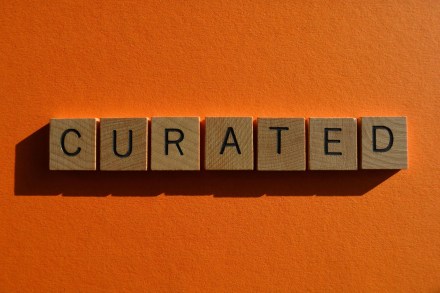
Have we reached peak ‘curation’?

Are we all curators now? From the hotel chef offering an artfully curated cheeseboard to the fashion world’s curated capsule collections, the sound curators (DJs) and the luxury tour operators flogging seamlessly curated travel experiences – and don’t forget the curated (actually, algorithm-generated) lists from Substack – nowhere is safe from the scourge of the contemporary curator. The actor Idris Elba sees himself less as a conventional musician, ‘more of a curator of music’. In 2023, he curated the Nigerian musician Fela Kuti’s Box Set 6, in case you’re not up to speed on your Afrobeat vibes. The American rapper and songwriter Kanye West identifies as an ‘inventor or maybe curator’, possibly not clocking they’re quite different things.

Nicolas Sarkozy and the problem with ‘sweet treat’

In October, Nicolas Sarkozy took with him to prison a copy of The Count of Monte Cristo. Its hero, Edmond Dantès, was imprisoned in the Château d’If for 14 years. Mr Sarkozy was in for 20 days. In his instant memoir, Journal d’un prisonnier, he says the food was horrible. Yet, ‘neither wishing nor knowing how to cook’, he left the hotplate in the cell untouched, even though a former chief of staff had taken the trouble to provide written instructions on how to boil an egg. He relied on yoghurt, cereal bars, apple juice and ‘quelques douceurs sucrées’. These are translated into English as ‘sweet treats’. I have an aversion to the jangling phrase sweet treat.

Are you ‘marred’ or ‘mired’ in scandal?

My husband made a noise which he thinks is like a klaxon but sounds as if he is choking on his whisky. Even though I was in the middle of making a roux, I had to hurry from the kitchen to make sure he wasn’t. The klaxon was to signal that he had found in the paper a cliché that had led to complete nonsense. ‘Sir Tony’s position on the board was marred in uncertainty because of his role in the 2003 invasion of Iraq,’ someone said in the Telegraph. The cliché he was aiming at was mired. But, as clichés are empty of meaning, he hadn’t noticed that marred made no sense. It is a common error. In an article on electrical charging, someone on the Times had written that ‘the process of getting approval is marred in red tape’.

invalid

‘Invalid’ has become invalid

‘They should ask me. I’m a complete cripple,’ said my husband, heaving himself from his chair with great determination to reach the whisky. The Department for Transport is asking disabled people whether the term invalid carriage in legislation should be changed and what term they might prefer. ‘Language has moved on and changed,’ the government says, since 1970, when legislation was drafted. One problem is having to keep changing terminology. No one, even my husband, should be called a cripple. No one should be called handicapped. Now no one should be called disabled, but rather a person with a disability. These changes are paralleled in the languages of our neighbours. The Paris Métro had seats reserved for mutilés de guerre. The term was replaced by personnes handicapées.

invalid

If you’re ‘reaching out’, you sound deranged

‘Why doesn’t anyone do what you ask them to?’ enquired my husband, who is something of an expert on the subject, I should have thought. He was referring to a plea I made three years ago to people I’ve never met to stop sending emails that begin: ‘I am reaching out to you.’ But it has grown worse. Using the expression makes it sound as though the emailer is deranged. Reach out has for more than a century meant ‘to offer sympathy, support or assistance’ to people. Correlatively it can mean to seek those things. As Prime Minister, Sir Keir Starmer has acquired the habit of issuing a Christmas message. For 2025 he said: ‘At this time of the year, which celebrates love and abundance, loss or hardship can feel even more acute. Reach out. It can make a huge difference.

Is ‘bloody’ still offensive?

Everyone has been declaring which words are too rude to utter in public. Shortly after breakfast, Radio 4 happily discussed by name the book by Cory Doctorow called Enshittification. But on Radio 4’s Feedback it proved impossible to say the word that shocked some listeners when they heard it on a dramatisation of a work by Doris Lessing on Rhodesia in the 1940s. It had to be called the N-word. One formerly taboo word still does sterling service as an intensifier. Kate Winslet, on Desert Island Discs last month, said: ‘You lot who were in my year at school, you were bloody horrible to me.

Shakespeare isn’t difficult

Chloe Zhao may have co-written and directed Hamnet (a film about William Shakespeare’s son), but she claims that she couldn’t understand Shakespeare’s words and had to rely on the actor Paul Mescal to help her. You might have thought that Zhao, who spent her sixth form years at Brighton College (where, one hopes, she at least sniffed at some form of Shakespeare), could have bestirred herself to read one of the many editions with glossaries, or even to bone up on the CliffsNotes, but no. Instead, she is simply contributing to the enduring, frustrating idea that reading Shakespeare is ‘difficult’, as if it were on a par with analytical philosophy or Judith Butler wanging on about hegemonies.

The changing flavour of ‘fudge’

‘Do you know what vibe coding is, darling?’ I asked my husband. ‘What do you take me for?’ he replied. ‘Or 67?’ ‘Ah, I do know that the Prime Minister had to apologise for leading a classroom of little children in a series of hand moves to that one. But I’ve no idea what it means.’ Thus was my suspicion confirmed that most ‘words of the year’ are far from general concern. Vibe coding, some sort of AI software development, is Collins Dictionary’s new Word of the Year; 67 (pronounced ‘six seven’), which has no agreed meaning, is Dictionary.com’s. To me, a far more interesting word is fudge. It is not new, but its entry in the Oxford English Dictionary was revised this year.

Who has ‘roadman’ vibes?

The Alibi bar in Altrincham, Cheshire, caused a hoo-ha last week by banning single entrants after 9 p.m. The landlord, Carl Peters, explained: ‘Sometimes, if you let people in on their own, the reason why they’re on their own is that they’ve got no one to talk to, so they start mithering other groups.’ Mithering is a familiar word in the north-west. Mrs Gaskell, who was brought up in Knutsford, nine miles from Altrincham, used it in Mary Barton (1848): ‘Don’t mither your mammy for bread.’ Mr Peters had other things on his mind, too. His quite chatty sign on dress code specifies: ‘No sportswear/trackies. No Stone Island. No ripped/frayed jeans. No baseball caps. No roadman vibes.’ I asked my husband whether any of these items would be acceptable in his club.

How to save the King’s English

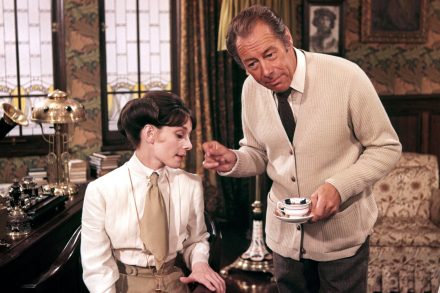
When a survey of 10,000 teachers revealed this month that Britain’s primary school pupils are increasingly relying on Americanisms (the Times front page declared ‘Trash-talking children are sounding like Americans’) I realised immediately what we needed. Rex Harrison. And if not Rex Harrison himself, then a dose of arguably his greatest role – that of Henry Higgins, the cantankerous professor of phonetics who first burst into the national consciousness in 1914 with the London premiere of Pygmalion.

What makes money ‘short’?

I heard on the wireless a reference to the growing number of small political parties getting funds from short money. I’m afraid I let it slide past me as one of the many things about money that I don’t understand. Short is an extremely productive element in English vocabulary. Shorthaul journeys preceded by decades the invention of aeroplanes. The unlikely-sounding shorthorn carrots have been with us since the 1830s. The lightweight Americans favour short hundredweights, which are only 100lb instead of the Imperial and godly 112lb; worse, their standard ton is consequently a short ton of 2,000lb, a long way off the metric tonne, to which British tons approximate.

How binding are Rachel Reeves’s ‘pledges’?

‘Pop goes the weasel!’ my husband exclaimed, expertly muddying the waters. We had just been listening to another news bulletin that referred to the Chancellor of the Exchequer being expected to ‘break her pledge’ in the Budget. It seemed to me that the ink on pledges were scarcely dry before they became aspirations that came to nothing. We are told that not raising income tax was ‘a key manifesto pledge’. Why don’t we imitate the Anglo-Saxon attitudes of our forebears and resort to frithborh or frank-pledge? It was a system making each householder of a tithing (ten households) responsible for the other nine. This fits in with the root meaning of pledge – a hostage held as security for the fulfilment of a promise.

What’s so fresh about ‘fresh hell’?

‘What fresh hell can this be?’ Dorothy Parker would ask if the doorbell rang. Now fresh hell has been freshly added to the Oxford English Dictionary. But was Parker the onlie begetter of the phrase? The hunt has been on to find earlier examples. The OED itself quotes a ghostly story within The Pickwick Papers (1837) for a parallel: ‘He started on the entrance of the stranger, and rose feebly to his feet. “What now, what now?” said the old man – “What fresh misery is this? What do you want here?”’ I’ve been doing what counts for me as research. In The Pickwick Papers, Dickens uses fresh twice as frequently as he does in Great Expectations 24 years later.

What makes a ‘survivor’?

Are you a survivor? We are not, luckily, all Gloria Gaynors. She declared in 1979: ‘I’ve got all my life to live, and I’ve got all my love to give/ And I will survive.’ She has so far made good on her promise. Surviving afflictions unscathed is not always an unmixed virtue. ‘She would be earning a good living somewhere… The Mary Taylors of the world were natural survivors,’ wrote P.D. James in Shroud for a Nightingale in 1971. Now, even a new biography of Margaret Beaufort (1443-1509) is subtitled Survivor, Rebel, Kingmaker. But what of those poor people who have gone through the misery of child sexual ‘grooming’? Are they victims or survivors? Or should they be neither?

The infantilising cult of comfort

I thought that maybe being in a wheelchair would stop my louche lunching ways, but somewhat to my own surprise (though not that of my mates, I’d wager), this isn’t the case. ‘You push – I’ll pay!’ has become my battle cry. But as I am wheeled about at this time of year, a pucker of irritation repeatedly flickers across my features. Pumpkin this, pumpkin that – all leading inevitably to the monstrosity that is pumpkin spiced latte. The final straw in my deciding that pumpkin spiced lattes are utterly, well, deplorable was when the ghastly Hillary Clinton described herself as a fan – ‘until I saw how many calories there are in them’. Soz, Hills, but it’ll take more than losing a bit of weight to keep a dog like yours on the porch.

What does ‘potash’ have to do with potassium?

‘“I am not screwed,” replied the Caterpillar, solemnly. “Whisky and potass does not agree with everybody; but I am not screwed, not at all.” So speaking he sat down rather suddenly.’ By screwed he meant ‘drunk’ of course. The Caterpillar is not the one in Alice in Wonderland but the nickname of a fifth-former in a book you might not wish your wife or your servants to read. It is The Hill by Horace Annesley Vachell (1905) about boys at Harrow, more particularly the love between them. Surprisingly it caused no outrage at the time. The Caterpillar was drunk on whisky, then sometimes mixed with potassium bicarbonate water. In Doctor Claudius (1883) by F.

Banish the B-word!

The SS Californian deserves more than mere footnote status when it comes to its role in the story of the RMS Titanic. For that was the name of the ship that sent repeated messages to the crew of the doomed cruise liner, all of them warning of ice ahead. But the Titanic’s wireless operators weren’t interested – to the point where one employee dismissed the Californian’s communications with a reply that read: ‘Shut up, I’m busy.’ Of course, the Titanic wireless crew weren’t really busy at all. They were simply spending their time sending private telegrams on behalf of the first-class passengers on board. A few hours later, well, we all know what happened. But we haven’t yet gone public enough with the overuse of what was, back in 1912, an absolutely deadly adjective.

What’s in a place name?

‘Oh, no!’ cried my husband from the other room in the tones of one who has upset the goldfish bowl on to a rare book. I rushed in, despite previous experience, and found the problem was that the BBC had just referred to ‘Princess Catherine’. To take his mind off it, I told him about Bedfordshire putting its foot down on the spelling of one of its villages. In future, when a road sign needs replacing, it will refer to Yelden – not Yielden or even Yieldon. There had been an attempt to resolve the uncertainty in 1998 when villagers were asked what they thought the village was called. Thirty said it was ‘Yielden’, but 44 said ‘Yelden’. The Royal Mail used the spelling Yielden but the Victoria County History (1912) had no doubts about calling it Yelden.

Is something ‘greenlit’ – or ‘greenlighted’?

‘It’s got to be greenlighted,’ said my husband, as though saying so made it true. I had been complaining of the vogue for using greenlit in the sense of both gave the go-ahead and given the go-ahead. In an obituary, the Times noted a low moment in the career of the film executive Frank Price, when ‘he greenlit a sci-fi comedy about an alien duck who finds love on Earth with a singer named Cherry Bomb’. The Observer looked back on the recent history of the National Gallery, when ‘the Sainsbury Wing revamp was greenlit’. My husband’s reasoning was that when referring to the means by which things are illuminated, one says moonlit, sunlit, lamplit, firelit.