Labour party

Exclusive: the moment Ed Miliband said he’ll bring socialism back to Downing Street

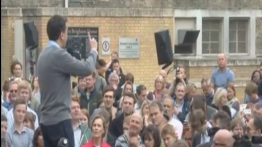
What’s Ed Miliband about? In a word: socialism. You can think this a good or a bad thing, but there ought to be no doubt about where he stands. At a Q&A in the Labour conference last night, he was challenged by an activist: When will you bring back socialism?' 'That’s what we are doing, sir' Miliband replied, quick as a flash. 'That's what we are doing. It says on our party card: democratic socialism'. It was being filmed, and your baristas at Coffee House have tracked down the clip as an exclusive. This little exchange will perhaps tell you more about Ed Miliband and his agenda than much of the over-wrought character-spinning stunts you can expect to see this week. It was no slip of the tongue.

Damian McBride shatters the Labour peace

If you want to know just how much anger Damian McBride’s book has created in the Labour party—and particularly its Blairite wing, just watch Alastair Campbell’s interview with Andrew Neil on The Sunday Politics. Campbell doesn’t scream or shout but the anger in his voice as he discusses McBride’s antics is palpable. He did not sound like a man inclined to forgive and forget. This whole row is, obviously, a massive conference distraction. Those close to Ed Miliband had hoped that this year, the Labour leader would get a free run at conference now that his brother has quite politics. But as one of his colleagues said to me late last week, ‘it used to be all about David, now it’ll be all about Damian.

Ed Miliband’s seaside start

Ed Miliband’s interview on the Andrew Marr show neatly summed up the Labour leader’s problems in cutting through. Marr started with a series of questions about Miliband’s plans to change Labour’s relationship with the unions. This might be an important issue but it is hardly one of paramount interest to the electorate and every minute Miliband is speaking about this, he can’t be speaking about other things. The next distraction is the whole Damian McBride business. Indeed, Miliband telling Marr that he’d told Brown to sack McBride is the BBC News headline on the interview. Miliband also had to fend off a whole host of questions about why his poll ratings are so bad. Miliband did, though, try to keep bringing the interview back to the cost of living.

Three reasons why you can’t write off Ed Miliband

This is not the backdrop that Ed Miliband would have wanted for Labour conference. Labour’s poll lead has—according to YouGov—vanished, Damian McBride is dominating the news agenda and there’s talk of splits and division in this inner circle. But, as I say in the cover this week, you can’t write Ed Miliband off yet. He has three huge, structural advantages in his favour. The boundaries favour Labour: Type Thursday’s YouGov poll, the best for the Tories in 18 months, into UK Polling Report’s seat calculator, and it tells you that Labour would be three short of a majority on these numbers. It is a reminder that if the parties are level pegging, Labour is winning.

Damian McBride and today’s Downing Street spin operation

Damian McBride's memoirs will naturally make uncomfortable reading for the Labour party, but the current occupants of Downing Street will also be feasting on his lesson in the dark arts, and wondering if there is anything they can take from it too. This sounds like an odd thing to say when so much condemnation for the poisoned operation of the Brownites (and, as Peter Oborne points out, the operation around Blair too) is flying about today. But the question of whether the current government needs its own Damian McBride is one that has occupied Tory MPs who like to think about these things for a while.

How McBride dripped poison into the system

If you want to know why Damian McBride was such a feared figure in Whitehall, read the section in his memoirs about how he sowed division between Charles Clarke, then the Home Secretary, and Louise Casey, the anti-social behaviour tsar. McBride’s approach was far more cunning than straight negative briefings or leaks. Rather, he went through the government grid looking for announcements in this policy area and then briefed them out to the papers in a way that made it sound like it had come from either Clarke or Casey’s teams. The result was that both sides became convinced that the other was trying to take all the credit for what the government was doing on this front.

Damian McBride’s confessions part I

Ever since the publication date of Damian McBride's book was set for the week of the Labour autumn conference, it was clear that the party would find itself lugging a bit of the past around as it tries to talk about what it wants to do in the future. But perhaps it wasn't clear quite what a festival of letting skeletons wander out of closets this week would be. There isn't one particularly horrifying skeleton, but the effect both of McBride's book, serialised in the Mail, and the cache of emails released by Benjamin Wegg-Prosser, former Number 10 strategic communications director, is to trawl up a row that had lain quiet.

Ed Miliband, a political genius? Pull the other one

Trouble is, I suppose, there’s so much space to fill these days, in the papers and on cyberspace, on your TV screens and on the wireless. And not filled with the same old stuff, but filled with something different. And so if you’re a columnist the pressure’s really on: what the hell is there that’s new to say? What attitude can I strike that would be different from what Aaronovitch had to say yesterday, but also different to what Heffer’s saying today? That’s the only explanation I can come to for three articles within a week saying what a bloody genius Ed Miliband is.

Coalition with Labour would suffocate the Liberal Democrats

I write this in Glasgow, at the Lib Dem conference. Nick Clegg has invented a constitutional doctrine. The doctrine teaches that after a general election, the party that comes third (should it have cohabitation in mind) must first approach the party that won the most seats. But there is no such rule. Our unwritten constitution is clear, minimal and simple. Any two parties jointly capable of commanding a Commons majority have an effective right to form a government together whenever they wish. That right is born of their joint ability to bring down any other government on the instant. So after the general election in 2015, unguided by the rule book, Mr Clegg and his party may have to make a primitive choice.

Extremists and the mainstream: the case of Comrade Newman

The Chippenham Labour Party has decided that its candidate to contest the 2015 general election will be one Andy Newman. As the anti-totalitarian blogs Howie’s Corner and Harry’s Place have already argued he is almost certain to be the worst politician to stand for a mainstream party. An innocent observer, who believes the British Left’s protestations that it is for workers’ rights and against sexism, racism and homophobia, could go further wonder how such a man could get close to the Labour Party – let alone close enough to run on a Labour ticket. Newman manages the laughably named “Socialist Unity" website: laughable, not just because it engages in vicious factionalism, but because it indulges the religious strain of far-right thinking.

Ashdown: We’re ‘a left wing party’ but we’ll do a deal with whoever the voters tell us to

A rather irritable Paddy Ashdown has just told Andrew Neil that the Lib Democrats are ‘a left-wing party’ but that their next coalition would be determined by the voters. Ashdown, whose chairing the Lib Dem election campaign, claimed that it simply wasn’t accurate to say that Lib Dems had a preference for who they’d like as their coalition partner. This is, to put it mildly, a dubious statement and Ashdown did feel the need to concede that senior Lib Dems did have ‘private likes and dislikes’. But he claimed that this wouldn’t influence their decision about who to go into government with.

Nick Clegg tells the Lib Dems, we’re the party of jobs

The Lib Dem conference rally was never going to be the same without Sarah Teather and her comedy routine. With Teather persona non grata following her decision to step down, it was duly a much tamer affair. The only risqué jokes were about Lembit Opik being bitten in the nether regions by a sausage dog. But seeing as Lembit has infuriated party loyalists by again calling for Clegg to go, they got a laugh from the leadership. The message of the conference rally was that the Liberal Democrats are the party of jobs. Nick Clegg claimed that the Tories weren’t the party of jobs, but the party of fire at will; a reference to the Beecroft proposals. But Clegg seemed much happier when he moved on to attacking the Labour party.

Labour get attacks in early on Toby Young

Toby Young has rattled some Labour cages by publicly mooting a bid for the Tory nomination for Hammersmith. ‘Z List Toryboy celebrity Toby Young wants to be an MP’ spins a Labour adviser Imran Ahmed. Then came the hammer blow: ‘Think he's gotten House of Commons mixed up with Big Brother house.’ Oh, that one will hurt. Should have saved it for the leaflets! So who is Ahmed? Well he last hit the headlines after he was accused of ghost-writing tweets for his old boss Andy Slaughter - the Labour MP for Hammersmith. Could he be speaking with Slaughter’s voice again?

Two weeks after his Syria defeat, David Cameron looks less wounded than many thought

It's two weeks since David Cameron looked rather sick in the House of Commons and Labour MPs jeered 'resign' following his defeat on Syria. On that night, all sorts of wild predictions were flying around about what this meant for the Prime Minister. But even some of the more sanguine commentary looked rather misplaced this week when Cameron was able to stand up at PMQs and produce a range of punchy jokes about how weak Ed Miliband was. Could a Prime Minister who had just lost a vote on a matter of war really call the leader of the opposition weak? Cameron's wounds have healed a little quicker than many of us thought, to the point that he is starting conference season in a reasonable position.

Well said Ian Katz. It’s Labour who should be ashamed, not you

I see the new Newsnight editor, Ian Katz, is in trouble for having 'tweeted' about the performance of one of the programme’s guests in an ungallant manner. He described the Shadow Chief Secretary to the Treasury, Rachel Reeves, as being 'boring snoring' during her interview with Paxo. The Labour Party has demanded an apology and suggests that Katz’s comments 'undermine the neutrality of the programme'. As a party member, could I just be allowed to say 'piss off Labour?'  Katz’s tweet – and why he feels the need to utilise this medium Christ alone knows – revealed no such thing. In fact, I suspect Katz is a Labour supporter.

Who donates what to the Labour party?

Who donates to Labour? It’s a question asked countless times since Ed Miliband began to reconsider his party’s links with the trade unions but there has been much confusion over the numbers, in particular the importance to Labour of union funding. Here’s a quick guide to who donates how much to the Labour party. 1. How much do Labour receive in donations? In 2012, Labour received £19 million in donations, which is roughly the same as the year before and in 2008, a similar point in the electoral cycle. It’s still down from £25 million at the last general election: For comparison, the Conservative party received £14 million in 2012 and the Liberal Democrats £3 million. 2. How much do the trade unions donate?

Ed Miliband vs the Trade Unions (and why Tories should hope the Unions win)

There is something distasteful about the latest Tory assault on the Trade Union movement. I hold neither candle nor torch for Len McCluskey and am, generally speaking, opposed to the kinds of policies much-favoured by Union bosses (sorry "Barons"). But the Tory attack on organised labour still jars. It may well be that the unions do a poor job of representing the interests of their members. It may also be that they have an outsized influence on the Labour party. These seem matters for union members and the Labour party to decide for themselves. It's not really anyone else's business. And, to be frank, the distinction between attacking Union bosses (sorry "Barons") without simultaneously seeming to attack union members (sorry, "hardworking, ordinary Britons") is a tricky one to make.