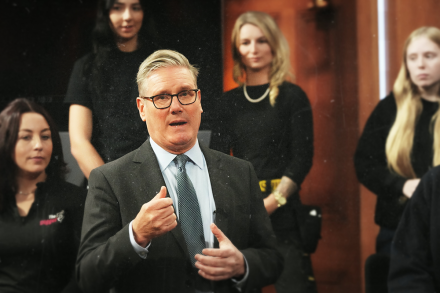
Keir starmer

What the UK can learn from Trump’s second term

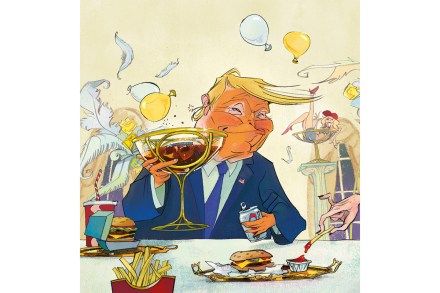
When John Swinney, the Scottish National Party leader, and former ambassador Peter Mandelson visited Donald Trump in the Oval Office a few months ago, the President showed them three different models for his planned renovation of the East Wing of the White House, which he has demolished to build a new ballroom. “If you’re going to do it,” Scotland’s First Minister suggested, “you might as well go big.” This Wednesday marked one year since Trump’s election victory, and going big captures the essence of his second term – bold and controversial moves, which have impressed even British politicians who thought him reckless in his first term.

toby young

Lord Young goes to Washington

I’m writing this from Washington, DC, where I’ve spent the best part of a week talking to politicos and think-tankers about the state of free speech in the mother country. Don’t believe our Prime Minister when he says it’s in rude health, I’ve been telling them. It’s on life support and any pressure that can be brought to bear on His Majesty’s Government to protect it would be hugely appreciated. Once again, it’s time for the new world to come to the rescue of the old. Not that they need much convincing. The view of Britain among Washington’s political class isn’t informed by diplomatic cables or articles in the Economist, but by viral videos on X.

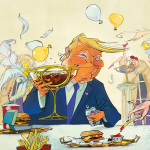
Gilded age: the lessons from Trump’s second term

Washington, D.C. When John Swinney, the SNP leader, and Peter Mandelson visited Donald Trump in the Oval Office a few months ago, the President showed them three different models for his planned renovation of the East Wing of the White House, which he has demolished to build a new ballroom. ‘If you’re going to do it,’ Scotland’s First Minister suggested, ‘you might as well go big.’ This Wednesday marked one year since Trump’s election victory, and going big captures the essence of his second term – bold and controversial moves, which have impressed even British politicians who thought him reckless in his first term.

China spy scandal: ‘a masterclass of ineptitude’?

From our UK edition

13 min listen

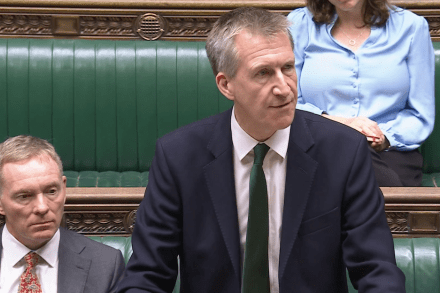
Tim Shipman and Charles Parton, China adviser at the Council on Geostrategy, join James Heale to discuss the ongoing fallout over the collapse of the Westminster spy case. Security minister Dan Jarvis answered an urgent question on the matter late on Monday in Parliament, stringently denying that the government played an active role in collapsing the case. But, as Charles and Tim stress, the case still doesn't add up. Is it as simple as the government not wanting to offend China? And is the deputy national security adviser being 'hung out to dry'? Produced by Patrick Gibbons.

Keir Starmer and the ancient question of word vs deed

From our UK edition

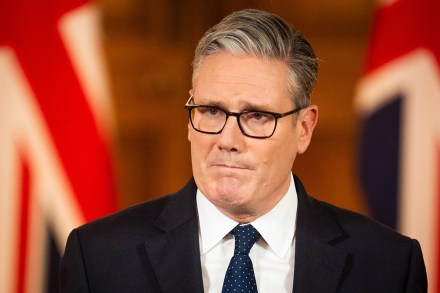
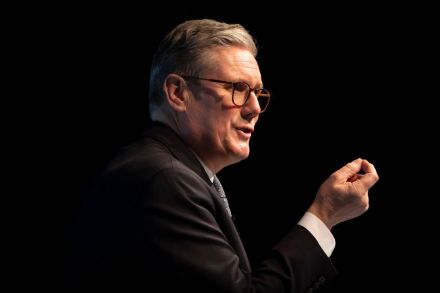
Sir Keir Starmer said that Britain had come to a fork in the road. As usual, he took it – the fork between his words and his actions. Athenians of the 5th C bc were fascinated by the implications of logos (‘speech, reason, argument’, cf. ‘logic’) and ergon (‘action/results’, cf. ‘erg’). While Homeric heroes (8th C bc) were ordered to excel as ‘speakers of words’ and ‘doers of deeds’ because that made them winners in both the political and military arenas, the statesman Pericles emphasised the high importance of the interaction between word and deed: ‘We do not think logos is an obstacle to action; no, the issue is the failure to use logos before action has to be taken.

Portrait of the week: Synagogue attack, pro-Palestine protests and a new Archbishop of Canterbury

From our UK edition

Home Two men at a synagogue at Heaton Park in Manchester were killed on Yom Kippur when Jihad al-Shamie, 35, drove a car at bystanders and went on the attack with a knife. He was a British citizen of Syrian descent, on bail after being arrested on suspicion of rape. He was bravely prevented by those present from breaking into the main building. Police shot him dead; they also accidentally shot a worshipper who died, and wounded another. Six people were arrested on suspicion of terrorist offences. Shabana Mahmood, the Home Secretary, appealed for a pause in pro-Palestinian protests but police arrested 488 people around Trafalgar Square demonstrating on Saturday in favour of Palestine Action – proscribed as a terrorist organisation.

Portrait of the week: Keir vs Nigel, ID cards and Trump’s peace deal

From our UK edition

Home Sir Keir Starmer, the Prime Minister, addressed delegates at the Labour party conference in Liverpool who had been issued with little flags of the home nations to wave. He said Nigel Farage, the leader of Reform UK, ‘doesn’t like Britain, doesn’t believe in Britain’. He had earlier put forward the difficult argument that Farage’s party was ‘racist’ in its migrant policy while Reform supporters were not racist but ‘frustrated’. Asked seven times whether there would be VAT rises, he repeated that ‘the manifesto stands’. Rachel Reeves, the Chancellor of the Exchequer, promised to keep ‘taxes, inflation and interest rates as low as possible’. Ofgem raised the energy price cap by 2 per cent.

Starmer has bought himself time. Can he use it wisely?

From our UK edition

The Labour conference in Liverpool was a curiously upbeat affair. Much of the good spirit came from schadenfreude at the misadventures of Andy Burnham. The Mayor of Greater Manchester scuttled out of Liverpool just before Keir Starmer’s speech, having united the party in mutual contempt at his posturing in recent days. ‘A fucking clown’ was the verdict of an ex-cabinet minister. ‘He did an Eric Heffer,’ remarked one Labour official – a reference to the cantankerous Liverpool MP who stormed out of Neil Kinnock’s conference speech 40 years ago. ‘It was the worst coup attempt since South Korea,’ says a former aide. Burnham, however, is merely a symptom, not a cause of Labour’s woes. Serious rivals are unlikely to telegraph their ambitions quite so blatantly.

Labour’s deputy divisions: insider vs outsider?

From our UK edition

14 min listen

Tim Shipman and Claire Ainsley from the Progressive Policy Institute join Patrick Gibbons to reflect on Labour's party conference as it draws to a close in Liverpool. This conference has been received positively for Labour but, on the final day, a hustings for the deputy leadership demonstrated that divides remain under the surface. Is Lucy Powell versus Bridget Phillipson a case of left versus right in the party, or is it more about the outsider versus the insider? And, as a leading political commentator declares Labour to now be the 'party of the professional middle class', what does the contest tell us about who Labour needs to appeal to? Produced by Patrick Gibbons.

Is Labour ‘racist’ too? Plus Trump’s Gaza gamble & Rowling vs Watson

From our UK edition

48 min listen

This week, Michael and Maddie report from the Labour party conference in Liverpool and unpick Keir Starmer’s big speech. Was his attempt to reclaim patriotism for Labour a genuine statement of values – or a clumsy exercise in stereotypes about steelworkers, chip shops and football nostalgia? And why does Labour’s attack line on Nigel Farage risk sounding like political ‘nuclear warfare’ that could backfire outside the conference hall? And what about the Tories? With Labour bringing the fight to the Reform party, where does this leave Kemi Badenoch and the Conservatives ahead of their conference later this week? They then turn to Donald Trump’s extraordinary new Middle East peace initiative.

Shabana Mahmood in conversation with Michael Gove – Labour Conference 2025

From our UK edition

49 min listen

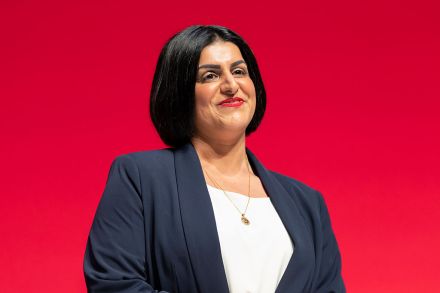
Whilst a certain noisy northern mayor has positioned himself as the problem child of conference 2025, The Spectator finds another Labour politician far more interesting. All around Liverpool the newsstands are decorated by the image of the Home Secretary Shabana Mahmood, dubbed the ‘Terminator’ by Tim Shipman in the most recent issue of The Spectator. As one strategist notes: ‘Shabana is not afraid to use power. That’s what we need.’ In this special edition of Coffee House Shots we present a wide-ranging in-conversation between Shabana Mahmood and Spectator editor Michael Gove.

Starmer’s make-or-break conference

From our UK edition

13 min listen

Labour conference kicks off this weekend in Liverpool – but the mood going in is far from triumphant. On today's Coffee House Shots, Lucy Dunn is joined by Tim Shipman and More in Common’s Luke Tryl to take the temperature ahead of Labour’s big set-piece. They discuss why some voters already see Starmer as ‘just as bad as the lot that came before’, and whether Labour can turn things around with new policies aimed at revitalising local communities – from saving libraries and pubs to giving residents more power over development. There is also a fascinating hypothetical poll in which an Andy Burnham-led Labour party outpaces Reform UK, turning a deficit into a narrow lead.

First they came for the Jews…

From our UK edition

It was moving to watch Keir Starmer announce this week, from a corridor in Downing Street, that his government has decided to recognise a state of Palestine. Starmer took this bold action at the same time as his French, Canadian and Australian counterparts. But as with Emmanuel Macron, Mark Carney and someone called Anthony Albanese, he seemed to be labouring under a number of misunderstandings. The first was that it makes any difference. Starmer and his counterparts overseas appear to be under the misapprehension that the creation of states still lies in their hands. I had thought that the present generation of leftists looked down on imperialist western powers making their colonialist interventions in foreign regions.

This is Shabana Mahmood’s moment

From our UK edition

What is the point of Keir Starmer? He was the means by which the Labour party could suffocate the hard left and assume the mantle of respectability and, in due course, power. But he lacked, and has never acquired, a governing philosophy. He was handed a landslide by an electorate determined to eject the Conservatives from office with ruthless force. Yet he has contrived to forfeit the authority it lent him and now rivals the government he supplanted in unpopularity and lack of direction. The men and women who engineered his ascent to the leadership, and delivered the majority he has acquired but does not command, have always known his limitations.

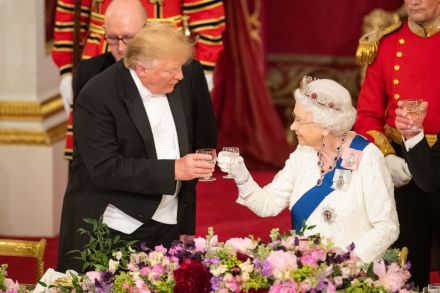
Press-pool stew

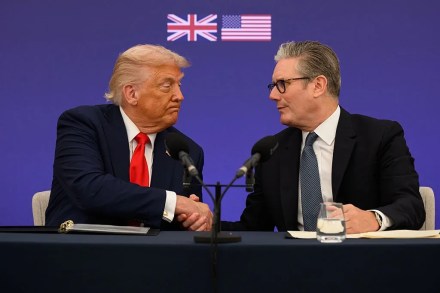
Looking for a good time, sweet’eart? Team Trump is back in Washington today after their sojourn to Britain for a state visit. The President took to the Old Country with the gusto of an American girl on study abroad: castles, royals, knights, fancy dinners, all the pageantry. “I saw more paintings than any human being has ever saw, and statues,” he gushed to the press pool on the flight back. He even managed to dodge the most difficult question in his joint press conference with Prime Minister Keir Starmer, flatly claiming “I don’t know him, actually,” of ousted UK ambassador Peter Mandelson, who was fired over new revelations of his ties to Jeffrey Epstein.

Trump

Weimar Britain, the war on science & are you a competitive reader?

From our UK edition

36 min listen

First: a warning from history Politics moving increasingly from the corridors of power into the streets, economic insecurity exacerbating tensions and the centre of politics failing to hold; these are just some of the echoes from Weimar Germany that the Spectator’s editor Michael Gove sees when looking at present-day Britain. But, he says, ‘there are grounds for hope’ – what are they? Michael joined the podcast to discuss.   Next: why did science succumb to the ‘culture wars’? Biologist and peer Matt Ridley bemoans the ‘cultification of science’, arguing that ‘left-wing ideological nonsense’ ended up permeating through all scientific disciplines.

Trump returns to backwater Britain

President Trump returns to Britain this week for his second state visit, to a country which is much changed yet depressingly still the same. On his first, six years ago, Britain had yet to complete its departure from the EU, Elizabeth II was still on the throne and the Conservatives still in power – with three Prime Ministers to go before their eventual ejection from office. He will no doubt receive a warm and dignified welcome from King Charles, whatever is going through the monarch’s head – the impeccable neutrality of the British throne has survived the change of reign. Yet the President will find a country that is anything but transformed by Brexit or by its change of government.

Donald Trump

What does Trump want from his state visit?

From our UK edition

16 min listen

Donald Trump touches down in Britain next week for his state visit and political editor Tim Shipman has the inside scoop on how No. 10 is preparing. Keir Starmer’s aides are braced for turbulence; ‘the one thing about Trump which is entirely predictable is his unpredictability,’ one ventures. Government figures fear he may go off message on broadcast – he is scheduled to be interviewed by GB News. A second state visit, especially during a second term, is unprecedented. But, as Tim says, ‘Britishness is fashionable in Washington’ and no-one likes ‘royal treatment’ more than Trump. So, can Starmer take advantage of the President’s ‘love of the deal’?

Trump leads tributes to Charlie Kirk

Charlie Kirk’s senseless murder on a Utah college campus yesterday led to an instant and disgusting avalanche of celebration from a small minority on the extremely online left. But Kirk’s friends and allies also rallied to pay tribute to the slain conservative activist. They know what we lost. President Trump gave a four-minute message from the Resolute Desk and Truth Social, “The Great, and even Legendary, Charlie Kirk, is dead. No one understood or had the Heart of the Youth in the United States of America better than Charlie. He was loved and admired by ALL, especially me, and now, he is no longer with us. Melania and my Sympathies go out to his beautiful wife Erika, and family. Charlie, we love you!

charlie kirk