James bond

Bond makes a great video game

Grade: A– He may not know how to make a drinkable martini, but James Bond makes a great videogame. GoldenEye on the Nintendo 64 was the first, but there’s always been potential there for more. After all, the character has all the stuff that the medium excels at. He has car chases, he fights, he shoots people, he blows things up and he appeals strongly to adolescent boys. In 007: First Light, he gets ample opportunity to do all those things, sometimes in very quick succession. Our man here is not yet a wintry Daniel Craig, a suave Sean Connery or a campy Roger Moore: when we first encounter him in the mandatory pre-credits sequence he’s not even a spy.

Is Jacob Elordi too tall to play James Bond?

From our US edition

The casting of the new James Bond is the biggest story in Hollywood at the moment. The sheer amount of disinformation and exaggeration that has accompanied snippets of news about the production of a new 007 adventure is remarkable, even by the standards of La La Land. Ever since the Bond franchise was purchased by Amazon, taken out of the restrictive hands of Barbara Broccoli and Michael G. Wilson, and placed in the care of Amy Pascal and David Heyman, the question of who’s doing what has been a source of fascination. The hiring of Dune’s Denis Villeneuve to direct was broadly seen as a smart, auteur-ish move; the decision to entrust the script to Peaky Blinders’ Steven Knight, who has written an awful lot of bad films and television series, less so.

They should never make another James Bond film

From our US edition

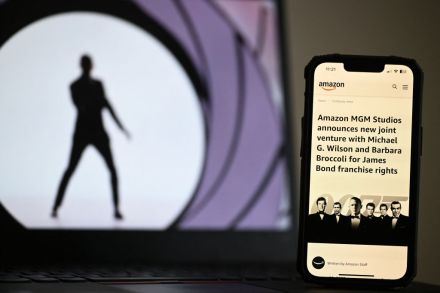
The 25th and most recent entry in the James Bond franchise, No Time to Die, premiered over four years ago. Since then, there has nonetheless been Bond drama. In 2022, Amazon acquired MGM, and with it the rights to 007. But it took several more years to wrest producer control from Eon productions, run by the Broccoli family’s Barbara Broccoli and her half-brother Michael G. Wilson, scions of the filmic spy empire created by their father Albert “Cubby” Broccoli. (The family claims that the vegetable is named after them, their fortune having been founded by crossing rabe with cauliflower.) Most recently, writers for the long-delayed upcoming 26th Bond film, set to be directed by Denis Villeneuve, appear to be stumped, plotwise.

Is Jack Carr behind the Department of War?

From our US edition

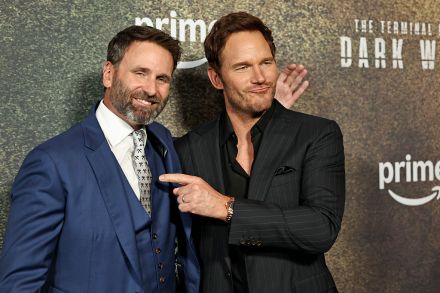
As a Navy SEAL for 20 years, who reached the rank of Lieutenant Commander and served in Iraq and Afghanistan, Jack Carr knows about warfare on an expert and visceral level. And as the New York Times bestselling author of The Terminal List series and writer of the Amazon hit show based on the books, starring Chris Pratt, he knows the power of words. He also has a tendency to succeed at whatever he turns his mind to (see the above). But, still, when he decided the Department of Defense should be renamed the Department of War, it seemed like a very tall order and he was a lone voice. Undeterred, he wrote in op-eds about how the department had lost its way and needed to refocus on warfighting by changing its name back to that it was given in 1789.

Jack Carr

Glorious: Good Night, Oscar, at the Barbican, reviewed

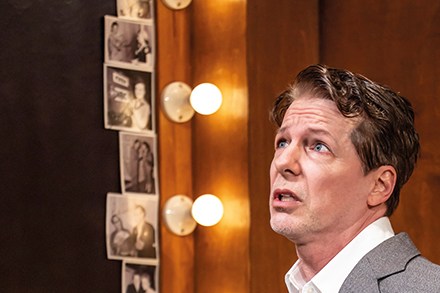
Good Night, Oscar is a biographical play about Oscar Levant, a famous pianist who was also a noted wit and raconteur. The script starts as a dead-safe comedy and it develops into a gripping battle between the forces of anarchy, represented by Oscar, and the controllers of NBC who want to censor his crazy humour. The backstory is complicated. Oscar has been secretly committed to a mental asylum and his wife gets him released for a few hours so he can do an interview on Jack Paar’s TV show. It takes two long scenes to explain this improbable set-up but it’s worth it because Oscar (Sean Hayes) is such a lovable character. He’s a total wreck, addicted to drugs, suffering from OCD, and afflicted by aural and visual hallucinations that leave him curled up on the floor like a baby.

Make Bond great again

One of the great recurring James Bond tropes is to make it look as though 007 has actually been killed before the film’s title credits. You Only Live Twice, From Russia with Love and Skyfall all begin with Bond in a position where his demise seems inevitable. Of course, he always turns up alive. (Quite what the rest of the film would consist of if he didn’t is anyone’s guess: perhaps Moneypenny dealing with probate or M arranging one of those ghastly direct cremations.) Now, however, we may have reached a danger from which even Bond cannot wriggle out. Amazon, the company responsible for one of the biggest flops in TV adaptation history, the Middle-earth prequel series The Rings of Power, has paid more than $1 billion to take ‘creative control’ of the Bond franchise.

Why SNL 50 bombed in the ratings

From our US edition

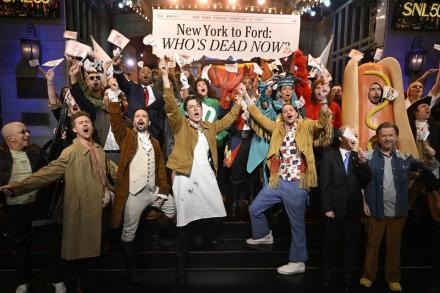
On my favorite Hollywood-focused podcast The Town, host Matt Belloni and his producer and guests offer predictions all the time on television ratings, relying on the Nielsen numbers for reference for what's anticipated versus what it turns out to be. Predictions for Saturday Night Live's fiftieth anniversary had it tracking above 20 million viewers — a reasonable expectation given the year-long promotional campaign and the fact that it would be on NBC, streaming on Peacock and on E! Network at the same time. The conversation on The Town was mostly a debate about whether it would hit 25 million, putting it well above expectations for the Oscars. Instead, it came in far lower, not even getting to 15 million — below the Grammy Awards, for sake of comparison.

snl 50

Why is British espionage drama so in vogue?

From our US edition

If you’re a Paramount+ or Showtime subscriber, there’s a decent chance that you spent at least some of the Thanksgiving break watching the first two episodes of The Agency, the Michael Fassbender-fronted espionage drama that the company has invested a huge amount of money in. Based on the cult French series The Bureau, starring Matthieu Kassovitz, it’s a grim and self-consciously serious piece of drama, low on explosive shootouts and one-liners and high on tortured scenes of introspection, as Fassbender’s deep-cover operative, codename Martian, is brought in from the cold by his CIA superiors to their London outpost, only to realize that he has not been entirely honest as to a tortured romantic liaison that he went through in Africa.

espionage

Bored of the rings: ‘wokery’ takes on Tolkien

From our US edition

"Woke” is a term much overused by those on both sides of the culture war but — a little like pornography — while it may be difficult to define, you absolutely know it when you see it. The capture of the entertainment industry by an ideology — perhaps more accurately described as a group of roughly consanguineous ideas that seem, superficially, to be the Right, Kind and Thoughtful beliefs to hold — seems now to be absolute. Fiction of all kinds has been affected, but heroic narratives have proved especially vulnerable, perhaps because of the size and dedication of their audiences. You will doubtless know the kind of thing I mean.

Rings

An accidental spy: Gabriel’s Moon, by William Boyd, reviewed

When was the last time you described – or indeed thought of – someone’s face as ‘even-featured’, ‘angular’ or ‘refined’? If the answer is never, I suspect you’re not a novelist, and definitely not one of the William Boyd, old-school kind. In 1983 Boyd was among the 20 writers on Granta’s famously influential list of Best Young British Novelists, along with the generation-defining likes of Martin Amis, Julian Barnes, Kazuo Ishiguro and Salman Rushdie. In the decades since, however, he’s increasingly moved away from more obviously literary fiction towards the sort that’s earned him the routine (and accurate) label of ‘master storyteller’.

How Elon Musk could solve the housing crisis

People sometimes ask me why I don’t go into politics. Why on earth would I do that? No, if you want to exercise power and imagination, the only remaining role which appeals is to be some kind of Bond villain. To anyone familiar with modern bureaucracy, there’s something hugely attractive about an organisation where the HR department is replaced by a pool full of sharks. I think this fantasy largely explains why electorates are now drawn to candidates who seem a tiny bit sinister or weird. ‘Who knows?’ they think. ‘They might actually do something different.’ Never mind Trump: my guess is that if Elon Musk were eligible to run for president, he’d get 60 per cent of the vote.

A calculated insult to the viewer: Channel 4’s The Princes in the Tower – The New Evidence reviewed

Major spoiler alert: if you don’t want to know the ending of The Princes in the Tower: The New Evidence, skip the next paragraph. Still with me? Good. The answer is no, Richard III did not order the killing of the two princes. That was just Tudor propaganda. Both boys, the sons of Edward IV, survived, and escaped to Europe. Thence, supported by their aunt Margaret of Burgundy, they made separate, ultimately unsuccessful attempts to regain the throne for the Yorkists, one under the name Lambert Simnel, the other as Perkin Warbeck. I’m telling you this not to be a spoilsport but to spare you 82 minutes of valuable life. Yes, the bare-bones story is fascinating, and researcher Philippa Langley deserves huge credit for her discoveries.

The astonishing truth about 007

The novel as a form is a fundamentally capitalist enterprise. It was invented at the same time as capitalism – Robinson Crusoe tots up his situation in the form of double-entry bookkeeping. Its interests dwell on the disparate and unequal natures of human beings and feed off rivalry, social transformation, moneymaking, profit and loss. No rigid feudal society has managed to create an effective school of novelists; and having once struggled through Cement, Fyodor Gladkov’s classic of socialist Soviet literature, I would say that systems dedicated to forcible equality also struggle.

No one wants a more sensitive James Bond

Men do not come to see James Bond movies for the sensitive brooding of an ageing spy. They come for the car, the bikini and the volcano. This is apparently lost on some people in Hollywood – the same people who occupy the unfortunate position of actually making James Bond movies. The Daily Telegraph reports: 'The next James Bond films will have bigger roles for women and a more sensitive 007, according to the producers.' Variety quotes producer Barbara Broccoli saying 'Bond is evolving just as men are evolving', adding: 'I don’t know who’s evolving at a faster pace.' I have a difficult time believing that any fan of James Bond ever expressed a desire for the greatest secret agent in the history of film to be more in touch with his feelings.

There is no best martini

From our US edition

What’s the best suit? To an American, it’s something from Brooks Brothers. Classical, democratic and made with high quality. To a Brit, it might be something from Henry Herbert or Gieves & Hawkes, a tailor-made garment from Saville Row, cut from perfect navy. But a suit can be just as good when rendered in draped, colorful cloth by the late Edward Sexton, or a hot corset-blazer blend by H&M and Mugler. There is no universal best suit. There’s just the best suit for the man or woman who wears it. And so, I come around to the refined blazer of beverages: the martini. In the pages of our July magazine, Chilton Williamson, Jr. wrote about his effort to “search of the perfect martini.

martini

Oppenheimer and the triumph of Christopher Nolan

From our US edition

The Barbenheimer phenomenon — thought of by many as just idle chatter on the internet — has enduring power. Last weekend, Barbie and Oppenheimer earned a combined $511 million in global box office receipts; an unprecedented number where neither film is a superhero picture or a sequel. Barbie made more money, on the grounds that it’s an hour shorter and is PG-13 rated, but the vast box office success of the R-rated Oppenheimer, which made over $170 million in its opening weekend, is testament both to Barbenheimer excitement, and to the film’s very own brand: its powerful writer-director-producer, Christopher Nolan.  James Cameron aside, it is hard to think of any filmmaker who wields such power and influence in contemporary Hollywood.

Christopher Nolan

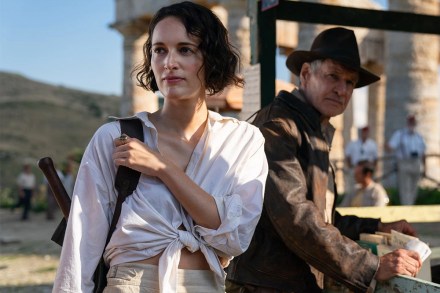
Phoebe Waller-Bridge is a franchise murderer — and Indiana Jones is her next victim

From our US edition

Phoebe Waller-Bridge must be destroyed before it's too late. The short-bob comedienne fond of wall-breaking and lazy edits has, in very short order, emasculated and destroyed multiple franchises thanks to the overwrought praise for her adaptation of her one-woman show, a descriptor that should itself elicit a bit of vomit in the back of the throat. Not content to politicize Star Wars as an irritating droid in Solo or to chop off the balls of James Bond in Daniel Craig's swan song whose name no one remembers, Waller-Bridge has now set her sights on a firmly American man to take down: Indiana Jones, whose fifth edition box office she will eradicate in spite of all the goodwill of these United States. https://twitter.

phoebe waller-bridge

Mission: Impossible makes the Daniel Craig Bond movies seem anemic and dull

From our US edition

The British comedian, actor and author Charlie Higson is famous internationally for being one of the writers that has carried on the mantle of Ian Fleming by writing novels and stories that continue James Bond’s adventures, most recently On His Majesty’s Secret Service, published to coincide with King Charles III’s coronation. Yet in a recent interview with the Sunday Times of London, Higson was openly dismissive of the recent Daniel Craig-starring 007 films. He said “I went to see No Time to Die with my oldest boy, Frank, who is thirty, and he said, ‘That felt like a Bond film made by people who are embarrassed to make a Bond film.’ You had to watch two films in advance to know who such-and-such is and you think, ‘Oh, fuck off with that.

mission: impossible

How boredom begat James Bond

It is sobering to think that if Ann Rothermere had been a less enthusiastic painter, James Bond might never have existed. In January 1952, Lady Rothermere and Bond’s creator Ian Fleming were on holiday at Goldeneye, his house in Jamaica. Tension crackled in the air. He and Ann had been lovers since 1939. Her husband, Viscount Rothermere, chairman of Associated Newspapers, had recently divorced her. The news had reached the gossip pages of the Daily Express. The scandalous couple had discussed marriage — with some urgency because Ann was pregnant — but Fleming’s expectations of marital bliss were slim. ‘I can promise you nothing,’ he told her. ‘I have not an admirable character. I have no money. I have no title. Marriage will be entirely what you can make it.

Do James Bond’s would-be censors have a point?

From our US edition

James Bond may have battled the nefarious forces of SMERSH, SPECTRE and other international terror organizations, but surely he has never faced quite so implacable a foe as the sensitivity reader. Following in the footsteps of Roald Dahl, the wholesale revision of whose books led to international outrage, Ian Fleming’s Bond novels, which have been re-released to mark the seventieth anniversary of the first publication of Casino Royale, have undergone their own exercise in alteration. But is it an egregious travesty à la Dahl, or — whisper it — might someone have had an idea arising from nobler motives?

bond