Islam

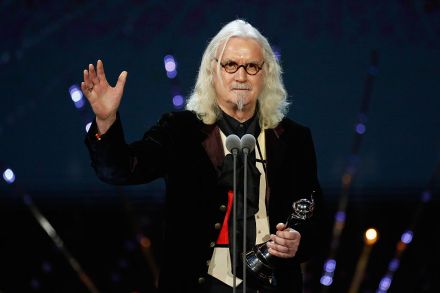
Why was a disabled grandad sacked by Asda for sharing a Billy Connolly clip?

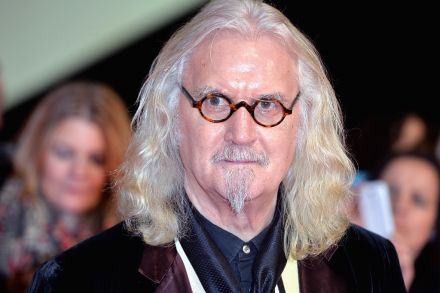
I don’t prefer shopping at a specific supermarket. For some it’s a sign of social status, like the toffs who pride themselves in navigating the aisles of Waitrose, while sneering at the plebs in Lidl. However, my supermarket choice may now be influenced by the outrageous behaviour of Asda (in Dewsbury), who sacked a disabled grandad for sharing a clip of Billy Connolly ridiculing both Islam and Christianity on his personal Facebook page. Has blasphemy become a sackable offence in modern Britain? The man in question is 54-year-old Brian Leach from Yorkshire. Leach, who’d worked for Asda for five years, told the Examiner Live: ‘I was summarily dismissed without notice following a disciplinary meeting for breaching the company’s social-media policy.

It’s time to crack down on Muslim-on-Muslim hatred

There is no doubt that we need a clear definition of anti-Muslim hatred. Having set up Tell MAMA – an organisation monitoring attacks on Muslims – in 2011, I have seen anti-Muslim hate jump in the years since. Fear within Muslim communities has risen as mosques, people and Islamic institutions have been targeted. Together with a corresponding rise in far-right extremist groups, a series of Islamist extremist attacks and the wild west of social media, it can be a difficult time to be a Muslim in Britain.

Muslims aren’t Europe’s new Jews

From our US edition

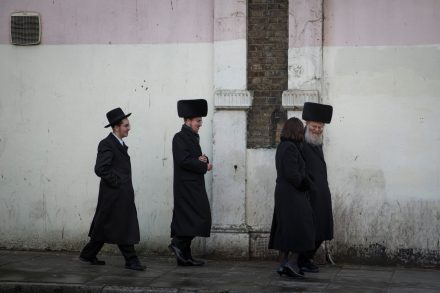
Last weekend, Felix Klein, Germany’s anti-Semitism commissioner, said that he can no longer ‘recommend to Jews that they wear the skullcap at all times everywhere in Germany.’ This statement betrayed two devastating truths. First, that anti-Semitism is back with a vengeance in Germany, as elsewhere in many European states. Second, that no one with any knowledge of the situation has any confidence that things will get better anytime soon. Instead of working to change the latter, Jews are instructed to hide their faith. This is abhorrent for several reasons. The kippah or yarmulke is, like the hijab, an external signifier. It proclaims to the world that the wearer identifies with a particular group and a particular set of ideas.

jews

Africa’s liberal Mufti

 Kigali, Rwanda To most outsiders, Rwanda is still synonymous with genocide. Nearly a million killed in 100 days; almost three quarters of the Tutsi population dead. The country’s attempts to rebuild have been much commented on, but something else is overlooked: Rwanda has become an astonishing oasis of tolerant Islam and, in many ways, an example to the West. In Rwanda, there is an Islam which stands firm against the petrochemical ‘Gulf Stream’ of Wahhabi finance, despite lacking the huge wealth that Muslims in the Arab world enjoy. It also refuses to yield control to the neo-fundamentalists of the Muslim Brotherhood now backed by Qatar and Turkey. This independence and liberalism are embodied by the spiritual leader of Rwandan Muslims, Sheikh Salim Hitimana.

China’s war on Islam

From our US edition

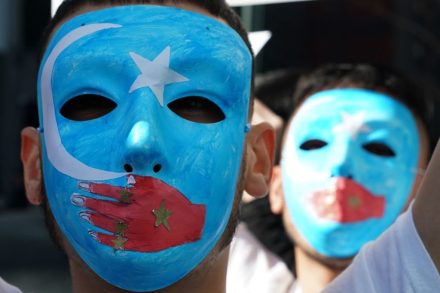
The Reuters photo could be mistaken for a shot of one of America’s ‘supermax’ prisons, the ones where the most dangerous criminals are held. An endless green security fence, topped with coils of barbed wire, punctuated by soaring octagonal guard towers with 360-degree views, all fronting what looks like a massive concrete wall or side of a building. Yet the Chinese workers walking outside the fence give away the truth. The picture is not of a US prison, but rather a Chinese ‘re-education’ center in vast Xinjiang, in the country’s far west. According to research by the Australian Strategic Policy Institute, there are 28 such massive detention camps in Xinjiang, most built within just the last several years.

uighurs

Roger Scruton is a friend, not a foe, of Islam

I am not a right-winger. I am ashamed to say that I discovered Sir Roger Scruton only four years ago when an argument in a Washington DC think-tank led to a search for contemporary philosophers who took a long view of civilisation, history, ideas, and implications of philosophy.  It happened when I was an advisor to Tony Blair and visited Washington DC for a think-tank meeting representing Tony. There, left-wing Muslim activists, who put their community’s interests before their country, accused me of being a ‘neoconservative’ because I argued that the national security of our countries and peoples mattered more than any Muslim community identity. A safer country, logically, meant a safer Muslim community.

What Isis wants

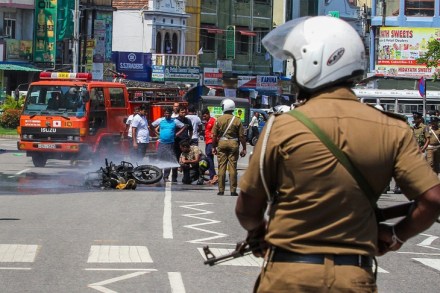
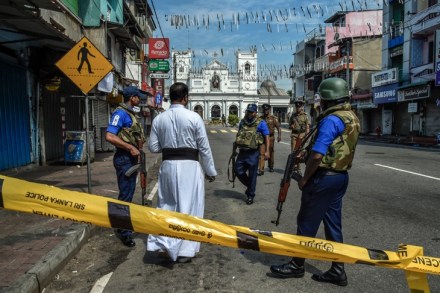
It has become commonplace to describe terror attacks as ‘senseless’. The horrific Easter Sunday bombings in Sri Lanka, which cost the lives of more than 350 people, several British citizens among them, make little sense. The only way to understand them is as a symptom of the growing globalisation of terror. The tactics — synchronised bombs on a Christian holy day — are grotesquely familiar. And it was not surprising to learn that one of the attackers was partly educated in London. The attacks, on three Catholic churches and three hotels favoured by westerners, clearly targeted Christians. The culprits have been identified as local Islamic extremists. The purpose of the attacks, therefore, was to increase tensions between Muslims and non-Muslims.

We’re in a terrible tangle over Islam

The carnage in Sri Lanka which left more than 300 dead may have been carried out by ‘Buddhists’, according to the BBC Today presenter Nick Robinson on the morning after those hideous bombings. We all grope slowly towards meaning, don’t we? We look for precedent, we search for clues. I did both when I heard of the murders and came to a different conclusion to Nick. Someone had attacked Christians and westerners in a series of suicide bombings: that gave me an inkling. Perhaps — just perhaps — it wasn’t Buddhists. Perhaps it was instead the fanatics responsible for the vast majority of terrorism outrages in the world (Global Terrorism Index, 2000-2013) and 92 per cent of all terrorism murders in the United States since 1992 (Cato Institute, 2017).

Islamic terror and the Left’s pretzeled language

From our US edition

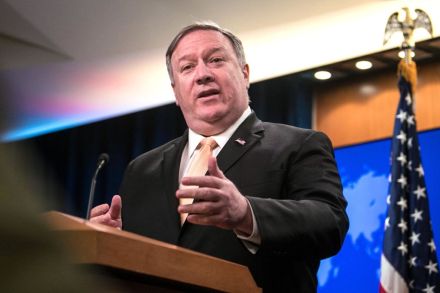
After years of Obama-era State Department obfuscations and Orwellian redactions, it was heartening to hear Secretary of State Mike Pompeo lay the blame for the ‘horrific wave’ of bombings at international hotels and Catholic churches across Sri Lanka on Easter Sunday where it belongs: at the feet of ‘Islamic radical terror.’ Pompeo stated at a press conference Monday that ‘radical Islamic terror remains a threat’ and that the US, along with international partners, is working against the ‘evil’ of ISIS, al-Qaeda, and other radical Islamist groups. That’s a far cry from the antics of the State Department under Obama.

mike pompeo sri lanka

Adopting the new Islamophobia definition would be terrible for the Tories  

I do not think I am alone in having real difficulty with the word Islamophobia and attempts to define it as “a type of racism that targets expressions of Muslimness or perceived Muslimness”. Racism of any sort is unacceptable and catered for in the existing law, but this definition is impossibly vague. The reality is that it will preclude any criticism of “Muslimness” which, however well balanced and evidenced, will automatically be regarded as racist. Let me give you an example. When I was a member of the Joint Committee on Human Rights, we examined legislation to ensure that it did not involve any violations of human rights. For the same reason, we conducted thematic enquiries. I suggested the position of Muslim women in the UK might merit an enquiry.

Bad blood | 4 April 2019

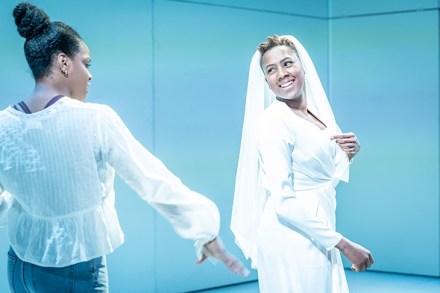
The Phlebotomist by Ella Road explores the future of genetics. Suppose a simple blood test were able to tell us how long we will live and what disease will kill us. If the tests were compulsory and the results publicly available, a new hierarchy based on life expectancy would emerge. Citizens facing chronic illness or early death would struggle to find jobs and spouses. The scientists who administer the tests would come under pressure to falsify the results. And alpha citizens with high-grade DNA would be murdered, and their blood harvested to create fake genetic identities. This gruesome, ingenious and all-too-believable scenario is presented through a squeaky-clean romance between two young lovebirds.

Is New Zealand really such a tolerant country?

For years, New Zealand has been talked of as a beacon of liberalism, a country that other democracies including Britain – and, in particular, Trump’s supposedly intolerant America – should try to emulate. This has been even more pronounced since the massacre of Muslim worshippers at two New Zealand mosques by an Australian white supremacist a fortnight ago. In a rare gesture, the world’s tallest building was dramatically lit up last week with a giant image to honour New Zealand prime minister Jacinda Ardern for her leadership following the killings. The Burj Khalifa skyscraper in Dubai beamed out a photo of Ardern embracing a woman at a mosque in Wellington.

The Muslim leader who offers an example on how to tackle Islamism

The Christchurch attack has prompted a considerable degree of soul-searching in the West about the potential impact of anti-Muslim rhetoric. The need to tackle deadly far-right conspiracy theories is clear for all to see and the debate about how to do so continues. But what lessons might we learn from the response to Christchurch in the Muslim world, where I spent many years of my professional life working? Yahya Cholil Staquf, the general secretary of Nahdlatul Ulama – the largest independent Muslim organisation in the world – wrote a good piece in the Daily Telegraph this week under the headline, “Don’t weaponise the term ‘Islamophobia’”.

Before the angel came

In his first book, published in 1977, Tim Mackintosh-Smith described mentioning the idea of travelling to Yemen while studying Arabic at Oxford because he had heard that Yemenis spoke the purest form of Arabic. ‘They all say that, you stupid boy,’ his tutor replied, suggesting he go ‘somewhere respectable’ instead. The student went to Yemen all the same, and has been there ever since, living through sweet and also turbulent times, including civil war and the ongoing Saudi-stirred nightmare that has taken at least 60,000 lives through combat and some 85,000 from famine. But not so very long ago, the word Arab in this country conjured up images of a sleepy, hospitable and ineffective people. How the wheel has turned.

Jacinda Ardern’s hijab shows what New Zealanders really think of Muslims

From our US edition

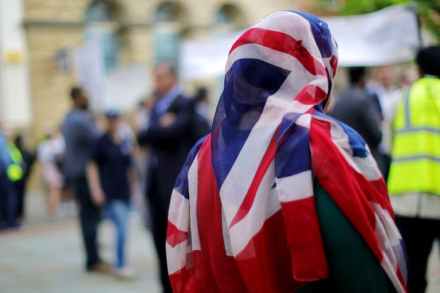
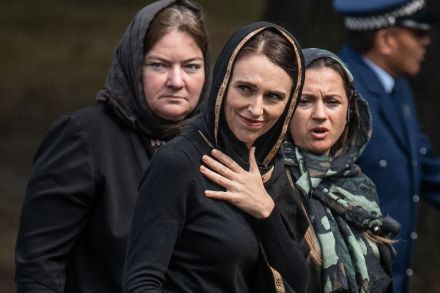
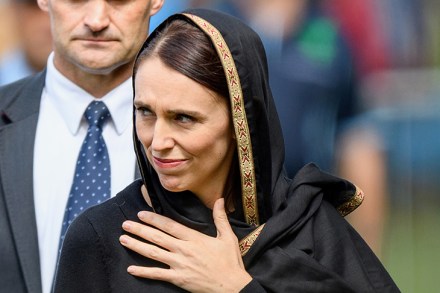
The reaction of New Zealand’s vast non-Muslim majority to the terrorist attack at the Al Noor mosque in Christchurch is both inspiring and alarming. Inspiring because, faced with a group of mostly recent arrivals who constitute a mere 1 percent of New Zealand’s population, the other 99 percent have chosen not to ignore their loss and distress, but to commiserate and console at a time when liberal democracies are beset by factional resentments. What is alarming is the form the reaction has taken. When New Zealand’s prime minister Jacinda Ardern observed Friday prayers in the park outside the mosque, she and many other non-Muslim women wore a hijab.

jacinda ardern

My grief for the victims of the New Zealand mosque attack | 15 March 2019

'We belong to Allah and to Allah we shall return'. Muslims around the world, including me, are now reciting the verse from the Quran that Muslims say on hearing of the death of a fellow believer. Taking in news of the murder of 49 worshippers at a mosque in sleepy, safe New Zealand at the hands of a white supremacist, this verse came to my lips again and again. I felt the same grief when I watched the attacks on 9/11 unfolding. In the days afterwards, I also struggled with the reaction of others in Riyadh, where I was living at the time, and their shameful sense of schadenfreude. This was hard to deal with as I struggled to comprehend the attacks on New York, a city I love and call home.

My grief for the victims of the New Zealand mosque attack

'We belong to Allah and to Allah we shall return'. Muslims around the world, including me, are now reciting the verse from the Quran that Muslims say on hearing of the death of a fellow believer. Taking in news of the murder of 49 worshippers at a mosque in sleepy, safe New Zealand at the hands of a white supremacist, this verse came to my lips again and again. I felt the same grief when I watched the attacks on 9/11 unfolding. In the days afterwards, I also struggled with the reaction of others in Riyadh, where I was living at the time, and their shameful sense of schadenfreude. This was hard to deal with as I struggled to comprehend the attacks on New York, a city I love and call home.

The false equivalence between ‘Islamophobia’ and anti-Semitism | 8 March 2019

I have been travelling in the Middle East for the last few weeks and slightly regret returning to the maelstrom of ancient animosities and unbridgeable sectarianism that is modern Britain. But in my absence I see that one of the worst tropes of our time has been stalking unhindered across the land. That is, of course, the latest push to make an equivalence between anti-Semitism and the crock term ‘Islamophobia’. It is not just in the UK that this play has been made. In America over recent days people have been able to follow the progress of the new Muslim congresswoman Ilhan Omar, with her supporters deciding to deflect attention from her expressions of anti-Semitism by claiming ‘Islamophobia’.

God’s messengers

A good question for your upcoming Lent quiz: where are angels mentioned in the Nicene Creed? I asked this at a vicarage supper party after finishing Peter Stanford’s highly informative book about angels, which had left me angel-obsessed and an angel bore. No one came up with the answer. ‘Of all things visible and invisible, of course!’, I declared triumphantly. Once you see it, it’s obvious that the ‘invisible’ are the angels, but it had never occurred to me before.

Bangladesh doesn’t want Shamima Begum. Here’s why it might have to take her

Whatever the arguments over the Government’s decision to revoke Isis bride Shamima Begum’s British citizenship, the teenager's future now depends on one thing: will the courts determine she is a dual national who is eligible for Bangladeshi citizenship? If so, Sajid Javid's decision is lawful, as this means that the loss of her British citizenship will not leave her stateless. But what does Bangladesh make of this row? The view from Dhaka has been clear: we don't want her. In a statement issued this week, the country's foreign ministry said: “The government of Bangladesh is deeply concerned that she has been erroneously identified as a holder of dual citizenship shared with Bangladesh alongside her birthplace, the United Kingdom.