Iraq

The three options facing Trump in Iran

As Trump contemplates a ground operation in Iran, he will be reckoning with the ghosts of previous western "excursions" in the region, as he recently labeled this war. History suggests three endgames for his intervention in Iran are plausible. First, a hasty deal on terms that aggrandize and empower Iran, creating an American equivalent to Britain’s Suez Crisis. Second, a protracted struggle which becomes structurally reminiscent of the Iraq War. Third, a dramatic escalation which achieves Iranian surrender quickly and cleanly. The bad news for Trump is that the outcome he seeks, number three, is the one without real precedent. In the first scenario, Trump makes a deal on terms that flatter Iran.

state of the union

It’s time for Congress to take back its war powers

On March 29, more than twenty years after the United States commenced Operation Shock and Awe in Baghdad, the Senate made history by repealing the military force authorization that green-lit the operation. The bill, which also aims to kill a previous 1991 authorization for the use of military force, or AUMF, against Iraq during the Gulf War, now heads to the House of Representatives where it faces an uncertain future.  On the face of it, repealing both measures would seem like an ordinary event. Saddam Hussein, after all, has been dead for over sixteen years, hanged by an Iraqi court for a litany of crimes against his own people. His regime dissolved within three weeks of the 2003 invasion.

I spent 25 years fighting neocons. Then Trump became one

Like everyone, I’m glued to the news coming out of Iran. I’m experiencing some depression, as one might, upon realizing that much of what one has worked on for 25 years has suddenly gone up in smoke, destroyed when Donald Trump discovered he was pretty much a neocon after all. Like everyone else, I have no idea what will happen in Iran, whether Trump’s bombing and perhaps breaking apart a very unpopular regime will lead to something better, or just chaos, a failed state spitting out a cohort of embittered men.

neocon

US troops finally leave Syria

In December 2018, to the shock of pretty much everybody in the US national security establishment at the time, President Donald Trump publicly ordered the withdrawal of all US troops from Syria. The announcement caused a panic within the Defense Department, State Department and National Security Council, whose officials teamed up to dissuade Trump from going through with it. A similar story unfolded ten months later, in October 2019. Again, the bureaucracy pushed back; in October 2019, the House went so far as to pass a resolution opposing a US withdrawal, with senior Republican lawmakers signing onto the measure. Fast-forward more than six years later, and the US troop withdrawal Trump floated about during his first term is finally coming to fruition in his second.

Syria

ISIS is stirring once more

Indications that the Islamic State (ISIS) has begun to employ artificial intelligence in its efforts to recruit new fighters should come as no surprise. At the height of its power a decade ago, Isis was characterized by its combination of having mastered the latest methods of communication with an ideology and praxis that seemed to have emerged wholesale from the deserts of 7th century Arabia. In 2014 and 2015, ISIS recruitment took place on Twitter and Facebook. YouTube was the favored platform for the dissemination of propaganda. The group's videoclips of its barbaric prisoner executions, including the beheadings of a series of western journalists and aid workers and the immolation of a captured Jordanian pilot, became the organization’s gruesome trademark.

isis

Trump won’t be dragged into a regime-change war

The handsome pages of The Spectator World’s July issue readers will find an essay of mine arguing that the United States doesn’t win wars anymore because we don’t even understand what a modern war is. From the French Revolution to the Cold War, and in the long, warm afterglow—thankfully, non-nuclear—of Cold War success, Western elites have tended to think about wars in terms of regimes and ideologies. Winning a war is all about changing the opponent’s regime so that it endorses one’s own ideology: turning a “dictatorship” into a “liberal democracy” through the magic of bombs and bullets.

Regime change

Why Trump met Syria’s interim president

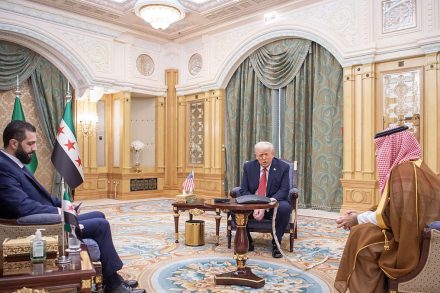
Few career arcs in modern history can be as remarkable as that of Ahmed Hussein al-Sharaa – or Abu Mohammed al-Jolani, to give him the nom de guerre under which he fought American troops in Iraq back when he was a firebrand member of al-Qaeda. Twenty years ago al-Sharaa was languishing in a US military prison in Baghdad, held on suspicion of terrorism. Today, as Syria’s new interim President, he shook hands with Donald Trump posing for photo-calls alongside the de-facto ruler of Saudi Arabia Mohammad bin Salman. Trump was evidently impressed by al-Sharaa, who has swapped the turban and dusty fatigues that he habitually wore before taking Damascus by storm last winter for a plain blue suit and purple tie. “He’s a young attractive guy.

al-sharaa

‘Blood! Blood! Blood!’: the Battle of Fallujah twenty years on

The National Museum of the Marine Corps has built a replica of a street in Fallujah, the Iraqi city that American forces half-destroyed in order to save it, in a battle twenty years ago next month. The exhibit promises visitors an “interactive experience that puts them in the boots of a Marine as he kicks down the door of a suspected insurgent stronghold.” If you have a games console, you can play Six Days in Fallujah, a video game where you take the role of a Marine who narrates the action of a firefight that really happened. Fallujah has become a symbol of gritty heroism and sacrifice — or for critics of the Iraq war, occupation and war crimes. Either way, the battle is deeply lodged in the popular imagination.

Fallujah

The fight for the burn pits veterans isn’t over yet

On July 28, 1932, the United States military attacked its own veterans. The desperate former soldiers, who had survived the horrors of World War One, had dug in for months in Washington, DC to get the bonuses that had been promised to them by Uncle Sam. Yet instead of paying the money they were entitled to, the Hoover administration dispatched General Douglas McArthur, who led against them four troops of cavalry, four companies of infantry, a machine gun squadron, and six tanks. Ninety years after the infamous attack on the Bonus Marchers, dozens of veterans camped out on the steps of the Capitol building for several days. These veterans were not routed, thankfully.

Why America was in the dark over Israel’s assassinations

For the last three months, the Biden administration has had one top priority in the Middle East: end the war in Gaza. President Biden’s May 31 address, during which he outlined a three-stage process whereby a temporary six-week ceasefire and hostage exchange would eventually led to a permanent end to the fighting and Gaza’s reconstruction, remains official US policy. CIA director Bill Burns, a former senior negotiator himself courtesy of his decades-long experience in the State Department, has spent the last ten months flying to Cairo, Doha, Jerusalem and Rome to close the remaining gaps between Israel and Hamas. It’s hard and thankless work.

Inside the May issue: technology

Western governments seem ill-prepared to grapple with rapidly advancing technology. Watch any congressional hearing where a crusty congressman tries to keep pace with Silicon Valley’s top “autists” if you need further evidence — and read Spencer A. Klavan’s analysis of the high-skill but low-status rejects uniting into a formidable social class. The Silent Generation and boomers simply cannot keep up. The Space Race is back on — and tycoons are eager to cash in on the final frontier. Shane Cashman dives into the new wild west of explorers and entrepreneurs commercializing the great unknown. Lionel Shriver brings us back to earth with a look at the electrical grid and our government’s push for green energy and electric vehicles.

technology

Why do neoliberals get let off the Iraq War hook?

Given the worldwide climate of political intolerance, I often try to deflect hostility by prefacing my comments with the old saw that “reasonable people can disagree.” As a strong believer in intellectual freedom and Socratic dialogue, I do in fact feel duty-bound to listen to the other side, or sides, of an argument. Yet there’s one subject about which I’m as close-minded as the wokest opponent of liberal debate — a topic about which I won’t brook any disagreement because there simply isn’t any reasonable form it can take: that is, George W. Bush’s and British prime minister Tony Blair’s disastrous decision to invade Iraq in 2003 and its deadly, still hugely malignant consequences in the Middle East.

invasion

On the anniversary of the Iraq invasion, spare us the sermons

Twenty-one years ago today, the United States committed its worst foreign-policy mistake in generations: invading Iraq to overthrow Saddam Hussein, the despot who ruled the Arab country with an iron fist for nearly a quarter-century. The entire operation was supposed to be a “cakewalk,” in which the mighty US military, stocked with the best technology and weapons the world had to offer, would pummel a decrepit Iraqi army that was hobbled by international sanctions for the better part of a decade. The mood at the time was serious but stoic. Donald Rumsfeld, the US defense secretary, argued that the entire war wouldn’t last more than five months.

iraq war

An impressive examination of the conjoined fates of Iraq and the United States

In July 4, 1821, secretary of state John Quincy Adams gave a speech to Congress on American foreign policy. He said of the United States that “wherever the standard of freedom and independence has been or shall be unfurled, there will her heart, her benedictions and her prayers be. But she goes not abroad, in search of monsters to destroy.” For the first 150 years of the republic, its leaders dutifully observed Adams’s counsel. But after Woodrow Wilson’s intervention in World War One, American policy has tacked in the opposite direction. For over a century America has indeed been going abroad, searching for monsters to destroy.

Iraq

Biden’s action in Iraq and Syria is merely delayed reaction

What do you think of the apothegm “Better late than never?” I think it is often dubious. For confirmation, I adduce the airstrike the Biden administration just conducted against eighty-five targets in Iraq and Syria. The attacks, against infrastructure associated with Iran’s Revolutionary Guard, are billed as the opening salvo in response to last week’s drone attack by Iranian assets in Jordan that left three Americans dead and more than forty injured. Taking a page from an earlier, square-jawed time, officials from the administration tersely commented that America’s “multi-tiered” response would continue at a “time and in a manner of our choosing.”  Spoken like a real administration. I wonder from what storeroom they got the script?

air strikes iraq syria

US launches retaliatory air strikes in Iraq and Syria

The US is currently launching retaliatory air strikes in Iraq and Syria, the Pentagon confirmed this afternoon.  The strikes come after three American servicemembers were killed in a drone strike by an Iranian-backed militia on Sunday, with dozens more wounded. Top Biden administration officials had said “it will pretty be clear” when the American response begins. “The first thing you see won’t be the last,” National Security Council spokesperson John Kirby told the media Wednesday. -Matt McDonald Soros staffers unionize — and immediately get laid off This month’s better-than-expected jobs numbers are cold comfort to employees of a George Soros-funded group that recruits young Democrats to run for office.

War tourism is alive and well

In 2004, the BBC sent me to the Iraqi city of Karbala to report on the gathering of Shia pilgrims for the religious holiday of Ashura. American troops knew to stay well away. They were already fighting a Sunni insurgency and didn’t want trouble with Iraq’s Shiites as well. The insurgency’s leader, Abu Musab al-Zarqawi — the butcher of Iraq — had just threatened to attack “the sects of apostasy,” as he called the Shia, and as we entered Karbala, militiamen searched us for weapons. The air hummed with tension. But at breakfast in the hotel, we ran into a gaggle of backpackers: Brits and Americans. Seeing the look on my face, a blonde woman in the group told me not to worry. “Things are much calmer now in Iraq, aren’t they?

tourism

Israel’s imperial problem is ours, too

Israel will win its war against Hamas. But can it win the kind of war the United States lost in Afghanistan? Israel is facing today a dilemma that the West will face tomorrow. For more than sixty years, it has been easy for Western liberals to believe that imperialism is an unnecessary evil. When the US conquers and militarily occupies a foreign country, liberals don’t call it imperialism. It’s merely “regime change,” “nation-building” and “promoting democracy.” Such Newspeak has been powerless to alter the outcome of America’s wars in Iraq and Afghanistan, wars which after successful regime decapitations followed by decades of occupation and trillions of dollars spent on rebuilding failed to establish anything resembling secure liberal democracies in either land.

Israel

Marking twenty years of America’s most endless war

The Iraqi people have been through plenty over the last twenty years: a regime change operation against Saddam Hussein; a jihadist insurgency against American occupation forces; a sectarian civil war between Shia and Sunni armed groups; Iranian political interference; an Islamic State rampage; a US-organized counter-ISIS coalition that destroyed the terrorist group’s territorial caliphate. According to Brown University’s Cost of War Project, at least 275,000 Iraqi civilians died in war-related violence between 2003 and 2019. On March 19, the US will mark the twenty-year anniversary of Operation Shock and Awe, the massive air campaign against Saddam’s Iraqi army that paved the way for the ensuing armored drive to Baghdad.

foreign policy

The shock and awe-inspiring art of Iraq

The road from Erbil consists of one large, tarmacked lane, no separation marks, no shoulder, despite seemingly never-ending ascents and descents and a barrage of trucks carrying huge oil tanks. As soon as the mountains of the Iranian border appear, the cars form a bottleneck into Sulaymaniyah, the “cultural capital of Kurdistan.” It leads to a maze of circular streets, where finding anything — let alone an old tobacco factory turned arts center — becomes a challenge, even for two journalists armed with Google Maps and a local fixer. Yet after some circling, a phone call, a bit of translating and the opening of two twelve-foot, light-beige metal gates, the artist Tara Abdulla appears, smoking a cigarette.